
Scratch-Resistant Lens Coatings Aren’t All Equal: Hard Coats Across CR-39, Poly, Trivex and High-Index


Most semi-finished polycarbonate blanks leave the factory with a hard coat on the front only. The lab generates the back surface, so the lab also applies its scratch-resistant lens coating, after surfacing, and the order form rarely mentions it. However, that lab-applied layer decides three of the most common coating complaints: haze at three months, crazing after a hot car, and rainbow fringes on high-index under office lighting.
What a Scratch-Resistant Lens Coating Does
A hard coat is a polysiloxane lacquer, typically 2 to 5 µm thick, that bonds to the lens surface. Because it is harder than the plastic beneath it, abrasion from wiping marks the coat instead of the substrate. The industry rates abrasion resistance with the Bayer test (ASTM F735), which compares a coated lens against uncoated CR-39 at a reference score of 1.0.
The Hard Coat Sets AR Durability
An anti-reflective stack consists of metal-oxide layers well under 1 µm in total. These oxides are brittle, while the plastic substrate is soft and expands far more with heat. The hard coat sits between them and absorbs that mismatch. As a result, its hardness, thickness, and cure determine how well the AR adheres and how much heat and flex it survives. So when a practice compares premium lens coatings on glare reduction alone, it judges the top of a system whose lifespan depends on the layer below.
Hard-Coat Requirements by Material
MIA LAB’s CR-39, polycarbonate and Trivex guide compares the materials themselves. This section covers only what each one demands from the coat.
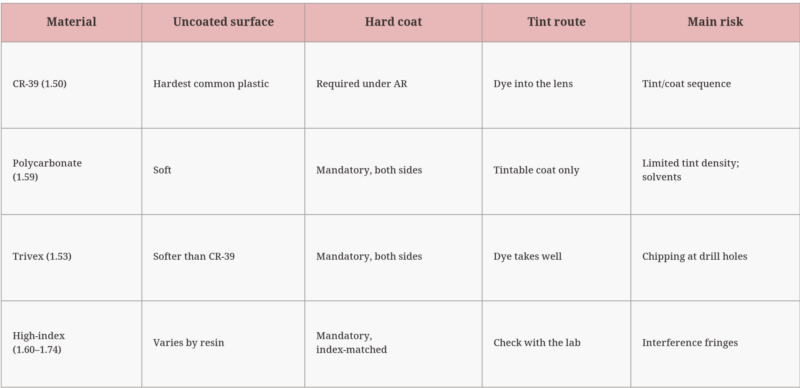
CR-39 (1.50)
CR-39 has the hardest surface of the common plastics. It also takes dye into the lens body, so the lab tints it before coating or uses a tintable coat. Even so, any CR-39 job that carries AR needs a hard coat underneath.
Polycarbonate (1.59)
Poly has a soft surface that abrades far more readily than CR-39, so never dispense it uncoated. In addition, poly absorbs dye poorly. For that reason, the tint lives in a tintable hard coat, which limits how dark it can go. Order the tint with the job, because adding it later gives unreliable results. Also warn patients about acetone and similar solvents, which attack the substrate wherever the coat breaks.
Trivex (1.53)
Trivex has a softer surface than CR-39, so labs coat it on both sides as standard. On the other hand, it tints well. Since Trivex is the usual choice for drill-mount rimless, the mounting puts the coat under mechanical stress at the holes. Consequently, chipping there reflects the coat and the finishing as much as the material.
High-Index (1.60 to 1.74)
A standard hard coat has an index near 1.50. On a 1.67 or 1.74 substrate, however, light reflects at the boundary between coat and lens. Those reflections then interfere and appear as faint rainbow fringes, most visible under fluorescent light. The remedy is a hard coat that the manufacturer formulates close to the substrate’s index, known as an index-matched coat. Therefore, confirm it with the lab on every high-index job.
Dip, Spin, and Cure
Manufacturers usually dip-coat the front surface of a blank and cure it thermally. The lab, by contrast, usually spin-coats the back surface it generated and cures it with heat or UV. Thermally cured polysiloxane generally gives higher abrasion resistance, whereas UV cure runs faster. Either method performs well when three conditions hold: a clean surface before coating, a controlled thickness, and a complete cure. All three happen inside the lab, which explains why the same lens from two labs can wear differently. For the steps that come before coating, see how free-form lenses are made, step by step.
Reading the Complaint
The appearance of the damage points to the cause.
Even haze across the surface: abrasion from dry wiping, paper towels, or clothing. In other words, a care issue, not a remake.
A web of fine cracks: crazing from heat, for example a dashboard, hot water, or a hair dryer. The substrate expands faster than the coating layers can follow. A well-cured hard coat raises the heat threshold, while a weak one lowers it.
Rainbow fringes on high-index: an index mismatch. In this case the lab owns the failure, because it lies in the specification.
Chips or flaking at drill holes: mechanical stress from mounting. Material, coat flexibility, and edging all contribute.
When you log returns by these four patterns, “bad coating” turns into a root cause. It is the same method behind reducing remakes and non-adaptations.
Specifying the Scratch-Resistant Lens Coating
- Poly, Trivex, high-index: treat the hard coat as the baseline, not an option.
- AR jobs: order hard coat and AR as one system from one lab, so hardness, expansion, and adhesion match. MIA LAB applies anti-reflective coating in-house in Hialeah, and every coated lens then passes the same quality control before it ships.
- At dispensing: tell the patient the lens is scratch-resistant, not scratch-proof, and then demonstrate cleaning.
A scratch-resistant lens coating stays invisible on dispensing day. Six months later, however, it is most of what the patient sees.
Frequently Asked Questions
- Is uncoated CR-39 still acceptable?
For a low-cost single-vision pair without AR, worn by a careful patient, it can be. It will haze faster than a coated lens, and it cannot take AR. For most patients a scratch-resistant lens coating costs little relative to the remake it prevents.
- Can a damaged hard coat be stripped and recoated?
Not practically for a patient’s lens. Stripping chemicals and re-coating risk the substrate and the prescription surface, and the result is inconsistent. A scratched or crazed lens is replaced.
- Does a thicker hard coat mean better scratch resistance?
Only up to a point. More thickness raises abrasion resistance but makes the coat more prone to cracking under flex and heat, and on high-index it amplifies any index mismatch. Manufacturers specify a thickness window for each coat and substrate.
- Does the hard coat contribute UV protection?
Not meaningfully. UV blocking comes from the substrate or its UV absorber: polycarbonate, Trivex, and high-index block UV by composition. An index-matched hard coat has no measurable effect on the lens optics.
- Which cleaning products damage a hard coat?
Acetone, ammonia-based glass cleaners, and abrasive cloths. Water with a drop of mild dish soap, dried with a clean microfiber, is the safest routine. Lens sprays formulated for AR-coated lenses are fine.


