
Contrast-Enhancing Sport Tints: Choosing Lens Colors for Golf, Tennis, Fishing and Shooting

A sport tint is chosen for what it removes from the scene, and most Rx sport-sun jobs are ordered for how the lens looks on the frame board. That gap is why a patient comes back saying the expensive new pair “doesn’t help.” The lens is fine. The color was picked for the wrong job.
A tinted lens does two separate things: it cuts total light, and it filters some wavelengths more than others. Darkness is about comfort. Color is about contrast between the thing the athlete is tracking and the background behind it.
How a Tint Creates Contrast
Color and darkness are two different decisions
Every tint has a luminous transmittance (the share of visible light it lets through) and a spectral curve (which wavelengths it favors). Two lenses can both transmit 15% of visible light and look completely different on the course: a gray lens cuts all colors evenly, while a brown lens cuts more blue than red. Specify both, separately, on the order.
Transmission categories set the darkness
Sunglass standards group lenses into filter categories by luminous transmittance. The working ranges are:
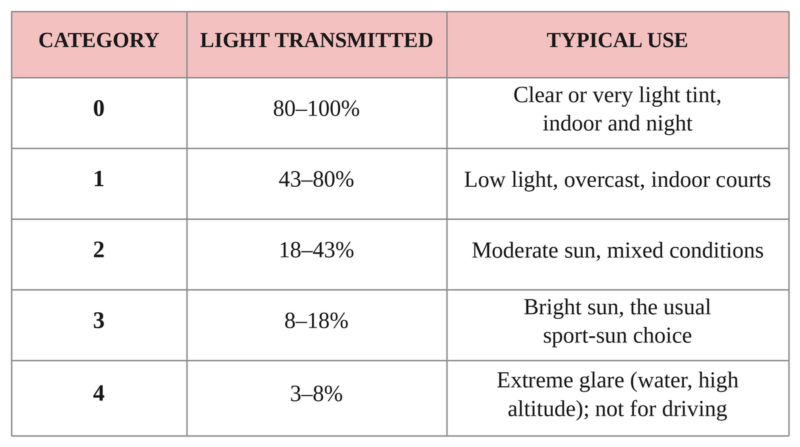
For most outdoor sports in Florida light, category 3 is the default. Lighter categories earn their place for dawn sessions, overcast days and indoor play.
Contrast comes from suppressing the background
A tint improves contrast when it absorbs the wavelengths that dominate the background more than those that dominate the target. Blue light scatters most in haze and glare, so filters that cut blue (brown, amber, copper, yellow) tend to sharpen edges and depth. Gray does the opposite job: it keeps colors natural and cuts brightness evenly
Matching the Color to the Sport
 Golf: the ball against sky and grass
 Golf: the ball against sky and grass
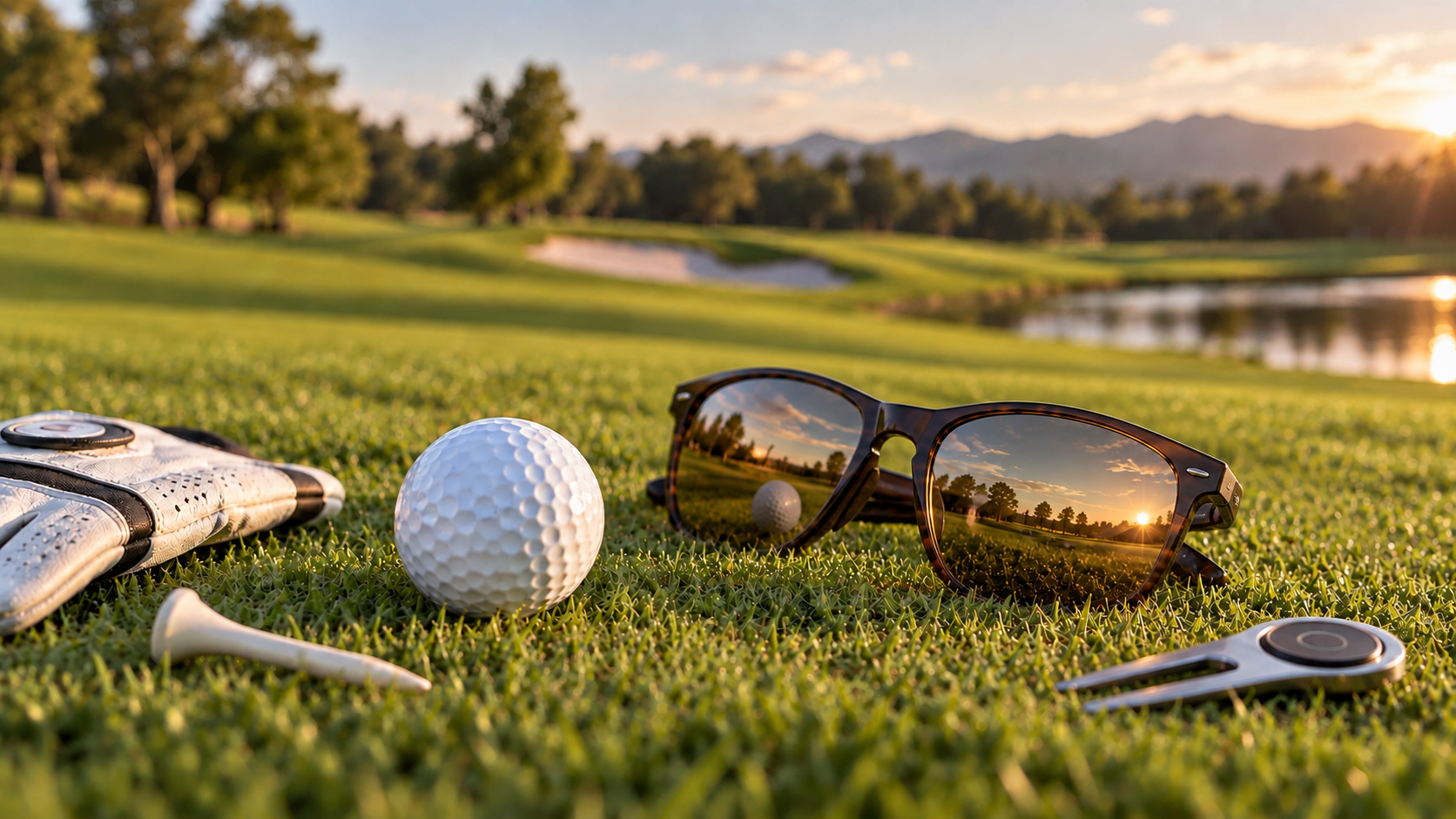
The golfer tracks a white ball against blue sky, then finds it against green grass. Brown, copper and rose tints suppress blue and lift the ball out of both backgrounds, and they sharpen the texture of the turf. Gray-green keeps color accurate for players who dislike a warm cast.
Polarization is a judgment call in golf. It removes surface sheen from water hazards and wet fairways, but some golfers use that sheen to read the slope and grain on the green. Ask whether the patient putts with the sunglasses on before specifying it.
 Tennis and pickleball: a fast ball against a flat court
 Tennis and pickleball: a fast ball against a flat court
The target is a small, fast, brightly colored ball. Amber, copper and brown tints increase the contrast of a yellow-green ball against both hard courts and the sky. For evening sessions and indoor courts, a lighter category 1 amber or yellow keeps contrast without cutting too much light. Polarization adds little here, since the court surface produces less directed glare than water.
Fishing: seeing into the water
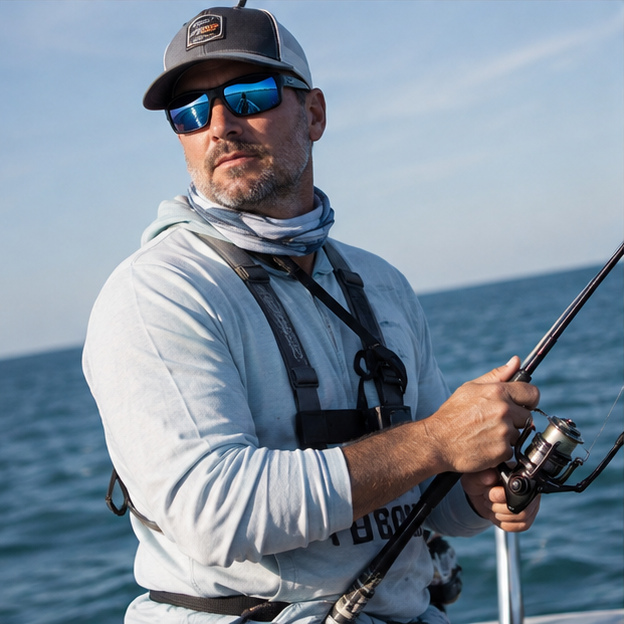
For fishing, polarization comes first and color second. A polarized filter removes the horizontal glare reflecting off the surface, which is what lets the angler see into the water at all. Then the color is chosen by water type:
- Gray polarized for open, deep water in full sun, where glare is the main problem.
- Copper or amber polarized for inshore flats and shallow water, where contrast against sand, grass and structure matters.
- Lighter amber or yellow polarized for early morning and overcast conditions.
A mirror coating over the polarized lens cuts more light for high-glare offshore days. Polarized lenses are made in their own fixed colors, so the color choice is made from the polarized line, not dyed afterwards. For more on when polarization helps and when it gets in the way, see our guide to photochromic vs polarized lenses.
Shooting and clays: impact first, then color
 Shooting and clays: impact first, then color
Shooting eyewear is protective equipment before it is a contrast tool. The lens material must be impact resistant (polycarbonate or Trivex), in a frame built for it. Only then does color matter:
- Orange and vermilion make orange clay targets stand out against sky and tree lines.
- Purple-based tints help an orange target stand out against a green background.
- Yellow works for low light and overcast conditions.
Shooters often rotate lenses through the day as the light and background change, so this is the patient most likely to want more than one tint. Polarization is rarely needed. The choice of lens material is the non-negotiable part of the order.
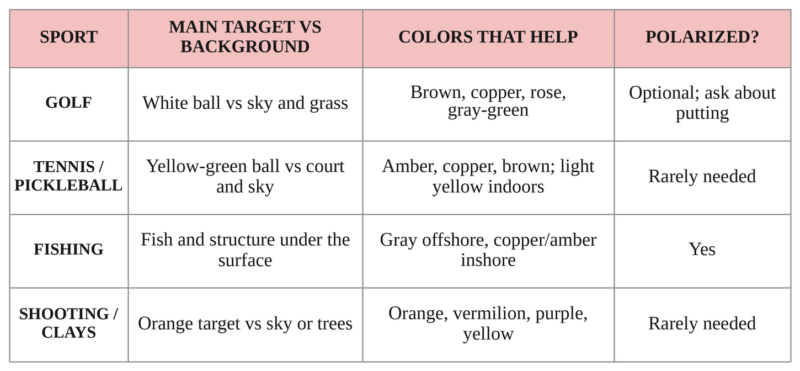
Quick reference
What the Lab Needs on the Order
Name the color and the darkness
“Brown, medium” is not a specification. Write the color, the target transmittance or filter category, and whether the tint is solid or gradient. If the patient is matching an existing pair, send the old pair or a sample so the lab can match it against a reference.
Check that the material will take the tint
Dyed tints are absorbed into the lens surface or its coating, and materials take dye differently. CR-39 and Trivex tint readily to deep densities. Polycarbonate tints through its hard coat, which can limit how dark the lens will go. High-index materials vary by product. If the patient wants a dark, saturated sport color in polycarbonate, confirm the achievable density with the lab before promising it at the counter.
Polarized and photochromic lenses are manufactured in their own colors. Choose those from what the product line offers rather than expecting a custom dye on top.
Add backside AR to every dark tint
On a sun lens, the main reflection problem is on the back surface: light from behind the wearer bounces off the inside of the lens into the eye. A backside anti-reflective coating removes that reflection. On a category 3 lens, it is the difference between a clean view and seeing your own eye in the lens.
Account for wrap
Sport frames often have a high wrap angle and strong pantoscopic tilt. At those angles, the written Rx no longer delivers the intended power at the eye, so the lens needs to be calculated for the position of wear. Send the wrap and tilt measurements with the order, not just the frame name.
Where Sport Tints Should Not Go
A strong colored tint is sport equipment, not an everyday pair. Rose, vermilion, purple and saturated yellow tints shift color perception, and a lens that changes how a red signal looks does not belong behind the wheel. Category 4 lenses are too dark for driving under any conditions. When a patient wants one pair for the course and the car, steer toward a gray, brown or green general-purpose tint, and make the high-contrast color a second pair.
Darkness also says nothing about UV. A dark lens without UV blocking dilates the pupil and lets more UV in. Polycarbonate and Trivex block UV by material; other materials need it added. Confirm full UV protection on every sport-sun order.
A Three-Question Framework at the Counter
- What is the patient tracking, and against what background? The answer picks the color family.
- In what light do they play most? The answer picks the filter category, and whether one pair is enough.
- Will this pair also be worn for driving? If yes, choose a general-purpose color and offer the sport tint as a second pair. Then check the material against the tint and add backside AR. That is the whole decision, and it fits in a two-minute conversation.
How MIA LAB Supports Sport-Sun Orders
Sport tints succeed or fail on details the patient never sees: matched color across both lenses, consistent density, and a clean back surface. At MIA LAB, AR coating is applied in-house in Hialeah, so backside AR on sun lenses runs through the same process as our clear AR work. For water sports, NuPolar polarized lenses are available with silver, gold and blue mirror options (see our lens portfolio), and every pair is checked by our quality control team before it ships. If you are ready to send sport-sun work to a lab that treats it as an Rx job, open an account.
The right sport tint is a clinical decision about contrast, made with a patient who describes what they need to see. Ask the question first. The color follows.
FAQ
- What is the best lens tint color for golf?
Brown, copper and rose tints give the most contrast for tracking a white ball against sky and grass. Gray-green suits golfers who want natural color. Ask whether the patient putts with sunglasses on before adding polarization, since some golfers read greens using the surface sheen polarization removes.
- Should fishing sunglasses always be polarized?
For seeing into the water, yes. Polarization removes the surface glare that otherwise hides what is below. Choose gray for open water in bright sun and copper or amber for shallow inshore water.
- Can any prescription lens material be tinted to a dark sport color?
No. CR-39 and Trivex take dye well. Polycarbonate tints through its hard coat, which can limit maximum darkness, and high-index materials vary. Confirm the achievable density with the lab before quoting a very dark polycarbonate lens.
- Is a darker tint more protective against UV?
Not on its own. UV protection comes from the material or a UV treatment, not from darkness. A dark lens without UV blocking can increase UV exposure because the pupil dilates behind it.
- Can a patient drive in a rose or vermilion sport tint?
It is not recommended. Strongly colored tints alter color perception, including how traffic signals appear, and category 4 lenses are too dark for driving at all. Recommend a separate general-purpose pair for driving.
- Do sport sun lenses need anti-reflective coating?
Yes, on the back surface. Light from behind the wearer reflects off the inside of a dark lens into the eye. Backside AR removes that reflection, which is most noticeable on category 3 and darker lenses.


