CR-39 vs Polycarbonate vs Trivex: Lens Material Comparison Guide from an Independent Optical Lab

Choosing Lens Materials: More Than Just Optics
Every optical practice makes lens material decisions daily. But this choice is rarely “just optics.” It affects patient trust, staff confidence, remake rates, and profitability.
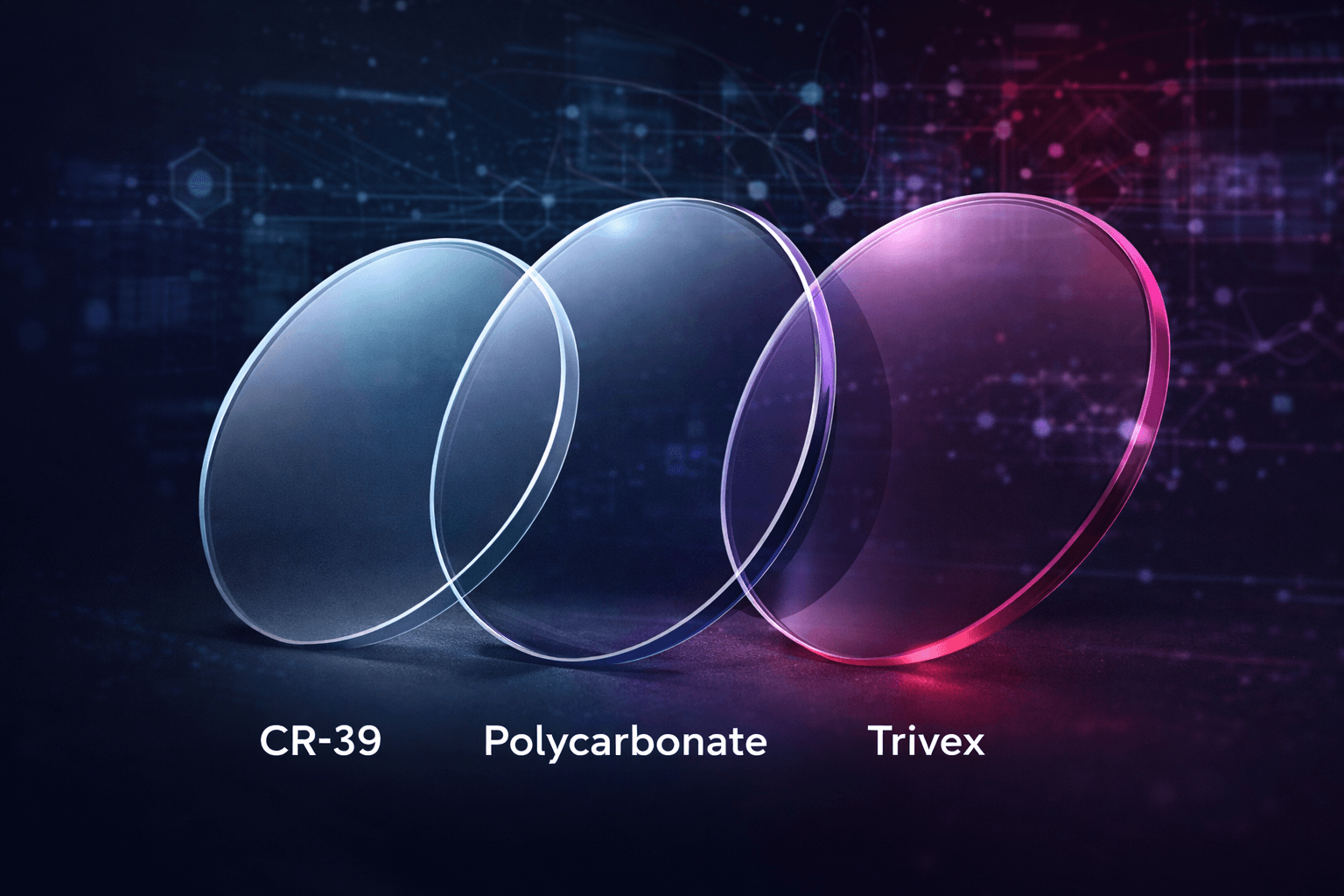
CR-39, polycarbonate, and Trivex aren’t interchangeable. They behave differently in real prescriptions, under real mounting pressure, and in real patient routines. The material you recommend influences how a lens looks and feels clarity, thickness, weight, durability, and adaptation and it plays a quiet role in whether that job stays “done” after dispense.
Patients can’t test lens quality before they buy. They judge the experience by signals: comfort, visual stability, cosmetics, and how smoothly you handle issues. That’s why material selection is less a product preference and more a repeatable system decision.
If you want a clinic-ready framework for standardizing material choices, start with our lens material guide for choosing the best lens material for every prescription.
Breaking Down the Big Three: CR-39, Polycarbonate, Trivex
In many practices, these materials feel like three dropdown options. In reality, they’re three different sets of trade-offs: optical, mechanical, and operational.
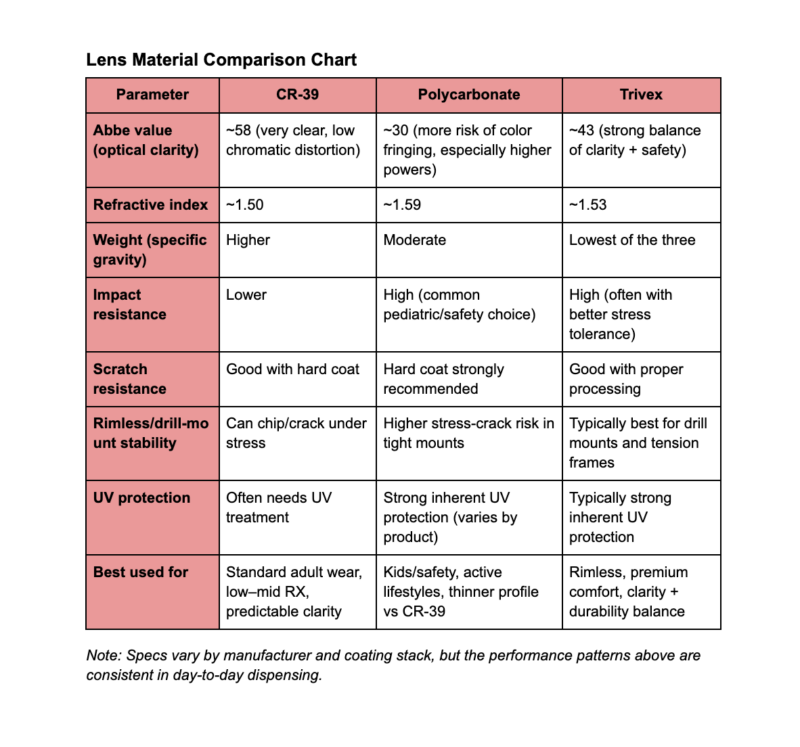
Here’s a practical comparison you can use for staff training and patient consults.
Optical Performance: What Vision Feels Like
CR-39 still leads in raw clarity in many low-to-mid prescriptions. High Abbe value often means a crisp, stable image that matches what many patients “expect,” which can reduce adaptation friction.
Polycarbonate can introduce more chromatic aberration, most noticeable in higher powers and in more visually sensitive wearers. Patients rarely describe it clinically, but you may hear: “It feels off,” “I’m not settling,” or “my old lenses were sharper.” Not always, but often enough that it should influence how you match poly to patient profile and RX.
Trivex often sits in the sweet spot: clearer than poly for many wearers, lighter than CR-39, and mechanically stable. When you’re trying to reduce vague comfort complaints without giving up impact safety, Trivex is frequently the quiet problem-solver.
Material performance also depends on surfacing. If your team needs a simple explanation of why modern surfacing improves stability, share what freeform technology is in optical lenses or the behind-the-scenes walkthrough how freeform lenses are made step-by-step.
Comfort, Safety, and What Patients Actually Perceive
Poly and Trivex are both impact-resistant and lightweight, but they don’t behave the same in the real world.
- Trivex tends to offer better drill-mount compatibility and stress handling, which is critical for rimless, semi-rimless, and tension-heavy mounts.
- Polycarbonate is widely used in safety and pediatrics and can be a practical choice, especially when thickness/cosmetics matter. But in visually sensitive patients or higher prescriptions, you may need a better clarity-first option.
- CR-39 is less impact-resistant, but for standard adult wear it’s often operationally efficient: predictable optics, smooth processing, and cost control.
Coatings also change perceived value fast. A premium AR won’t “fix” the wrong material choice, but it can dramatically improve comfort and satisfaction when the base match is correct, especially for glare sensitivity and day-to-day cleanliness.
See our anti-reflective coating overview for a practical breakdown.
Clinical Priorities: Matching Material to Prescription Needs
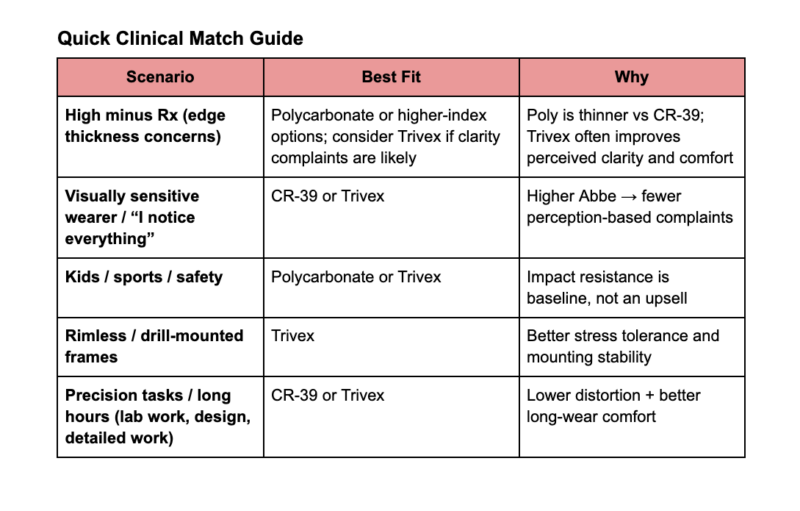
Good material selection aligns RX + frame type + patient sensitivity + lifestyle. When those match, you reduce chair time and remake risk.
High prescriptions and edge thickness
Polycarbonate can be a practical cosmetic choice versus CR-39 due to index. But if clarity and comfort are non-negotiable, especially for first-time wearers or “sensitive” patients, Trivex often reduces adaptation issues. Thickness is visible; dissatisfaction is louder.
Pediatric safety and active lifestyles
Poly and Trivex both meet the safety needs. The difference shows up later: stress cracks, drill stability, durability in real handling. If your practice sees frequent rimless or high-tension mounts in youth eyewear, Trivex can reduce avoidable failures.
Occupational and task-specific use
For long, vision-critical workdays, comfort is cumulative. CR-39 and Trivex often outperform poly in perceived stability due to higher Abbe value, especially as Rx strength increases.
Operational Truth: What the Lab Sees (and Helps You Prevent)
Material choice isn’t only clinical. It’s an operational risk factor. And the risk shows up first on the lab bench.
When material is misapplied or frame type and patient profile aren’t fully considered, you don’t just get “a remake.” You get: tension cracks (especially rimless/tight mounts), coating performance complaints, edge finish issues, vague comfort returns that meet spec but fail experience.
Common remake triggers by material (real-world patterns)
- Polycarbonate: more perception-based returns in sensitive wearers and higher powers; more stress failures in tight mounts if the job isn’t designed/finished for it.
- CR-39: thickness/cosmetic dissatisfaction in higher minus; occasional mounting breakage.
- Trivex: fewer remakes overall, but expectations mismatches can happen when patients want “poly thinness” with “CR-39 clarity” in high-Rx cosmetics.
This is why the modern lab process matters. If you want a broader perspective on where lab technology is going (and how it impacts outcomes), see how optical labs are using technology to revolutionize vision care.
Making the Right Choice: A Strategic Material Framework
Material selection works best when it’s standardized, not debated.
Key questions to align material with your practice strategy
- What do we prioritize most: durability, premium optics, low remake rates, cosmetics, speed?
- Which material supports that priority most consistently in our frame mix?
- Where do remakes cluster and is material choice part of the cause?
- Can every team member explain the recommendation confidently (not just quote a price)?
Standardize the 80%, customize the 20%
High-performing practices standardize material selection for the majority of cases by: frame type, Rx range,lifestyle category.
Then they customize for edge cases: sensitive wearers, special mounts, higher-risk cosmetics, or occupational needs. This approach reduces errors, speeds up consults, and makes your recommendations feel consistent.
Your lab is a strategic extension
The material is one variable. The lab execution is what makes it repeatable. When your lab understands your priorities (turnaround expectations, drill stability, coating durability), you stop managing problems and start scaling performance.
At MIA LAB, we help practices turn material selection into a system, so outcomes stay consistent, remakes drop, and patient trust compounds.
FAQ: Choosing the Right Lens Material
What is the difference between CR-39 and Trivex lenses?
CR-39 is known for excellent optical clarity and works well for standard adult wear when impact resistance isn’t the top priority. Trivex combines strong clarity with high impact resistance and lightweight comfort, making it especially versatile for premium and rimless applications.
Is polycarbonate better than CR-39 for kids?
In most cases, yes. Polycarbonate offers significantly higher impact resistance and lighter weight, making it a common baseline choice for pediatric eyewear and safety use.
Which lens material is best for rimless or drill-mounted frames?
Trivex is typically the strongest choice for drill-mount stability and stress tolerance, helping reduce cracks and alignment issues over time.
How do I reduce lens remakes in my optical practice?
Reduce remakes by aligning lens material with prescription type, frame design, and patient expectations and standardizing your defaults. Clear consult language + consistent lab execution is what prevents both mechanical failures and perception-based returns.