
Lens Material Guide: Choosing the Best Lens Material for Every Prescription


Every optician and optometrist has had that moment: the Rx looks straightforward, the frame looks fine, and then the patient comes back with “these feel weird,” “the edges are too thick,” or “I can’t see clearly out of the sides.”
A lot of those headaches don’t come from the design. They come from a material mismatch.
In 2025, patients expect thinner, clearer, lighter lenses and they expect it fast. Choosing the right material is one of the simplest ways to reduce remakes, improve patient satisfaction, and protect your margins.
This guide breaks down the most common materials (CR-39, polycarbonate, Trivex, high-index 1.67 and 1.74), plus practical “when to use what” rules, including tricky prescriptions. And if you ever hesitate between Trivex lenses and polycarbonate lenses, or high index vs polycarbonate lenses, you’re in the right place.
Best Lens Material by Prescription
If you want the fastest answer, here it is:
- Low Rx + budget-focused: CR-39
- Kids / safety / sports: Trivex (or polycarbonate when budget matters)
- Moderate to high Rx: high index lenses (often 1.67)
- Very high Rx (cosmetic priority): 1.74 high index lenses
- Rimless / drill mounts: Trivex
- High Rx + sensitive to clarity issues: avoid poly; choose Trivex or high-index with premium AR
Now let’s unpack the “why,” because in the exam lane, that’s what actually prevents remakes.
Why Lens Material Matters
Material choice affects far more than cosmetic thickness:
1. Optical clarity
This is the part we don’t always explain well to patients. Certain materials are more prone to chromatic aberration. If you’ve ever heard a patient describe “color fringes” or “swim,” material might be the culprit.
2. Impact resistance & safety
For kids, sports, and high-risk wearers, impact resistance isn’t optional. It’s the baseline.
3. Weight and comfort
A strong Rx in the wrong material is the quickest way to create a heavy, front-loaded frame that slides down all day.
4. Coating performance
Material and coatings work as a system. If you’re recommending premium AR, make sure the substrate choice supports it. (If your practice is already leaning into premium coating bundles, it’s worth reviewing MIA LAB’s coating options here: Anti-Reflective & Blue Light Coatings for Glasses
5. Frame compatibility
Drill mounts and grooved frames have different requirements than full-rim metal or acetate. The “best” material changes depending on the frame.
If you want a broader view of how these decisions tie into overall lens selection, this guide is a useful companion
Choosing the Right Prescription Lenses: A Comprehensive Guide
Lens Materials Overview (What to Use, When to Avoid)
Below is the optician-to-optician breakdown: best uses, watch-outs, and what I look for in real practice.
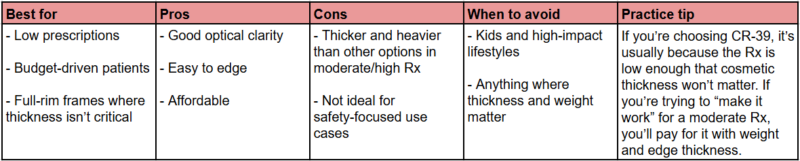
1) CR-39 (Standard Plastic)
2) Polycarbonate Lenses
Poly has been a workhorse for years. It’s thin and impact-resistant. But it’s not the universal answer people sometimes treat it as.
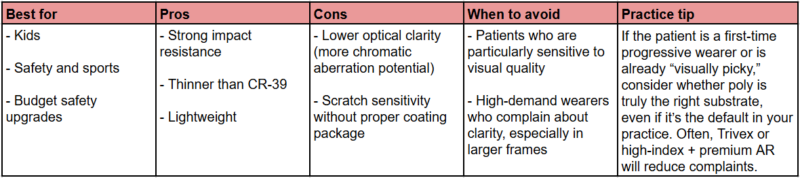
Also, if you’re prescribing poly regularly, it’s worth reinforcing coating education and performance.
MIA LAB’s AR overview is a helpful reference: Anti-Reflective Coating (Sky Matrix AR).
3) Trivex Lenses
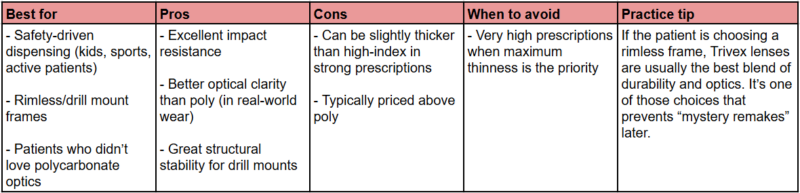
Trivex is one of the most under-used “quiet wins” in dispensing. It’s the material I reach for when I want impact resistance without compromising clarity.
4) High Index Lenses (1.67)
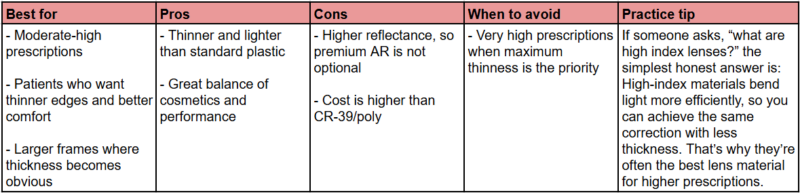
If the Rx is moderately high and the patient cares about cosmetics, high index is often the best step-up.
If you’re building your material strategy around high-index, it helps to pair it with proper digital surfacing and premium coatings. This is where a lab that specializes in digital processing matters.
MIA LAB’s lens technology pages give context here:
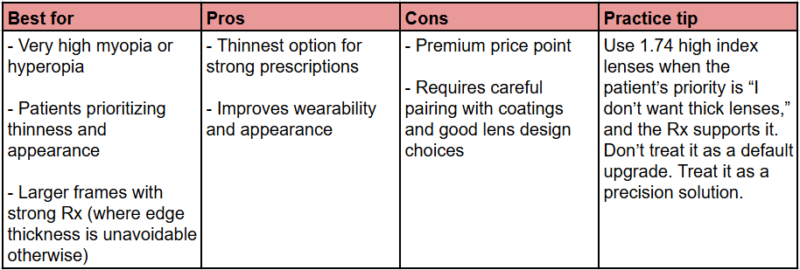
5) 1.74 High Index Lenses
This is your “maximum thinness” material. It’s not for everyone, but when it’s right, it’s the best way to dramatically improve cosmetics in strong prescriptions.
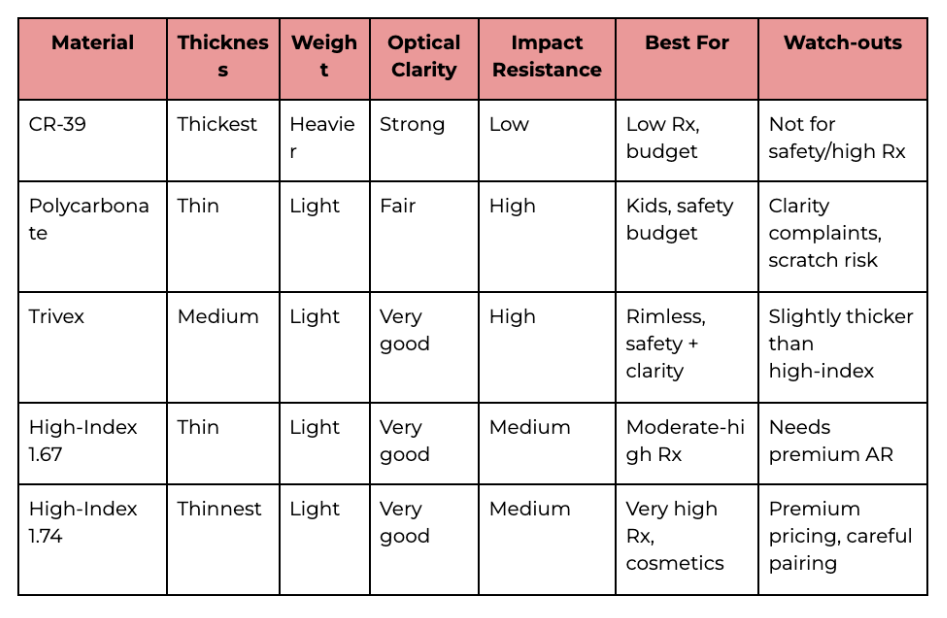
Comparison Table: CR-39 vs Polycarbonate vs Trivex vs High-Index 1.67 vs 1.74
Here’s the quick “dispensing table” version
If you want to reinforce optics + coatings as a single system, this is a good internal reference for your staff too:
The Impact of Lens Coatings on Optical Performance for Patients.
How to Choose the Right Lens Material (A Practical Workflow)
When your team is deciding between materials, this workflow avoids guesswork:
Step 1: Look at the Rx (and not just the sphere)
- Moderate-high Rx usually pushes you toward high index lenses
- High cyl and sensitive wearers may benefit from better optics choices (often Trivex or high-index with premium AR)
Step 2: Frame type matters more than we admit
- Rimless/drill mount: Trivex first
- Full rim: more flexibility
- Large frames: thickness will show, so consider high-index
Step 3: Lifestyle and safety profile
- Kids, sports, active: Trivex or poly
- If the patient is hard on glasses, poly + the right coating package might be the practical choice
Step 4: Cosmetic priorities and budget
- Cosmetic priority + stronger Rx: 1.67 or 1.74
- Budget priority: CR-39 for low Rx, poly for safety
Step 5: Coatings as the finish line
High-index without proper AR is like buying a sports car and putting on shopping cart wheels.
If you’re recommending high-index, make coatings part of the same recommendation, not an “optional add-on.”

Tricky Prescriptions: What Material Works Best (And Why)
This is where material choice becomes a practice-growth tool.
1) Very high myopia (cosmetic edge thickness)
Strong Rx + large frame = patient dissatisfaction risk.
In most cases, 1.74 high index lenses reduce thickness enough to improve wearability and perception.
2) High astigmatism + high sphere
High cylinder can magnify complaints if optics aren’t dialed in.
In these cases, I lean toward high-index with premium AR, and I’m careful about frame size.
3) Rimless frames
This is where Trivex is the “quiet hero.” Structural stability matters as much as thickness.
4) Kids with high Rx
Safety matters, but so does clarity.
If poly has caused visual complaints in the past, Trivex is often worth the upgrade.
5) “Sensitive wearers”
If the patient is particularly sensitive to peripheral optics or has previously rejected lenses due to quality complaints, avoid defaulting to poly.
Material + design + coatings should be treated as one package.
And this is exactly where having a lab partner who can troubleshoot is worth real money. If a job sits on the edge of “works” vs “remake,” MIA LAB’s team can help match Rx + material + coating combination before it becomes a problem.
You can see the lab’s full capability range here: Full-Service Lens Solutions
…and how they maintain consistency and reduce remakes here: Quality Control
Myths vs Facts: Trivex, Poly, and High-Index
Myth #1: Polycarbonate is always the best choice for kids.
Fact: Poly is a strong safety option, but if the child is sensitive to optics or you’re fitting rimless, Trivex can be a better long-term choice.
Myth #2: High-index always means better vision.
Fact: High-index is often a cosmetic and comfort upgrade, but it must be paired with premium coatings and appropriate design choices.
Myth #3: Trivex is just marketing.
Fact: Trivex delivers a real balance of safety + clarity + structural stability, especially for rimless mounting.
Myth #4: 1.74 is always worth it.
Fact: It’s worth it for very strong prescriptions with cosmetic priorities. For moderate Rx, 1.67 often provides a better cost-benefit balance.
How to Explain Lens Material to Patients (Chairside Script)
This is the part your opticians will actually use.
Script 1: Budget-friendly, low Rx
“Because your prescription is low, we can use a standard material that gives great clarity and keeps cost down. You’ll still get strong performance.”
Script 2: Safety + durability (kids / active wear)
“For safety and durability, we recommend impact-resistant materials. It helps prevent breakage and keeps lenses lighter and thinner.”
Script 3: High prescription, cosmetic focus
“With a stronger prescription, material choice affects thickness and comfort. A high-index material will make your lenses thinner and lighter, and with premium coatings you’ll also get clearer vision and less glare.”
How MIA LAB Helps Practices Choose the Right Material
Material selection isn’t just “what’s available.” It’s part of how your practice builds trust and reduces remakes.
MIA LAB supports the full range of materials, from standard options to premium high-index solutions, and can advise on selecting the right substrate for tricky prescriptions. If your team is building a premium lens program, MIA LAB’s digital manufacturing capabilities are also worth exploring:
FAQ: Lens Materials (Trivex vs Poly, High-Index, and Strong Rx)
Trivex vs polycarbonate: which is better?
It depends on the patient. Poly is strong and thin, but Trivex often offers better clarity and is excellent for rimless and drill mounts.
What are high index lenses?
High-index lenses use materials that bend light more efficiently, allowing the lens to be thinner and lighter for stronger prescriptions.
What lens material is best for a high prescription?
High prescriptions typically perform best with high index lenses (often 1.67 or 1.74), paired with premium AR coatings.
Is 1.74 always better than 1.67?
Not always. 1.74 is best for very strong prescriptions where cosmetics matter most. For moderate-high Rx, 1.67 often provides an excellent balance of thinness and value.
What material is best for rimless frames?
Trivex is often the best choice because it combines impact resistance with structural stability.
Do polycarbonate lenses cause distortion?
Some wearers are more sensitive to chromatic aberration with polycarbonate. If complaints occur, Trivex or high-index may be better options.
Final Takeaway
There is no universal “best” material. The best material is the one that matches the Rx, frame, lifestyle, and expectations.
Get that combination right and you’ll see fewer remakes, better patient satisfaction, and a stronger premium lens program.
And if you want support on tricky prescriptions or material pairing decisions, MIA LAB’s team is the kind of optical lab partner that helps your practice keep outcomes consistent, even when the Rx isn’t.
Explore material options and capabilities here.


