
Beyond Lenses: Building Patient Loyalty Programs and Recall Strategies


How independent practices can keep patients coming back, year after year, without turning every interaction into a “sales pitch.”
If you run an independent practice, you already know the uncomfortable truth: patients rarely leave because of your refraction. They leave because the experience felt forgettable, inconvenient, or uncertain.
And in 2026, “uncertain” is the big one. Patients have more options, more noise, and less patience. If something goes wrong, they want a simple, confident “We’ll take care of it.” If things take too long, they remember the delay, not the reason. If they don’t hear from you for 12 months, they assume you’re not thinking about them.
That’s why the best retention strategy today isn’t a single tactic. It’s a system.
A strong loyalty plan combines four things: recall, a clear warranty promise, regular education, and a consistent “care experience” your team can deliver every time.
And yes, your optical lab partner matters here more than most practices realize.
Quick Answer
A high-performing optical loyalty program includes:
1. a structured recall cadence (SMS + email + human touch),
2. a warranty program your team can confidently stand behind,
3. simple patient education initiatives that drive upgrades naturally, and
4. an experience promise supported by the right optical lab partner (speed, remakes, and dependable service).
If you build these four pillars, you build loyalty. Loyalty builds steady Rx orders and predictable demand for wholesale optical lenses. Everyone wins.
Why Loyalty Matters More Than Ever
Patients don’t remember lens design names. They remember how it felt to work with your practice. They remember how fast they got their glasses, how you handled a problem and whether you made it easy to say “yes”.
That last one is the heart of loyalty. The practices with the strongest retention aren’t necessarily the ones with the fanciest optical displays. They’re the ones where patients trust: “If something isn’t right, they’ll fix it.”
That’s why retention is not just about marketing. It’s operational confidence. And it’s why the best optical lab for optometrists is often the one that supports your team in delivering consistently great outcomes, not just the one with the biggest product list.

The 4 Pillars of an Optical Loyalty Program
1) A Recall System That Runs Like a Clock
Recall is the foundation. Without it, you’re hoping patients remember you. That’s not a strategy.
You need recall that’s: consistent, multi-channel and value-based (not just “time for an exam”)
2) Warranty Programs That Remove Friction
Warranty isn’t a cost. It’s a trust engine.
A strong warranty promise reduces hesitation at purchase, increases patient confidence, gives your team a script that feels supportive, not defensive.
3) Patient Education That Drives Upgrades
When patients understand why they’re upgrading, they don’t feel sold. They feel cared for.
This is where you naturally talk about:
- anti reflective coatings
- photochromic lenses
- comfort upgrades for screen use
without it sounding like you’re pushing add-ons.
4) A Consistent Care Promise
Your recall, warranties, and education should all reinforce one message: “We make vision easy, and we stand behind what we deliver.”
Recall Strategies That Actually Get Patients Back
Build a 3-Touch Recall Sequence (SMS + Email + Call)
Your recall should look like a workflow, not a one-off reminder. Here’s a simple sequence that works in independent practices:
Touch 1 (SMS):
“Hi [Name], it’s time to schedule your annual vision exam. We’ve got convenient openings this week. Reply YES and we’ll reach out.”
Touch 2 (Email, 3 to 5 days later):
“Your annual exam is due, and there are new lens options this year that can improve comfort and clarity (especially for screens and driving).”
Touch 3 (Call or personal SMS, week 2):
“Just checking in, we’d love to help you get set up before your prescription expires.”
The key is Touch 2. That’s where recall becomes retention.
Use “New Options” Messaging (not just “it’s time”)
Patients return when there’s a reason beyond routine.
Instead of:
“Time for your annual exam.”
Try:
“Your annual exam is due, and we can now offer lens options that reduce glare, improve night driving, and provide better comfort for long screen days.”
This is where your product expertise supports recall. A practice that can confidently recommend new options (and deliver them quickly) feels modern and valuable.
If your lab partner has a strong selection of lenses, recall messaging becomes easier because you can back it up with real solutions, not vague promises.
Pro tip: build one recall campaign each quarter around “what’s new,” and link it to a single upgrade conversation. That could be:
- screen comfort (digital designs)
- glare reduction (coatings)
- sun + driving (photochromics)
To support those conversations, it helps if your team has clear, patient-friendly resources, and your lab has a technology story you can summarize in 15 seconds. MIA LAB keeps that organized under Lense Technology, which is a useful reference when your team needs to translate “design” into “benefit.”

Warranty Programs That Build Trust
Why warranties work psychologically
Patients don’t mind paying for quality. They mind paying for uncertainty.
Warranties remove uncertainty by telling the patient: “You’re safe. We’ll make it right.”
That’s loyalty. And this is exactly why warranty programs are not “discounting.” They’re confidence-building.
How to turn lab warranties into your practice’s loyalty promise
Your warranty promise should be simple enough that every staff member can say it without thinking.
A strong “practice promise” sounds like:
“If something isn’t right, we fix it. Your comfort matters more than paperwork.”
When your independent optical lab supports remakes and warranty workflows reliably, your team gets to say “yes” faster. And that makes patients feel cared for.
If you want your warranty promise to feel real, align it with your lab’s policies and share them internally. For practices working with MIA LAB, the easiest starting point is having staff bookmark the policy and credits page so they know what’s covered and how to handle a remake request with confidence:
Mialab Policies / Credits & Warranties
You can also support this with a second layer: proactive education to reduce remakes and avoid non-adapt issues before they happen. A helpful companion read for teams is:
Reducing Remakes and Non-Adaptations
Patient Education Events
Education is the most underused retention tool in optical.
You don’t need an auditorium. You need a simple, repeatable format.
Three event formats that work
Vision Tech Night (20 minutes + Q&A)
Progressive Lens Demo Day
Sun & Driving Safety Week (especially strong for photochromics and AR)
What to teach
- “Why glare gets worse as we age”
- “What modern coatings do differently now”
- “Why screen comfort isn’t just blue light”
- “How photochromic lenses work for driving and outdoor use”
This is where you introduce upgrades like photochromic lenses and anti reflective coatings as solutions, not add-ons.
If you want to support these events with print-ready materials, it helps to give patients something tangible. MIA LAB provides practice-friendly resources like Brochures and a deeper set of handouts in the Remedy Document Center.
Upgrades That Naturally Fit Recall Campaigns and improve loyalty
If you want recall to drive retention and revenue, you need upgrades that feel relevant, not random. Here are a few that work especially well because patients notice the difference quickly:
Digital comfort and fatigue solutions
For patients who live on screens, this is often the simplest “yes.”
If you want a clean place to point your team for options and patient-facing language, see Digital Lenses / Anti-fatigue.
Coatings are a classic source of frustration if patients don’t understand care and expectations. They’re also a retention driver when positioned correctly: “clearer vision, less glare, easier cleaning.”
A good education + product approach starts with a clear coatings page your team can reference, especially when creating recall messaging around glare and night driving:
Anti-Reflective & Blue Light Coatings
Progressive upgrades that reduce non-adapt risk
If you’re building a loyalty promise, you want solutions that increase satisfaction and reduce remake headaches.
In the Remedy portfolio, practices often position different designs based on lifestyle and expectations:
And for practices that want a premium “technology story” to support high-value patients, Camber designs can be part of that narrative:
Remedy Lenses with Camber Technology
Branded options for trust and familiarity
Some patients feel more confident when they recognize the name behind the product, especially in progressive upgrades. If branded offerings are part of your positioning, your team can review options here:
Branded Lenses
The Chairside Scripts That Increase Retention
Retention improves when your team speaks consistently.
Here are three scripts that work well and don’t sound salesy.
Script 1: Annual exam recall + “new options”
“Your prescription is due for renewal. The good news is lens options have improved a lot since your last pair. We can review what would make your daily life easier, especially for screens and night driving.”
Script 2: Upgrade without pressure
“You don’t need to upgrade, but many patients notice better comfort with newer coatings and designs. If you’ve had glare or fatigue, it’s worth considering.”
Script 3: When something goes wrong (“yes approach”)
“Thanks for telling us. Let’s make it right. We’ll work with you until you’re comfortable.”
That third script is loyalty in one sentence. Patients don’t expect perfection. They expect support.
And if your practice serves a strong Spanish-speaking patient base, consistency matters even more. It’s one reason practices in South Florida often prefer a bilingual optical lab in miami that can support the team with bilingual resources, smoother communication, and fewer misunderstandings during problem resolution.
How Your Lab Partner Supports Loyalty without creating extra work
This is where practices often miss the link.
Your recall system might be perfect. Your warranties might be generous. Your chairside scripts might be polished.
But if delivery is slow, remakes are difficult, or communication is unclear, patients still walk away thinking:
“That took too long.”
“They made it complicated.”
A strong optical lab partner protects your practice experience.
Speed = perceived value
Quick turnaround makes your practice feel efficient and modern. That impression alone increases trust and reduces buyer’s remorse.
If you’re working with a fast prescription lens lab miami, that speed becomes part of your “care promise,” not just a logistical detail.
Clear warranties = trust
When your lab supports remakes and warranty workflows, your staff can say “yes” quickly. That reduces friction and increases loyalty.
Reliable ordering + tracking = fewer surprises
Patients get anxious when staff don’t have answers. Online ordering and tracking reduces “where are my glasses?” stress, which means your front desk stays calm and your patients feel cared for.
And when patients feel cared for, they stay.
If you want a simple place to point staff for quick answers when troubleshooting comes up, keep this link handy:
FAQ & Troubleshooting
30-Day Implementation Plan
You don’t need to redesign your practice. You need to build a repeatable system.
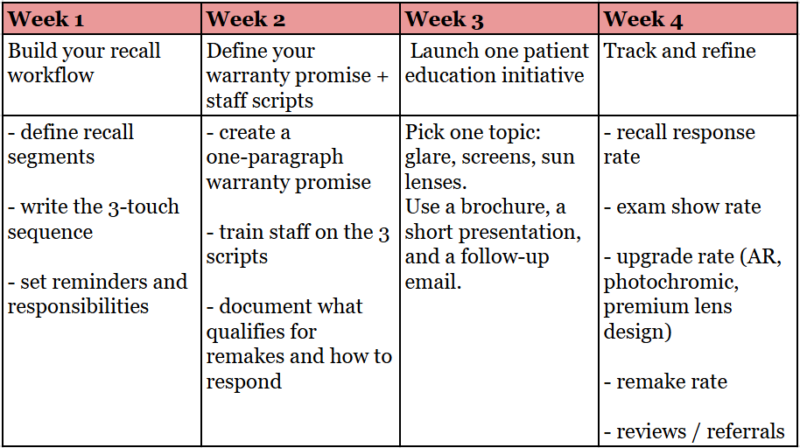
Even small improvements here compound over time.
Key Metrics to Track (so it pays for itself)
If you want retention to be a real business driver, measure it.
Track:
- Recall response rate
- Show rate for annual exams
- Upgrade rate for premium options
- Remake rate
- Review velocity and patient referrals
A loyalty program doesn’t need to “feel” good. It needs to work.
Conclusion: Loyalty is a system, not a slogan
The best practices don’t rely on luck to keep patients. They build a structure that makes patients feel cared for through a predictable recall cadence, a warranty promise that reduces fear, ongoing patient education, and a consistent “yes” experience.
And behind all of it, a lab partner that supports you with speed, reliability, and practical resources.
If you want to make your loyalty system easier to execute, explore the tools and resources your lab can provide. Start with core options like Our Lenses, then support staff education with Brochures and the Remedy Document Center. For deeper product conversations, review Lense Technology, Digital Lenses / Anti-fatigue, and coatings support through Anti-Reflective & Blue Light Coatings.
And if your team ever needs to lean on policy clarity or support-first remakes, keep these pages on hand:
When your operations support your promise, loyalty becomes automatic.
For practices looking to align recall, warranties, education, and turnaround into one smooth patient experience, MIA LAB is built to support that work. Learn more or connect with the team here:
https://mialab.com/
FAQ: Patient Loyalty Programs & Recall for Optical Practices
How often should we send recall reminders?
A 3-touch sequence over 2 to 3 weeks is a practical baseline. Patients respond best when the message includes value, not just timing.
Do loyalty programs work for independent practices?
Yes. Independent practices often win on relationship and experience. A structured recall + warranty promise builds trust and repeat visits.
How do warranties improve retention?
Warranties reduce patient anxiety. When issues are solved quickly and confidently, patients stay loyal and refer others.
What’s the easiest way to start a recall strategy?
Start with one segment (annual exams due this month) and one 3-touch campaign. Track response and refine.
How can we promote new lens options without sounding salesy?
Frame upgrades as solutions to a patient’s daily challenges: glare, screens, fatigue, driving. Education beats selling.
Can a lab partner support patient education?
Yes. Many labs provide brochures, training resources, and product explanations that help practices educate patients consistently.
Why does turnaround time affect loyalty?
Because patients remember convenience. Fast service becomes part of perceived quality and improves trust.


