
High Index vs Polycarbonate Lenses: Which Should You Recommend?

Why This Choice Matters More Than It Seems
In daily optical practice, lens material selection is often treated as a routine step. It happens quickly, somewhere between frame selection and coatings, and is rarely positioned as a critical decision.
In reality, this is one of the most influential variables in the final patient experience.
Why patients rarely understand lens materials, but always feel the difference
Most patients do not understand what high index lenses or polycarbonate lenses are. They are not evaluating refractive index, Abbe value, or optical lens manufacturing quality.
What they do evaluate, often within the first few days, is how their vision feels. They notice whether their eyes relax or fatigue, whether transitions feel natural, and whether the lenses look balanced in the frame.
This is why material choice becomes visible through perception rather than explanation.
How the wrong material leads to remakes, complaints, and lost trust
When material selection is not aligned with the prescription or patient expectations, the issue rarely presents as a clear technical failure. The prescription is correct, the lenses meet specifications, and yet the patient returns with hesitation.
In practice, this sounds less like a complaint and more like uncertainty. Patients often say their vision feels slightly strained by the end of the day, or that the lenses require more effort to use than expected. Others describe a subtle sense of imbalance when shifting focus, especially in peripheral vision.
These are not random reactions. They are consistent signals that the material choice does not match how the patient uses their vision.
Over time, this leads to remakes, increased chair time, and a gradual erosion of trust in recommendations.
The real decision: thickness vs clarity vs comfort
The comparison of high index vs polycarbonate lenses is not about identifying a universally better material. It is about balancing three competing priorities: how thin the lens appears, how stable the visual experience feels, and how comfortable the lens is over extended wear.
Every recommendation is essentially a decision about which of these factors matters most in a specific case.
High Index vs Polycarbonate: Core Differences Explained
Refractive index and lens thickness (what actually changes visually)
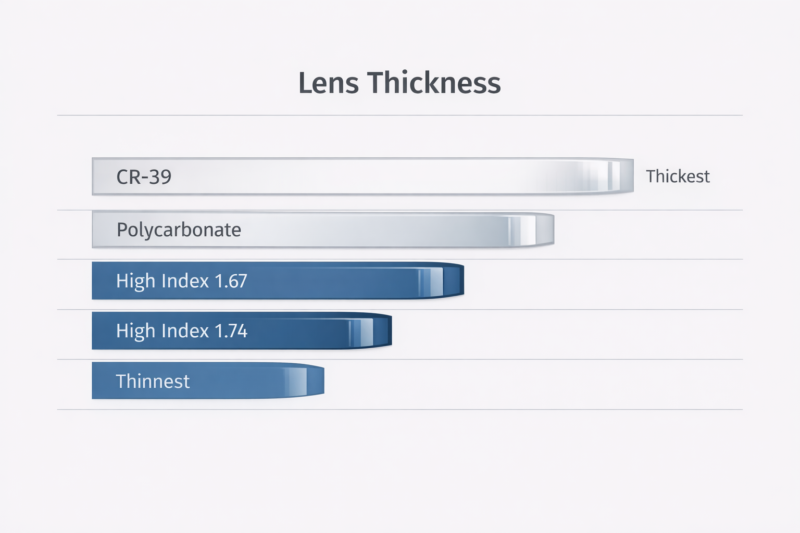
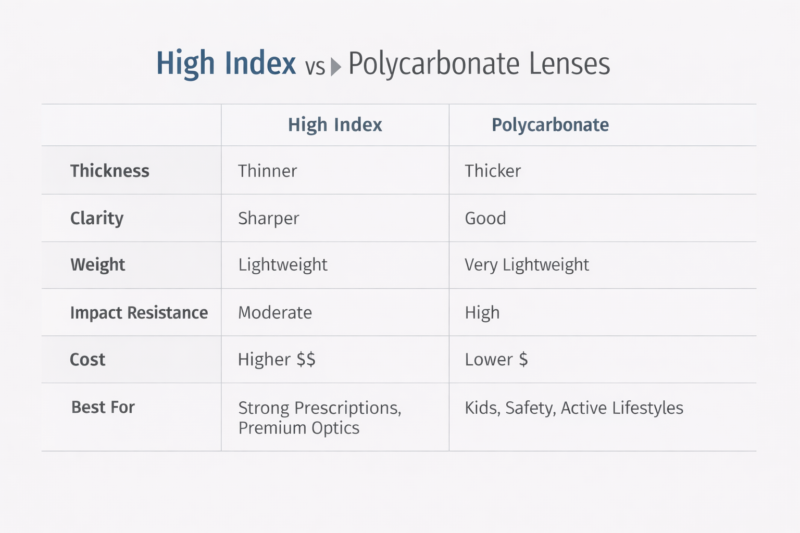
High index lenses are engineered to bend light more efficiently, which allows them to reduce lens thickness without changing the prescription. This becomes especially relevant in moderate to high prescriptions, where standard materials produce a visibly thick edge.
Polycarbonate lenses, with a refractive index around 1.59, offer a moderate reduction in thickness compared to standard plastic lenses. However, they do not achieve the same level of edge refinement as higher-index options such as 1.67 or 1.74 high index lenses.
In practice, this difference is not theoretical. It directly affects how the lens sits in the frame and how the patient perceives the final result.
Optical clarity and Abbe value (why patients say “something feels off”)
Optical clarity is where the distinction becomes more subtle but more impactful.
Polycarbonate lenses have a lower Abbe value, which increases the likelihood of chromatic aberration, particularly in peripheral zones. Patients do not describe this in technical terms. Instead, they often report that their vision feels slightly less stable, especially when moving or shifting focus throughout the day.
High index lenses are not free from optical limitations, but they generally provide a more controlled and predictable visual experience, particularly when paired with precise surfacing and coatings.
Weight and comfort in daily wear
Polycarbonate lenses are lightweight and widely considered comfortable, particularly in standard prescriptions.
High index lenses reduce overall lens volume, which can also improve balance and comfort, especially in higher prescriptions where thickness would otherwise increase weight distribution unevenly.
The difference is not always dramatic, but it becomes more noticeable in full-day wear.
Impact resistance and safety considerations
Polycarbonate lenses are designed for impact resistance and remain the standard for safety applications, pediatric eyewear, and active environments.
High index lenses are durable but not optimized for impact protection. This distinction becomes critical when safety is a primary concern.
Lens Thickness and Edge Profile: What Patients Actually Notice
How high index reduces edge thickness in high prescriptions
In higher prescriptions, lens thickness becomes a visible factor rather than a technical one. High index lenses significantly reduce edge thickness, improving both aesthetics and the overall balance of the lens within the frame.
This is particularly important in minus prescriptions, where edge thickness can become pronounced.
Why polycarbonate is thinner than standard lenses but not optimal for clarity
Polycarbonate offers a thinner profile than standard plastic lenses, but it does not provide the same level of refinement as higher-index materials.
While it improves structure, the trade-off often appears in optical perception rather than physical appearance.
How frame size and shape amplify thickness issues
Frame selection plays a direct role in how thickness presents. Larger frames increase edge exposure, making thickness more noticeable regardless of material. Smaller, well-centered frames reduce this effect and allow materials to perform more effectively.
Material and frame should always be considered together, not independently.
When aesthetics becomes the deciding factor
For many patients, the visual outcome carries as much weight as optical performance. A lens that appears thick or unbalanced can reduce satisfaction, even if the prescription is correct.
In these situations, high index lenses often provide a more acceptable result.
Optical Clarity: Why Polycarbonate Causes More Complaints
Understanding Abbe value in real patient perception
Abbe value is rarely discussed with patients, but its effects are consistently observed in practice. Lower values increase the likelihood of color dispersion and peripheral instability.
Polycarbonate lenses, due to their lower Abbe value, are more likely to produce these effects.
Peripheral distortion and visual fatigue
Over time, small distortions in peripheral vision can lead to increased visual effort. Patients may not identify the cause, but they often describe a sense of fatigue, particularly during prolonged tasks such as computer work or driving.
Which patients are most sensitive to clarity differences
Patients who rely heavily on precise vision, those transitioning from higher-quality materials, and those using progressive or customized lenses tend to notice these differences more quickly.
When to Choose High Index Lenses
High index lenses are most appropriate in situations where visual refinement directly affects the outcome. This includes higher prescriptions where edge thickness becomes visible, patients who prioritize a thinner and more balanced appearance, and individuals who are sensitive to subtle distortions in vision.
They are also more appropriate in premium cases, particularly when working with custom progressive lenses or advanced lens design personalization, where expectations are higher and tolerance for compromise is lower.
When to Choose Polycarbonate Lenses
Polycarbonate lenses remain essential when durability and safety are the primary concern. They are the standard choice for pediatric patients, where impact resistance is non-negotiable, and for individuals with active lifestyles where lenses are exposed to higher physical stress.
They also perform well in lower prescriptions, where thickness is less of a concern and optical compromises are less noticeable. In these cases, the balance between durability and performance is acceptable.
High Index vs Polycarbonate in Real Practice (Not Theory)
Why polycarbonate leads in volume but not always in satisfaction
Polycarbonate lenses are widely used because they offer versatility, safety, and efficiency. However, they are also associated with a higher frequency of perception-based dissatisfaction, particularly in cases where visual quality expectations are higher.
Why high index reduces perception-based complaints
High index lenses tend to deliver a more stable visual experience, especially in moderate to high prescriptions. This reduces the likelihood of subjective complaints and improves long-term satisfaction.
How expectation mismatch creates “these feel worse” feedback
When patients transition between materials without clear expectations, even a technically correct lens can feel like a downgrade. The issue is not performance alone, but alignment between expectation and outcome.
The Role of Frame Selection in Material Choice
Large frames vs small frames: how they change lens outcome
Larger frames amplify thickness and edge visibility, while smaller frames minimize these effects. The same prescription can produce very different results depending on frame size.
Rimless and semi-rimless considerations
In rimless and semi-rimless frames, structural behavior becomes more important. Polycarbonate can be used, but materials such as Trivex lenses often provide better long-term stability under mounting stress.
Matching material to frame stress and mounting
Material selection should always account for how the lens will be mounted and worn. This reduces the risk of stress-related issues and improves durability.
How to Explain the Difference to Patients
Translating technical specs into patient language
Patients respond more effectively to outcomes than to specifications. Explaining how the lenses will look and feel is more meaningful than discussing technical parameters.
How to position high index as a visual upgrade, not just thinner lenses
High index lenses should be presented as a refinement in both appearance and comfort. The focus should be on how they improve the overall experience.
Avoiding confusion when offering multiple options
Clear and confident recommendations reduce uncertainty and help patients make decisions without hesitation.
The Role of Your Optical Lab in Material Performance
Why manufacturing quality affects both materials differently
Both high index and polycarbonate lenses are sensitive to manufacturing precision. Variations in surfacing and finishing can affect performance significantly.
Edge finishing, polishing, and coating interaction
The final perception of the lens is influenced by edge polish, coating adhesion, and overall finishing quality. These factors directly impact both appearance and durability.
How lab consistency reduces remakes and complaints
A consistent optical lab partner ensures repeatable results. Reducing variability is one of the most effective ways to minimize remakes and improve patient satisfaction.
High Index vs Polycarbonate: A Practical Recommendation Framework
How to decide in under 30 seconds during a consultation
In most cases, the decision can be made quickly by evaluating prescription strength, lifestyle, and patient expectations.
Aligning prescription, lifestyle, and expectations
The most effective recommendations are those that reflect how the patient actually uses their vision, not just the prescription.
Standardizing decisions to reduce errors in your team
Clear internal guidelines help ensure consistency and reduce variability across staff recommendations.
FAQ: High Index vs Polycarbonate Lenses
- Are high index lenses always better than polycarbonate?
No. Each material serves a different purpose, and the correct choice depends on the specific clinical situation. - Why do some patients complain about polycarbonate lenses?
Most complaints relate to perceived clarity differences and subtle visual instability rather than objective defects. - Is 1.74 high index worth it for all prescriptions?
It is most beneficial in higher prescriptions where thickness reduction is significant. - Which material is best for rimless frames?
Material stability is critical. While polycarbonate can be used, alternatives such as Trivex lenses often provide more reliable results.
Final Insight: Material Choice Is a Clinical Decision, Not a Default
Choosing between high index vs polycarbonate lenses is not a routine step. It is a clinical decision that directly affects how patients experience their vision.
When material, prescription, frame, and expectations are aligned, the result feels natural and requires no further explanation.
That consistency is what defines a high-performing optical practice.


