
High Index Lenses Explained: When and Why to Use Them
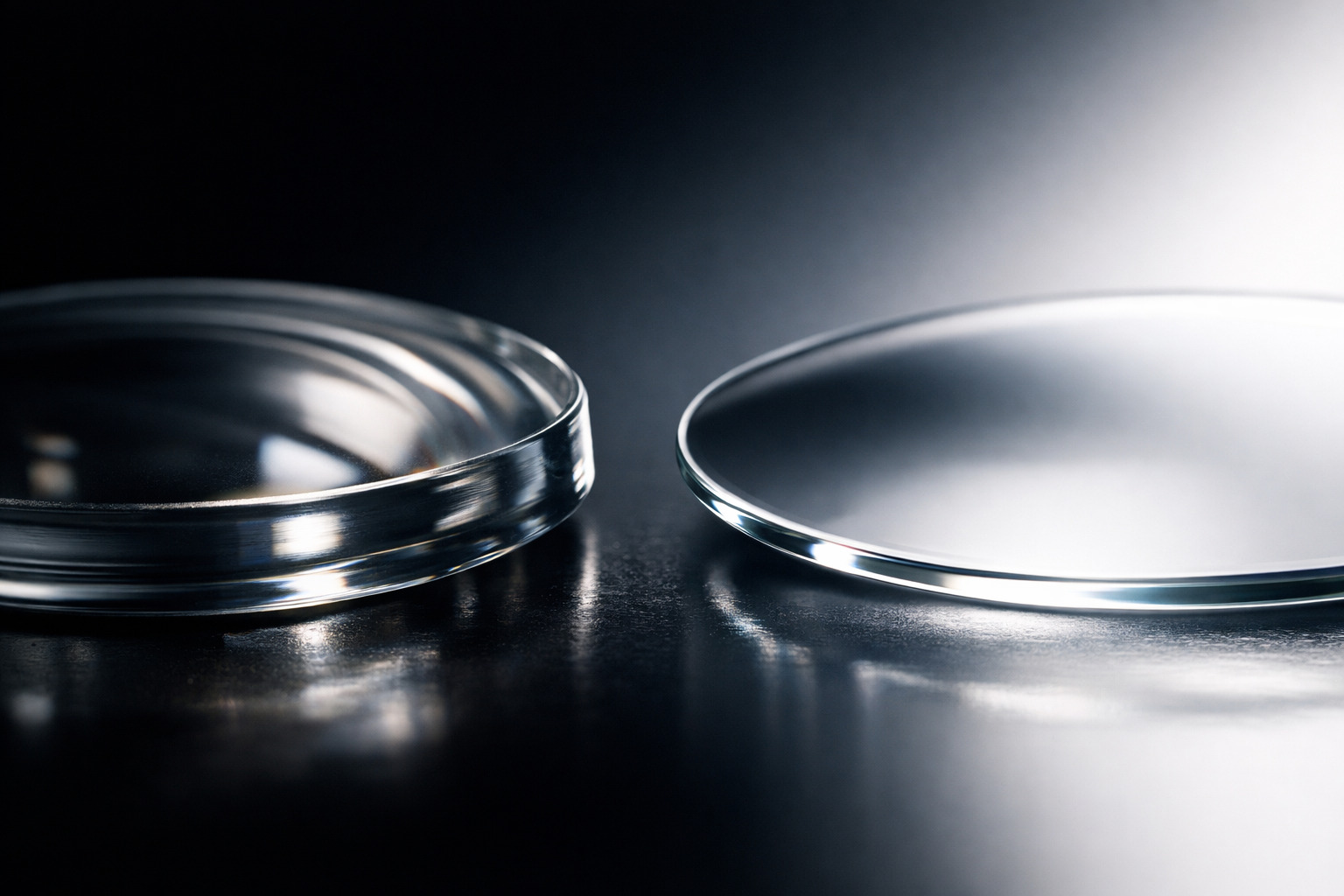

High index lenses are often positioned as a simple upgrade: thinner, lighter, more aesthetic. In practice, they are a design decision that directly affects lens thickness, edge profile, visual clarity, and how the final eyewear looks and feels on the patient.
To understand when high index lenses make sense, it’s important to look beyond the material itself and focus on how it interacts with prescription strength, frame selection, and patient expectations.
What Are High Index Lenses and How Do They Work
High index lenses are designed to bend light more efficiently than standard materials. This allows the same prescription to be achieved with less physical thickness.
The concept is based on refractive index, a measure of how strongly a material bends light. The higher the index, the less material is required to achieve the same optical power.
In practical terms, this means that a lens made from a higher index material can be noticeably thinner, especially in stronger prescriptions. This reduction in thickness directly affects edge profile, weight, and overall appearance.
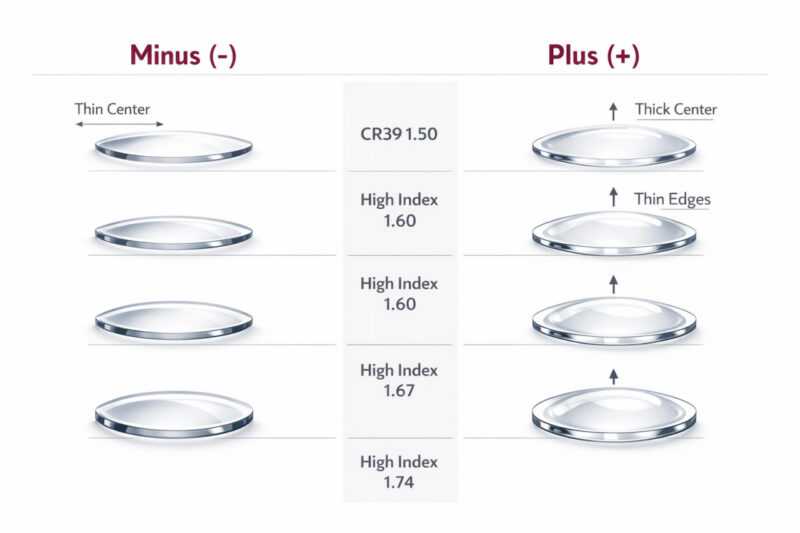
This becomes particularly visible in minus prescriptions, where standard lenses tend to develop thick edges, and in plus prescriptions, where center thickness becomes more prominent.
Why Lens Thickness Matters More Than Patients Expect
Lens thickness is not only a cosmetic concern. It affects how the glasses sit on the face, how heavy they feel over time, and how well they integrate with the chosen frame.
As prescription strength increases, lens thickness grows non-linearly. A small increase in diopters can result in a disproportionate increase in edge thickness, especially in lower index materials.
This creates several practical challenges. Thick edges become more visible in thin or rimless frames, weight increases pressure on the bridge of the nose, and lens protrusion can affect both aesthetics and comfort. In high prescriptions, this is often the main reason patients feel dissatisfied with their glasses, even when vision is technically correct.
High index materials address this by reducing the physical volume of the lens. The result is a thinner edge profile, improved balance within the frame, and a more refined appearance.
High Index vs Polycarbonate Lenses: What’s the Difference
High index and polycarbonate lenses are often compared, but they are designed for different priorities.
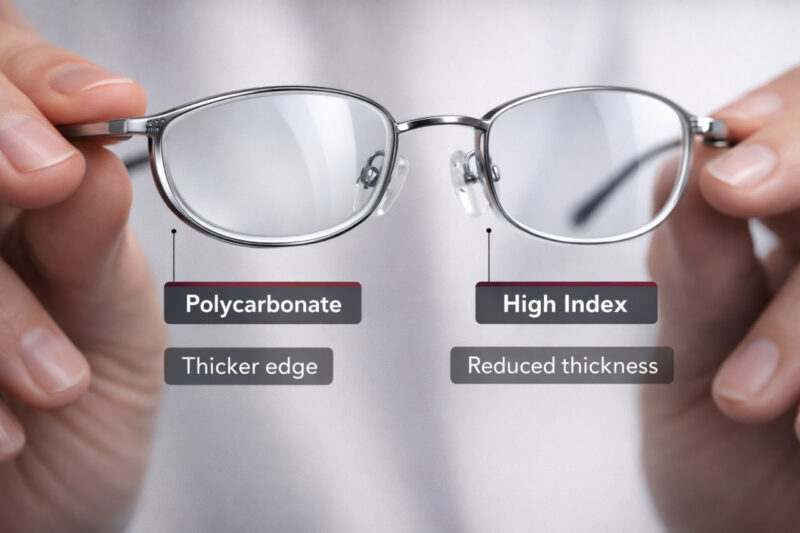
Polycarbonate is built around impact resistance. It is significantly more durable under stress, which makes it suitable for children, safety eyewear, and certain occupational environments. However, it has a lower Abbe value, which can introduce more chromatic aberration and reduce optical clarity in some prescriptions.
High index materials, on the other hand, prioritize optical precision and thickness reduction. They generally offer better visual clarity and a more refined optical experience, especially in higher prescriptions where distortion becomes more noticeable.
This is not a question of which material is “better.” It is a question of which trade-off is appropriate. In cases where safety and durability are critical, polycarbonate remains the correct choice. In cases where visual quality, thickness, and aesthetics are the priority, high index becomes the more suitable option.
Understanding Different High Index Options (1.60, 1.67, 1.74)
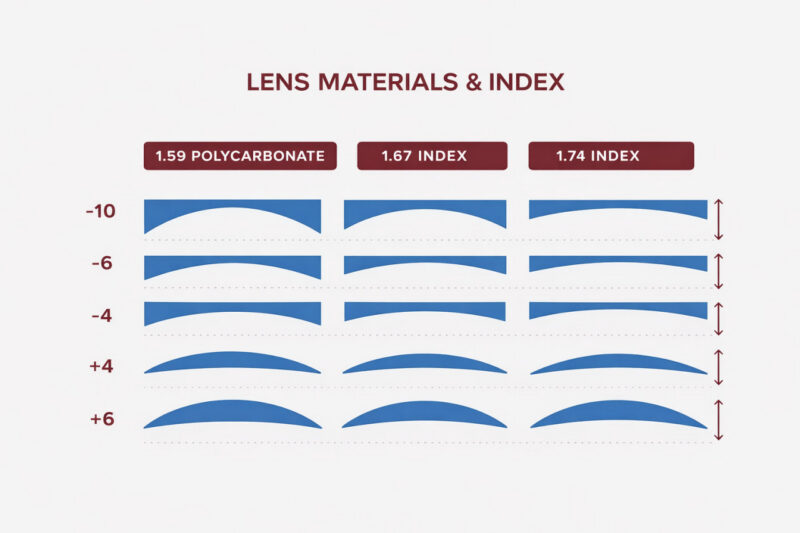
Not all high index lenses perform the same. The difference between 1.60, 1.67, and 1.74 is not just numerical. It directly affects thickness, weight, and optical behavior.
A 1.60 lens offers moderate thinning and is often sufficient for mid-range prescriptions. Moving to 1.67 provides a more noticeable reduction in edge thickness and is commonly used in stronger prescriptions or thinner frame designs. A 1.74 lens represents the highest commonly used index and delivers maximum thinness, particularly in high minus prescriptions.
The benefit of 1.74 high index lenses becomes most visible in prescriptions above ±4.00, where edge thickness would otherwise become a dominant visual factor. In these cases, the difference is not subtle. It changes how the glasses look and how patients perceive them.
However, a higher index is not always necessary. In lower prescriptions, the visual and structural difference between materials may be minimal, while cost and potential optical trade-offs increase. Over-prescribing index is a common mistake that does not improve patient experience.
1.74 High Index Lenses: When the Highest Index Makes Sense
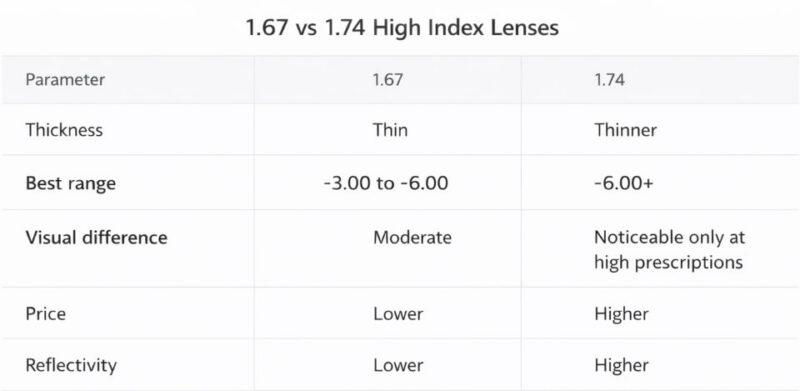
1.74 is often overused and misunderstood. The difference between 1.67 and 1.74 becomes meaningful in prescriptions stronger than approximately -6.00, particularly in larger frames. Below that range, the visual improvement exists but is often marginal.
Where 1.74 adds real value is edge refinement. It reduces the “heavy ring” effect at the lens edge and improves cosmetic balance in thin frames. Higher index materials also increase reflectivity, so without a high-quality anti reflective coating the lens can look visually noisy despite being thinner. That is why material and coating should always be paired decisions, not separate upgrades.
Lens Thickness vs Frame Choice: Why Material Alone Is Not Enough
Many thickness issues are blamed on the lens when the frame is the real cause. A large square acetate frame will produce thick edges even in high index, while a smaller, rounder frame can make a mid-index lens look acceptable.
Controlling lens thickness is a three-part equation: prescription, material, and frame geometry. Adjusting only one variable leaves results inconsistent. Experienced opticians solve thickness issues before the order is placed by guiding frame selection, so the material becomes a refinement tool rather than a correction tool.
When Should You Recommend High Index Lenses
The decision to use high index lenses should be based on a combination of prescription strength, frame choice, and patient expectations.
In lower prescriptions, standard materials often provide sufficient performance. As prescriptions move beyond ±2.00, thickness begins to become noticeable, and high index starts to provide visible benefits. Beyond ±4.00, it becomes a practical necessity rather than an upgrade, particularly in thinner or more aesthetic frames.
Frame selection plays a critical role. Large frames increase edge thickness regardless of material, while smaller, well-centered frames reduce it. High index lenses are most effective when paired with frame choices that support thickness reduction.
Patient lifestyle also matters. Patients who wear glasses full-time are more sensitive to weight and balance, while those choosing rimless or semi-rimless frames will immediately notice edge thickness differences.
Key Triggers in Practice
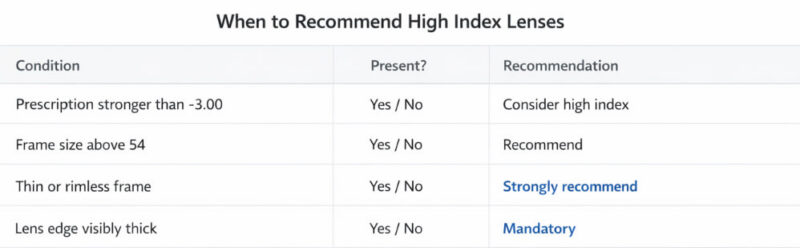
In practice, the recommendation should be driven by how visible the thickness will be, not by prescription alone. These are the most common triggers:
- Prescriptions above approximately -3.00 to -4.00, where edge thickness becomes noticeable in standard materials
- Frame sizes above 54 eye size or wide shapes, where edge exposure increases significantly
- Thin metal or rimless styles, where lens thickness cannot be visually hidden
When these triggers are present and high index is not recommended, the outcome is predictable: the patient accepts the order, receives the glasses, and then questions the result. In premium positioning, especially with custom ophthalmic lenses or digital designs, high index is part of delivering a consistent visual standard.
When High Index Lenses Are Not Necessary
High index lenses do not add value in every case, and over-prescribing them reduces trust.
In prescriptions under ±2.00, thickness differences are minimal in most frame sizes, and the patient will not see a meaningful change in appearance. In safety-driven cases such as children or occupational eyewear, material selection should prioritize impact resistance over refinement, so polycarbonate or Trivex lenses are more appropriate.
There is also a behavioral factor. Some patients are not sensitive to lens thickness or aesthetics, and if the frame hides the edge effectively, upgrading the material will not change their perception. The practical rule is simple: if thickness is not visible, high index will not be appreciated.
How High Index Lenses Affect Patient Experience
From the patient’s perspective, the difference between materials is rarely described in technical terms. It is felt.
Thinner lenses reduce forward weight, improving balance on the face and reducing pressure on the nose. They sit more naturally within the frame, making the glasses feel more integrated rather than added on.
At the same time, higher index materials can introduce subtle optical effects. As index increases, Abbe value typically decreases, which can increase sensitivity to peripheral distortion in some cases. This is usually not problematic when lenses are properly designed and fitted, but it becomes noticeable when combined with poor frame alignment or low-quality surfacing.
Coatings also play a critical role. High index materials reflect more light, which makes anti reflective coatings essential, not optional. Without proper coatings, patients may experience increased glare and reduced visual comfort.
For a deeper understanding of coating performance, see:
https://mialab.com/anti-reflective-coating
How to Make the Right Recommendation in Practice
The fastest way to decide is to look at prescription and frame size together before discussing materials. If the combination produces visible edge thickness, move directly to high index. If it does not, keep the recommendation simple and avoid unnecessary upgrades.
This approach reduces decision fatigue for the patient and standardizes recommendations across staff. Consistency here has a measurable effect: fewer remakes, fewer second-guessing conversations, and more confidence during dispensing.
How an Optical Lab Impacts High Index Lens Performance
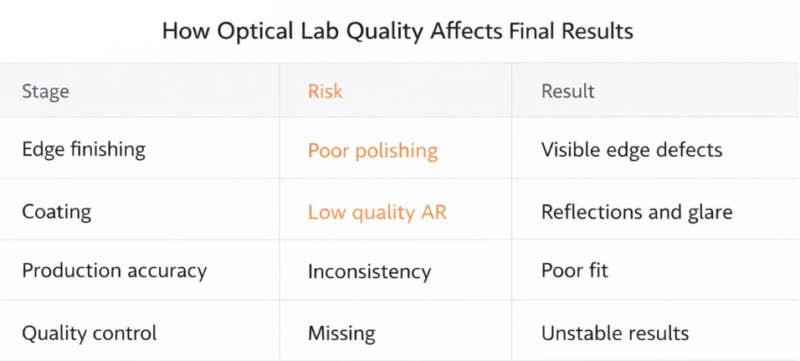
High index lenses are more sensitive to manufacturing precision than standard materials. As lenses become thinner, small inconsistencies in surfacing, edging, or coating become more visible.
Precision surfacing ensures that the intended lens geometry is preserved. Edge finishing affects how the lens fits into the frame and how clean the final result appears. Coating application must be consistent to maintain durability and optical performance.
Variability at any of these stages can lead to issues that patients perceive as discomfort, distortion, or poor quality, even when the prescription itself is correct.
A reliable optical lab reduces this variability through controlled processes and consistent standards. That consistency directly impacts remake rates, turnaround predictability, and long-term patient satisfaction.
High index lenses are less forgiving in production. As lenses get thinner, edge quality, polish, and coating performance become more visible, so even small inconsistencies in finishing affect how the final lens looks and performs. To see how lab process and quality control shape the final outcome, read how freeform lenses are made, step by step.
If you’re evaluating lab quality, start here:
https://mialab.com/how-to-choose-the-best-optical-lab
FAQ: High Index Lenses Explained
What are high index lenses used for?
They are used to reduce lens thickness and improve the appearance and comfort of glasses, particularly in stronger prescriptions.
Are 1.74 high index lenses worth it?
They are most beneficial in higher prescriptions where thickness becomes a significant issue. In lower prescriptions, the difference may not justify the cost.
Do high index lenses make glasses thinner?
Yes. They reduce lens thickness by bending light more efficiently. The effect is most visible in minus prescriptions, and the higher the prescription, the more noticeable the difference.
Are high index lenses better than polycarbonate?
They offer better optical clarity and thinner profiles, while polycarbonate offers higher impact resistance. The choice depends on the use case.
Do high index lenses require anti reflective coating?
Yes. Due to higher reflectivity, AR coatings are essential for visual comfort and performance.
When should you choose high index lenses?
When the combination of prescription and frame creates visible thickness, especially in larger frames or thin metal and rimless styles.
What is the difference between 1.67 and 1.74 lenses?
1.74 lenses are thinner and mainly make a difference in stronger prescriptions, typically above -6.00. In lower prescriptions, the visual change is minimal.
Do high index lenses have any downsides?
They reflect more light and need high-quality anti reflective coatings. They are also less impact-resistant than materials like polycarbonate.
Final Perspective: High Index Lenses as a Design Decision
High index lenses are not simply a premium option. They are a structural tool that changes how a prescription is expressed physically.
Thickness, weight, edge profile, and optical clarity are all interconnected. When high index is used appropriately aligned with prescription, frame, and patient expectations, it improves both the visual and physical outcome of the eyewear.
When used without context, it becomes an unnecessary upgrade.
In modern optical practice, the goal is not to recommend a higher index by default, but to use it precisely, where it makes a measurable difference.


