

Photochromic Lenses vs Polarized Lenses: What to Recommend and When

Patients often ask the same question two ways: “Should I get the lenses that change color?” or “Should I get the anti-glare ones?” Both are light management solutions. Both involve UV. And recommending the wrong one produces a patient who is mildly disappointed, unsure why, but quietly skeptical of the next premium recommendation.
The distinction is mechanical, not cosmetic. Photochromic lenses and polarized lenses solve different problems. Knowing which problem a patient has is what makes the difference between a recommendation they trust and an upgrade they regret.
Two Technologies, Two Different Problems
Photochromic lenses and polarized lenses are both responses to the same underlying issue: too much light, at the wrong intensity, in the wrong form. But they address that issue through entirely different mechanisms and serve patients with different visual needs.
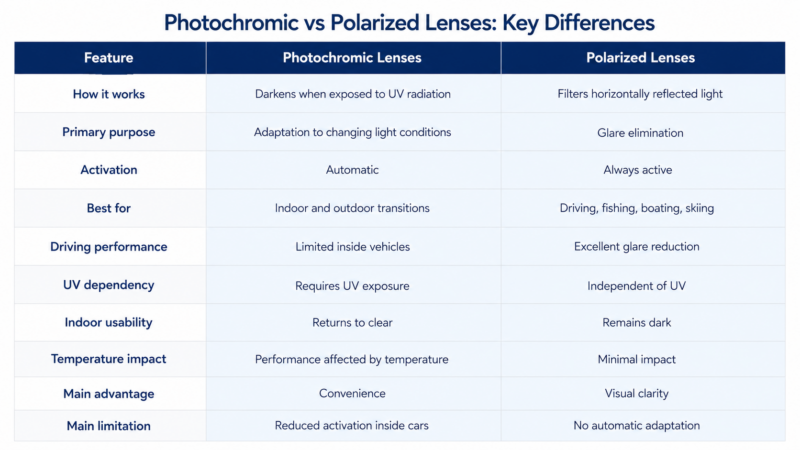
Photochromic lenses adapt. Their light-responsive molecules darken in the presence of UV radiation and return to a clear state when UV exposure decreases. The lens adjusts automatically to the environment. The patient does not have to think about it.
Polarized lenses filter. A laminated polarizing filter blocks horizontally oriented light (the specific type of light that reflects off flat surfaces like water, wet road, and sand) and creates a selective reduction in glare without changing the total light level in the same way tinted lenses do.
One technology is dynamic. The other is constant. One is about convenience and adaptation. The other is about glare precision. Understanding which problem a patient has is what determines which technology serves them.
How Photochromic Lenses Work and Where They Fall Short
Photochromic lenses darken through a photochemical reaction triggered by UV radiation. In most modern designs, silver halide molecules or organic photochromic compounds embedded in the lens surface change shape when UV light reaches them, absorbing more visible light and creating the darkened state.
Activation is relatively fast. Most quality photochromic adaptive lenses reach 70-80% of their darkened state within 30-60 seconds outdoors. Return to clear takes longer: typically 2-5 minutes in a warm environment, longer in cold conditions.
The UV-triggered mechanism is also the source of the technology’s main limitation.
The Car Limitation Nobody Explains in Advance
Modern vehicle windshields are designed to block UV radiation. They do this effectively, which is exactly why photochromic lenses do not darken significantly inside a car. A patient driving in full afternoon sun may notice that their lenses stay noticeably lighter than expected. This is not a product defect. It is the expected result of a UV-dependent system operating behind a UV-blocking barrier.
Patients who are not told this in advance interpret it as inconsistency. Patients who are told in advance accept it as a known tradeoff. The difference in satisfaction between those two groups is entirely a function of what the prescriber communicated before dispensing.
Temperature and Fade Time
Cold temperatures accelerate photochromic darkening and slow the return to clear. Warm temperatures, common in Florida year-round, reduce how dark the lenses get and speed up the fade. Patients in South Florida will generally experience a somewhat lighter tint ceiling than patients in northern climates. This is worth mentioning proactively for any patient with high outdoor exposure.
How Polarized Lenses Work and What They Cannot Do
The horizontal polarizing filter in polarized lenses works by blocking light waves aligned on a horizontal plane. Most reflected glare (from roads, water, hoods of cars, and wet pavement) is horizontally polarized. The filter eliminates that specific type of reflected light while allowing other light through.
The result is not simply darkened vision. It is qualitatively cleaner vision. Contrast improves. Depth perception on water surfaces becomes more reliable. Headlight scatter on wet roads decreases at night. Patients who have used prescription polarized lenses in high-glare environments consistently describe the difference as more significant than they expected.
For outdoor visual tasks such as fishing, boating, driving in sun-intensive environments, and skiing, polarized lenses deliver performance that photochromic lenses cannot replicate.
Glare Elimination vs Light Reduction
This distinction is clinically important. Photochromic lenses reduce the total amount of light transmitted through the lens. Polarized lenses selectively remove the most visually disruptive type of reflected light. In practical terms: a photochromic lens makes everything slightly dimmer. A polarized lens makes specific reflections disappear.
For a patient sitting in a car at noon with the sun reflecting off every hood on the highway, the polarized lens delivers a more specific and more useful correction. For a patient walking from a grocery store to a parking lot and back, the photochromic lens requires no thought and delivers consistent UV protection.
The Limitation: Fixed Tint, No Adaptation
Polarized lenses are typically produced with a fixed tint level, most commonly 75-85% transmission reduction. The lens material used affects both optical clarity and how the polarizing layer integrates. For a detailed comparison, see our lens material guide. This means they are dark indoors and cannot clear. A patient who relies exclusively on polarized prescription sunglasses must switch eyewear when moving indoors, which creates the same inconvenience that photochromic lenses are designed to eliminate.
Some newer photochromic polarized designs exist, lenses that both adapt and polarize, but they carry tradeoffs in cost, photochromic performance ceiling, and availability.
Photochromic vs Polarized: A Clinical Decision Framework
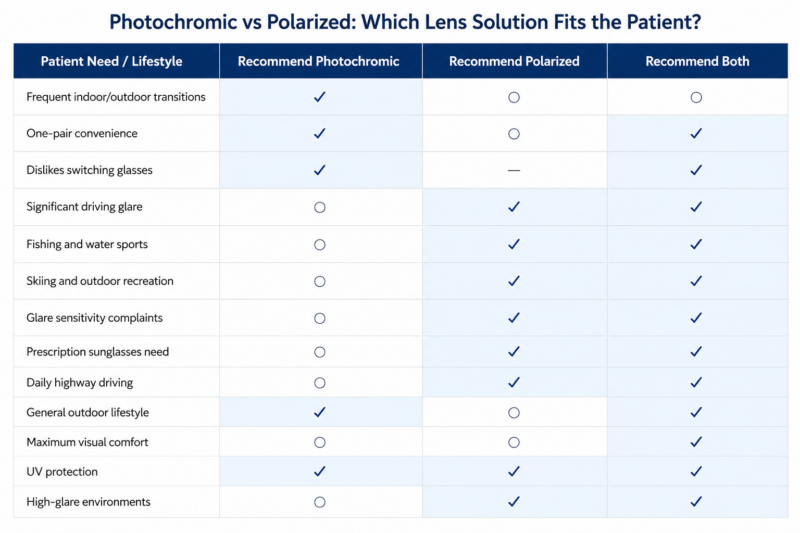
The question is not which lens is better. The question is which patient’s lifestyle a given lens matches. Here is a practical framework for the dispensing conversation.
Recommend Photochromic Lenses When
- The patient moves frequently between indoor and outdoor environments throughout the day
- Convenience is the primary driver: one pair for all conditions
- The patient dislikes switching between glasses
- The patient does not report significant driving glare complaints
- Outdoor time is moderate and varied rather than concentrated in one activity
- The patient is already satisfied with photochromic lenses from a previous pair
Photochromic lenses are the right answer when the primary problem is adaptation across environments, not performance in a specific high-glare scenario.
Recommend Polarized Lenses When
- The patient drives frequently in sun-intensive conditions and reports glare discomfort
- The patient participates in water sports, fishing, skiing, or other high-reflectance activities
- The patient has previously used photochromic lenses and reported dissatisfaction with car performance
- Glare sensitivity is documented or reported as affecting daily function
- The patient wears contact lenses for daily use and needs prescription sunglasses for outdoor activities
Prescription polarized lenses are the right answer when glare, not light adaptation, is the problem.
Recommend Both: the Most Common Answer
Most patients with significant outdoor exposure benefit from both options. Photochromic lenses serve as their primary pair, handling daily transitions without requiring any thought. Polarized prescription sunglasses serve as their activity pair for driving in intense sun, water exposure, and situations where glare precision matters.
This is not upselling. It is matching optical tools to the patient’s actual visual environment. The AOA recommends UV protection and glare management as part of comprehensive eyecare, and patients who receive this conversation understand it as a clinical recommendation, not a product pitch.
The Second Pair Conversation
The clinical trigger for introducing polarized lenses is already present in most patient records. It is just not being used consistently at the dispensing table.
Intake questions about driving frequency, outdoor hobbies, and prior glare complaints provide everything needed. A patient who reports an hour of daily highway driving, weekend fishing, or light sensitivity in the chart is already telling you that photochromic lenses alone will not fully serve them.
The conversation does not need to be built from scratch. It needs to connect the intake data to the dispensing recommendation: “Based on the driving time you mentioned and your outdoor activities, I’d recommend your primary pair with photochromic lenses for everyday wear, and a polarized pair for driving and weekends on the water. The polarized lenses eliminate reflected glare in a way that photochromics can’t replicate, especially in the car.”
That sentence takes fifteen seconds. It converts a single-pair patient into a two-pair patient with complete clinical justification.
How Lab Quality Affects Both Photochromic and Polarized Performance
Both photochromic and polarized lenses are sensitive to production consistency in ways that directly affect patient experience.
For photochromic adaptive lenses, the uniformity of the photochromic layer determines whether both lenses in a pair activate and fade at the same rate and to the same depth. Inconsistencies in lens processing create visible differences between the two eyes that patients notice as uneven or unreliable performance.
For polarized lenses, the alignment and integration of the polarizing filter is critical. Misalignment reduces the effectiveness of glare elimination. Poor lamination adhesion creates visual distortions that patients describe as “wavy” vision or inconsistent clarity. These are production issues, not prescription issues, but they present as prescription complaints.
Both lens types require a lab that controls the full production process in-house. When photochromic treatments and polarized lamination are outsourced or processed with variable quality control, the results appear in the dispensing chair as subtle complaints that are difficult to diagnose and frustrating for patients to describe.
For a practical guide to evaluating lab quality, see how to choose the best optical lab.
At Mialab, both photochromic and polarized lens processing are handled in-house at our South Florida facility, with quality verification on every order through calibrated Focovision and Visionix lensmeters.
FAQ: Photochromic Lenses vs Polarized Lenses
- Are photochromic lenses the same as polarized lenses?
No. Photochromic lenses darken in response to UV radiation and return to clear indoors. Polarized lenses contain a fixed filter that blocks horizontally reflected light, primarily glare from water, roads, and reflective surfaces. They address different aspects of light management and are not interchangeable. - Can a lens be both photochromic and polarized?
Some manufacturers produce photochromic polarized lenses that combine both technologies. These offer adaptation and glare filtering in a single lens. However, they typically carry a higher cost and may not reach the same darkening depth as dedicated photochromic designs. They are a valid option for specific patients but are not a universal solution. - Do polarized lenses block UV light?
Polarized lenses reduce glare but do not inherently provide UV protection. UV blocking depends on the lens material and any applied UV coating. For a breakdown of coating tiers and their UV protection levels, see our premium lens coatings comparison. UV protection is a clinical standard for all patients with significant outdoor exposure, and the long-term risks of cumulative UV exposure are well documented in ophthalmic literature. - Why don’t photochromic lenses darken in the car?
Modern vehicle windshields block a significant portion of UV radiation, the same radiation that triggers photochromic activation. Behind a UV-blocking windshield, photochromic lenses receive insufficient UV to reach their full darkened state. Patients who spend significant time driving and need sun protection in the car benefit more from prescription polarized sunglasses. - Which is better for driving: photochromic or polarized lenses?
For driving, polarized lenses outperform photochromics in glare-intensive conditions. The windshield blocks UV and limits photochromic activation; polarized lenses work independently of UV and eliminate reflected horizontal glare from road surfaces and other vehicles. For patients who drive frequently in sun-intensive environments, prescription polarized sunglasses are the more reliable solution. - Should I recommend photochromic or polarized lenses to a patient who fishes?
For a fishing patient, prescription polarized lenses are the priority. The primary visual challenge in fishing is surface glare from water, exactly what the polarizing filter eliminates. The ability to see through water surface reflection is a specific advantage of polarized lenses that photochromics do not provide. A photochromic primary pair plus polarized prescription sunglasses is the most complete solution for this patient profile. - How long do photochromic lenses last before performance degrades?
Most modern photochromic adaptive lenses maintain consistent performance for 2-3 years under typical conditions, with gradual reduction in maximum darkening depth thereafter. High UV exposure environments accelerate this process. Patients who spend significant time outdoors may notice reduced performance sooner. Annual dispensing evaluations provide an appropriate opportunity to assess lens performance alongside prescription changes.


