
UV Protection Lenses: What Optometrists Need to Tell Every Patient


A patient comes in for an annual exam. Clean bill of health. New prescription, single vision, nothing dramatic. The optician writes up the order: polycarbonate, standard anti-reflective coating, done.
Nobody mentions UV.
That patient spends four hours a day driving, walks the dog every morning, and coaches youth soccer on weekends. Cumulative UV exposure, year after year. No discussion. No documentation. No recommendation.
This is not an unusual scenario. It is the default in many independent practices. And it is a gap, clinically, professionally, and operationally, that is worth closing.
Why UV Protection Is a Clinical Issue, Not a Coating Upgrade
The connection between ultraviolet radiation and ocular pathology is well-established. Prolonged UV exposure is associated with accelerated cataract formation, pterygium development, and cumulative damage to the macular region. The cornea, crystalline lens, and retina are all exposure-dependent tissues. They do not recover between exposures the way skin can.
UV radiation is divided into three bands: UVA (315 to 400 nm), UVB (280 to 315 nm), and UVC (100 to 280 nm). UVC is largely absorbed by the atmosphere. UVB causes direct corneal and anterior segment damage; UVA penetrates deeper into the eye and reaches the crystalline lens and retina.
The cumulative burden begins in childhood. Children spend significantly more time outdoors than adults. The crystalline lens in younger patients transmits more UV to the retina than in older patients with denser, more absorptive lenses. If UV exposure is a lifetime accumulation problem, the case for protection starts at the first pair of glasses.
What makes UV ocular risk different from skin UV risk: patients cannot see it. They notice sunburn. They do not notice the gradual clouding of a lens or the slow changes in macular density that develop across years of inadequate protection. By the time UV damage becomes clinical, the window for prevention has passed.
What UV400 Actually Means and What It Doesn’t
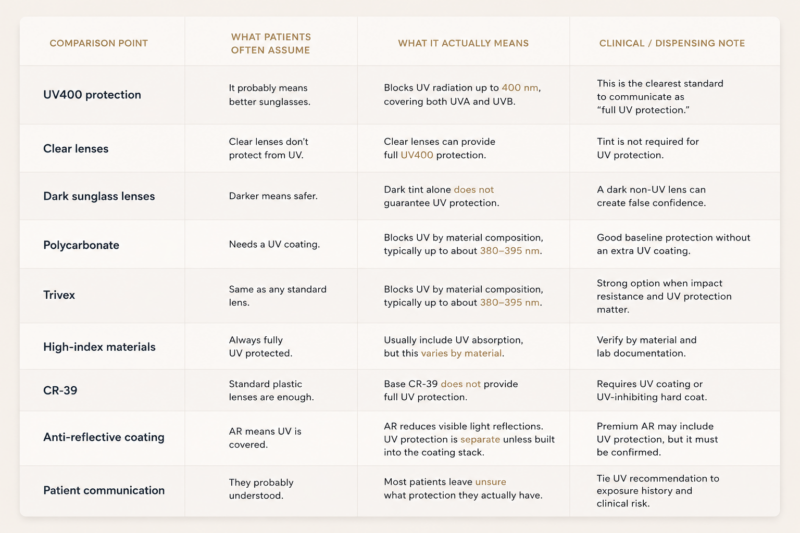
Most lens materials used in contemporary optical practice offer some degree of UV protection. Polycarbonate and Trivex block UV to approximately 380 to 395 nm by their material composition alone, without any additional coating. This is a meaningful starting point.
UV400 protection, the industry standard for full UV blocking, means the lens absorbs or blocks UV radiation up to 400 nm. This encompasses both UVA and UVB. UV400-rated lenses are appropriate for comprehensive ocular UV protection.
Several critical distinctions matter in practice:
UV protection is not visible tint. A clear lens can provide full UV400 protection. A dark sunglass lens without UV treatment offers cosmetic darkening with no meaningful UV blockade. Patients who rely on tinted sunglasses they purchased outside of optical channels may have less UV protection than their prescription glasses.
UV protection does not require a separate step in most modern materials. Polycarbonate and Trivex are UV-blocking by composition. High-index materials typically include UV absorption, though verification by material is recommended. CR-39 in its base form does not provide full UV protection and requires a UV coating or UV-inhibiting hard coat.
Anti-reflective coatings do not inherently include UV protection. AR coatings are designed to reduce visible light reflectance. UV protection is a separate layer or material property. Premium AR coatings, including full-protection designs, integrate UV blocking into the stack, but this varies by coating tier and manufacturer. Assuming UV is covered because AR is present is a documentation and communication risk.
The Communication Gap: Why Most Patients Don’t Know
Ask patients leaving your dispensary whether their new lenses protect against UV. Most will say yes, or give an uncertain answer. They may have heard UV mentioned somewhere in the visit. They are unlikely to understand what UV400 means, whether their lens material provides it, or whether their coating adds to or replaces that protection.
This is not a patient failure. It is a workflow failure.
UV protection conversations are often absorbed into the general noise of a dispensing appointment: frame adjustments, lens thinning options, coating comparisons, adaptation timelines, insurance copays. When UV comes up at all, it is typically a line on a product brochure rather than a clinical recommendation from the provider.
The result is that patients with chronic high UV exposure (outdoor workers, drivers, athletes, patients with light sensitivity, patients with a family history of cataract or macular disease) leave the practice without a targeted UV recommendation because nobody connected their exam findings to their exposure history.
That connection is what the dispensing conversation should make explicit.
Building UV Into the Dispensing Workflow
The most effective UV conversations happen in the exam room, not at the dispensing table.
When pretesting captures outdoor time, driving habits, or occupational exposure, and the doctor references that information during the exam, the dispensing conversation starts from a clinical recommendation rather than a product pitch. The difference in patient reception is significant.
A practical workflow integration looks like this:
During intake or pretesting, capture UV-relevant lifestyle data: approximate daily outdoor time, driving frequency, geographic or occupational factors. In South Florida, year-round UV index values are among the highest in the United States, and that context belongs in every lens conversation.
During the exam, if UV risk is relevant, note it in the handoff to the optician. “Mr. Ramirez coaches outdoors three days a week. Make sure we discuss UV and photochromic options with him” takes five seconds and changes the entire frame of the dispensing discussion.
At the dispensing table, the conversation moves from product to outcome: “Based on your outdoor time and the UV levels here in Miami, full UV400 protection in your lenses is a clinical recommendation, not just a feature. Let me show you what that looks like in your prescription.”
This is not a sales script. It is clinical continuity: the exam findings reaching all the way to the lens in the frame.
UV Protection and Photochromic Lenses: A Natural Pairing
Photochromic lenses represent one of the most consistent UV protection delivery mechanisms in clinical practice. Because they activate in UV-rich environments (outdoors, under direct sun) and provide continuous UV400 protection regardless of activation state, they align well with patients who have significant outdoor exposure. For a full clinical breakdown of how photochromic lenses work and where they add the most value, see our guide to photochromic lenses explained.
The key clinical point: photochromic lenses protect against UV even when they are in their clear state. A patient walking from the parking lot to the practice, spending twenty minutes in bright sun with lenses that have not yet fully activated, still has UV protection. The protection is in the material and coating, not in the tint.
This distinction is worth making explicitly to patients. Many assume that if the lens is not dark, it is not protecting. Correcting that assumption improves confidence in the product and reduces the perception of inconsistency.
Photochromic lenses are not a substitute for prescription sunglasses in high-intensity environments like prolonged beach or snow exposure. But for everyday outdoor activity, commuting, and mixed indoor-outdoor routines, they provide reliable UV protection that a standard clear lens without additional coating does not always match.
UV and the Standard of Care Question
There is a legitimate professional discussion about whether UV400 protection should be considered a clinical standard of care rather than an optional upgrade. Several national and international optometric bodies have moved toward recommending UV protection as a default in all spectacle prescriptions.
For independent practices, the operational implication is straightforward: if UV400 protection is your clinical default, it should be built into your standard lens offering, not presented as a premium add-on with an additional line item. Practices that frame UV protection as an upgrade implicitly signal that the standard lens option is clinically adequate without it. That is a harder position to maintain under scrutiny.
Documenting UV recommendations, or the reasons a patient declined them, is increasingly part of responsible clinical practice. A chart note that records discussion of UV protection creates accountability and positions the practice appropriately if a patient’s ocular health becomes a future clinical or legal question.
What to Look for in Your Lab Partner’s UV Capabilities
Not all UV protection delivered through coating is equivalent. In-house coating facilities allow tighter quality control over UV layer deposition, application consistency, and final verification. When UV protection is applied as a hard coat or integrated into an AR stack, the consistency of that application, from batch to batch and lens to lens, matters.
Practices that source from labs with external coating facilities introduce a variable they cannot directly observe: coating consistency across different production runs, different environmental conditions, and different operators. For UV protection specifically, variability in deposition can mean lenses leaving the lab with incomplete UV coverage on portions of the surface.
In-house coating operations, with integrated quality verification using calibrated instruments, produce more consistent UV performance than outsourced alternatives. When selecting or evaluating a lab partner, UV coating integration and in-house finishing capability are meaningful factors in the quality assurance conversation. A practical overview of what to look for is available in our guide to how to choose the best optical lab.
At Mialab, UV protection is integrated into our Matrix AR coating series, including the Full Protect coating, which combines UV blocking, blue light filtering, and anti-reflective performance in a single finished layer, applied in-house at our Hialeah facility. Every lens is verified before it ships.
Closing
UV protection in prescription lenses is not a conversation about selling a coating. It is a conversation about what the lens should do by default, and whether the practice is making that expectation explicit to every patient who needs it.
Patients trust their optometrist to tell them what their eyes need. If UV protection is clinically relevant for a patient and the practice does not say so, the practice has not served that patient fully.
That gap closes with one sentence. In the exam room. Connected to what was just seen on the slit lamp.
That is all it takes.
FAQ
- Do all prescription lenses include UV protection?
Not automatically. Lens materials like polycarbonate and Trivex block UV by their composition, providing solid baseline protection. CR-39 lenses in their base form do not offer complete UV protection and require an additional UV treatment. AR coatings do not inherently include UV blocking. This depends on the specific coating tier and manufacturer. Confirming UV protection by lens material and coating selection is part of responsible dispensing.
- What does UV400 mean in prescription lenses?
UV400 means the lens blocks ultraviolet radiation up to 400 nanometers, which covers both UVA and UVB bands. This is the recognized standard for comprehensive ocular UV protection and should be the clinical target for patients with regular outdoor exposure, driving habits, or elevated UV risk based on geography or occupation.
- Can a clear lens protect against UV?
Yes. UV protection is a material or coating property. It does not require visible tint. Polycarbonate and Trivex lenses are clear but block UV effectively. Premium clear AR coatings with integrated UV protection provide UV400 blocking in fully transparent lenses. Dark sunglass lenses without UV treatment, by contrast, provide cosmetic darkening without meaningful UV blockade.
- Do photochromic lenses protect against UV when they are clear indoors?
Yes. Photochromic lenses provide UV400 protection in both their clear and activated states. The UV protection is in the lens material and coating, not in the tint level. A photochromic lens in its clear indoor state still protects the eye from UV, which is a clinically important distinction for patient counseling.
- Is UV protection in prescription lenses a standard of care?
This is an active professional discussion. Several optometric organizations now recommend UV400 protection as a default standard in all spectacle prescriptions, particularly for pediatric patients and high-exposure adults. Independent practices that treat UV protection as an optional upgrade may want to review how they document and communicate UV recommendations, both for patient care quality and for professional liability purposes.
- How does lens coating quality affect UV protection consistency?
UV protection applied through coating is subject to production variability. Inconsistent deposition, batch variation, or external coating processes can result in lenses where UV coverage is uneven or incomplete. In-house coating facilities with calibrated quality verification produce more consistent UV performance than outsourced alternatives. When evaluating an optical lab partner, UV coating integration and in-house finishing capability are relevant quality indicators.
- Should UV protection be recommended differently for children?
Yes. The crystalline lens in children transmits more UV radiation to the retina than in adults, making early and consistent UV protection more important, not less. Children also typically spend more time outdoors and accumulate a larger proportion of lifetime UV exposure before age 18. UV400 protection in children’s prescription lenses is a clinical priority, not an optional add-on.
_________________________________
MIA LAB is an independent optical laboratory in Hialeah, Florida, producing precision prescription lenses for independent eyecare practices across the U.S. Our Matrix AR coating series, including Full Protect with integrated UV and blue light filtering, is applied in-house with calibrated quality verification on every order. To learn more about our anti-reflective coating technology or open a practice account, visit mialab.com.


