
Reducing Remakes and Non-Adaptations: Why Quality Matters More Than Ever


Every optical practice knows the feeling: a patient returns with a pair of glasses that “just doesn’t feel right.” Maybe the reading zone seems too narrow. Maybe something feels “off” in the periphery. Maybe the new progressives cause discomfort, dizziness or a vague sense that the prescription simply isn’t helping.
When this happens, the cost is always higher than the remake itself. Time is lost, trust is shaken, and the entire practice feels the ripple effect.
And yet, many remakes and non-adaptations are not inevitable.
In fact, they are often symptoms of deeper issues: inconsistencies in measurements, limitations of outdated designs, low-quality lens materials, insufficient coating durability, or the biggest factor of all-variability in the optical lens manufacturing process.
The good news?
With stronger lens design personalization, digital free-form technologies, consistent communication, and a high-quality optical lab partner, the number of remakes can drop dramatically.
This article explains why remakes happen, what’s really going on inside the production process, and how our independent optical lab in Miami, Florida help practices achieve the accuracy and consistency needed to prevent non-adapts before they start.
The Hidden Cost of Remakes Inside an Optical Practice
When a remake occurs, the problem rarely stays confined to the exam room. A single pair of non-adapt progressives may require:
- several rounds of troubleshooting,
- staff time for adjustments and communication,
- new lenses or coatings,
- additional edging and finishing,
- and ultimately a replacement that must be absorbed by the practice or the lab.
For many clinics-especially those juggling high patient volume these disruptions create pressure not just on profits, but on workflow, confidence, and the patient experience.
A remake also touches the patient emotionally. Most people only get new glasses every one or two years. When the experience fails, even once, their trust weakens. Some never return.
That is why quality matters, not as a marketing claim, but as a measurable, operational foundation for any practice that wants to grow sustainably.
Why Remakes Happen: Looking Beyond the Obvious
It’s easy to assume that remakes happen because the prescription changed or the measurements were off. Sometimes that’s true. But more often, the issue is far more nuanced.
Subtle Measurement Variations
A few millimeters in PD, seg height, pantoscopic tilt, wrap angle, or vertex distance can shift the experience of progressive lenses for presbyopia in ways patients immediately notice. Digital designs magnify both the benefits and the consequences of misalignment.
Frame Dynamics and Position-of-Wear
Modern eyewear-fashion frames, oversized shapes, wraps, and thin metals-has changed how lenses sit relative to the eye.
A progressive corridor engineered without accounting for these variables will never feel “right,” even if the prescription is perfect.
Limitations of the Lens Design or Material
Older or lower-quality lens designs lack the optimization needed for today’s multitasking lifestyle. Patients who spend several hours on screens daily often struggle with outdated progressives or coatings that produce glare, smudging, or short-lived clarity.
For example:
- Polycarbonate lenses behave differently from high index lenses and trivex lenses.
- 1.74 high index lenses offer aesthetic benefits but require excellent surfacing precision.
- Insufficient coatings can lead to early scratching or visual haze, prompting patient dissatisfaction.
Manufacturing Variability
This is often the “invisible” reason behind remakes.
Two progressives with the same design and prescription can feel dramatically different depending on the precision of surfacing equipment, calibration consistency, coating chamber conditions, and the quality assurance processes of the lab.
This is where the difference between a mass-production facility and a high-precision optical lab in Miami Florida, like MIA LAB, becomes impossible to ignore.
Why High-Quality Manufacturing Reduces Remakes at the Source
Modern digital manufacturing has transformed what is possible in ophthalmic lenses.
At MIA LAB, every pair of lenses-whether progressives, photochromics, high-index, occupational, or blue light lenses-is produced with a level of accuracy that directly reduces remake rates.
Free-Form Surfacing as the Foundation
Digital surfacing creates the optical surface point by point. This allows algorithms like IOT Digital Ray-Path® 2 to calculate how the eye naturally rotates and how light enters the lens at different angles.
When this information is translated into lens geometry at the micron level, the resulting digital freeform lenses are not simply more accurate-they are more intuitive for the patient’s visual system.
Camber™ Technology for Progressive Comfort
Many non-adapt cases originate from narrow intermediate zones or uncomfortable near vision.
MIA LAB Camber lenses address this through a curved front surface that naturally expands the reading zone. For busy presbyopes, this difference is often the determining factor between success and frustration.
Coatings That Protect Optical Clarity
Many remake complaints start with coatings, including glare, smudging, peeling, reduced transparency under certain lighting, and difficulty cleaning AR surfaces.
MIA LAB solves these issues with premium lens coatings engineered for Miami’s climate-heat, humidity, and constant temperature shifts. This is crucial for patients who rely on consistent optical performance.
A Quality Assurance System That Captures Tiny Deviations
What distinguishes a high-quality lab is not just its technology-it’s the culture of quality behind it.
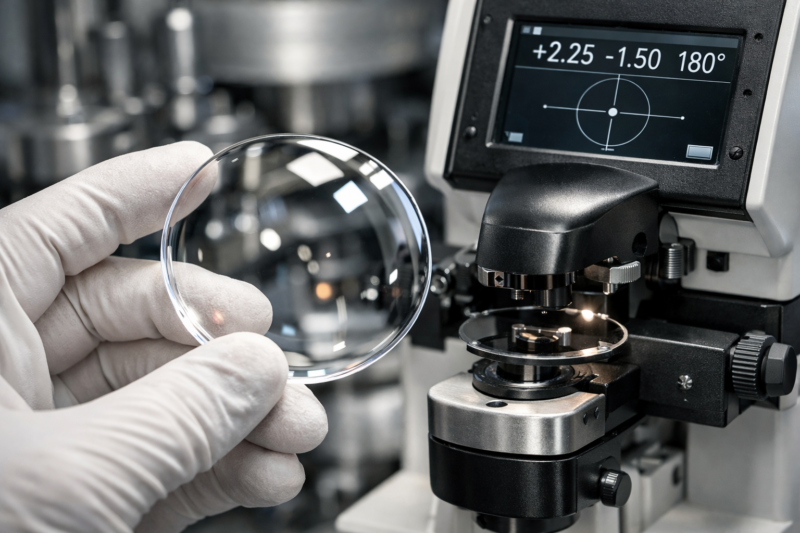
At MIA LAB, every lens is inspected for prescription accuracy (power, prism, axis), for optical clarity under specialized lighting, for coating uniformity, and for the structural integrity required for long-term wear.
Explore the full QA system here
When each stage of production is controlled and verified, the number of issues that make it into the hands of patients drops dramatically.
Reducing Remakes in Practice: What Clinics Can Do Every Day
Even the best lab can’t prevent remakes alone; the magic happens when the lab and the practice work in sync.
-
Take Measurements With the Frame On
Progressive performance depends heavily on where the patient naturally looks through the lens. Always measure with the final frame in place.
-
Ask Lifestyle Questions That Matter
A presbyope who spends 8 hours on a laptop may need occupational progressive lenses or computer lenses, not general-use designs. A patient who spends much of their time outdoors may benefit more from photochromic adaptive lenses or uv protection lenses than they initially realize.
-
Choose Materials Intentionally
For high prescriptions, high index lenses reduce thickness, but for impact resistance, trivex or polycarbonate may be the superior option. For delicate frames, edging tolerances matter; sharing frame information with the lab helps ensure fit and durability. -
Communicate With the Lab Early and Clearly
A strong relationship with a reliable wholesale optical lab Florida such as MIA LAB Hialeah allows quick troubleshooting, design adjustments, or coating suggestions.A lab isn’t just a supplier. It’s an extension of the practice.
A Real-World Example: When Lab Quality Changes Everything
A South Florida practice was struggling with progressive lens remakes. Many patients described the same issues-soft edges in the reading zone, trouble adapting at intermediate distances, and a general sense of “not getting used to it.”
The practice switched its progressive work to MIA LAB, a fast prescription lens lab in Miami known for its digital precision and consistent QA. Within weeks, remake numbers dropped. Patients who previously needed several adjustments adapted on their first try.
What changed?
- Better personalization through digital freeform progressive lenses
- Wider, more comfortable Camber reading zones
- More durable, clearer AR coatings
- Micron-level surfacing accuracy
- A lab team that reviewed measurements and consulted on design choices
This pattern is common across clinics that move from standard production to a highly controlled independent optical lab Florida environment.
Quality Isn’t a Feature. It’s the Foundation of Patient Success
Patients rarely see the complex optical engineering behind their lenses. But they always feel the results.
When the optical design aligns with their lifestyle, when the coating stays clear day after day, when the corridor performs exactly as intended, and when every detail is dialed in with precision-their reaction is immediate and unmistakable:
“These are the best glasses I’ve ever had.”
Reducing remakes isn’t only about avoiding mistakes.
It’s about elevating the experience.
It’s about giving patients vision that feels natural, stable, and effortlessly comfortable.
And it’s about choosing a lab that treats every lens as if someone’s quality of life depends on it-because it does.
Tired of costly remakes? Partner with a lab that prioritizes precision.
MIA LAB is an independent optical lab in Miami, serving practices across South Florida with:
- advanced digital surfacing,
- premium coatings built for durability,
- Camber™ and Digital Ray-Path® progressives,
- a 24-hour average turnaround on uncut lenses (about 2 more days with AR),
- bilingual support for Spanish-speaking clinics,
- and a 1-year warranty on all digital lenses, for any reason, no questions asked.
Experience consistency your patients will notice.


