
Trivex Lenses and Optical Clarity: Why Abbe Value Changes the Material Conversation


Why Polycarbonate Lenses Became the Default and What Gets Missed
Polycarbonate lenses earned their place in the dispensary on two merits: impact resistance and thinness. For pediatric patients, active adults, and safety eyewear, the case has always been sound. Polycarbonate passes ANSI Z87.1 impact standards, cuts thinner at moderate prescriptions than CR-39, and is available from virtually every optical lab supplier at predictable cost. It became the default not because it was the best optical choice in every scenario, but because it was the most practical choice in most scenarios.
What that efficiency-driven adoption pattern left out is the other side of the material profile. Polycarbonate lenses have an Abbe value of approximately 30, the lowest of any commonly dispensed ophthalmic material. That number has real consequences for a subset of patients that most practices don’t identify until the remake is already on the bench.
What Abbe Value Measures in Optical Lens Materials
The Abbe value (also called the Abbe number or V-number) quantifies a lens material’s chromatic dispersion: how much it separates white light into its component wavelengths as it refracts. Every wavelength in the visible spectrum bends at a slightly different angle when it passes through a refractive medium. The Abbe value measures how pronounced that separation is.
Higher Abbe value = less chromatic dispersion = better optical clarity. Lower Abbe value = more chromatic dispersion = more chromatic aberration.
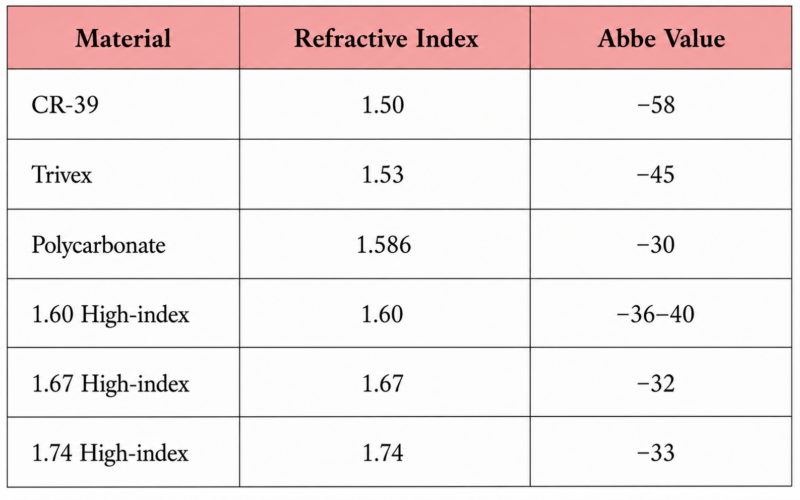
The practical range for common ophthalmic materials runs from approximately 30 to 58:
For a fuller clinical comparison, the table below maps all three primary materials across the properties that matter most for dispensing decisions. For a broader look at how these and other materials perform across prescription ranges, see our lens material comparison guide.
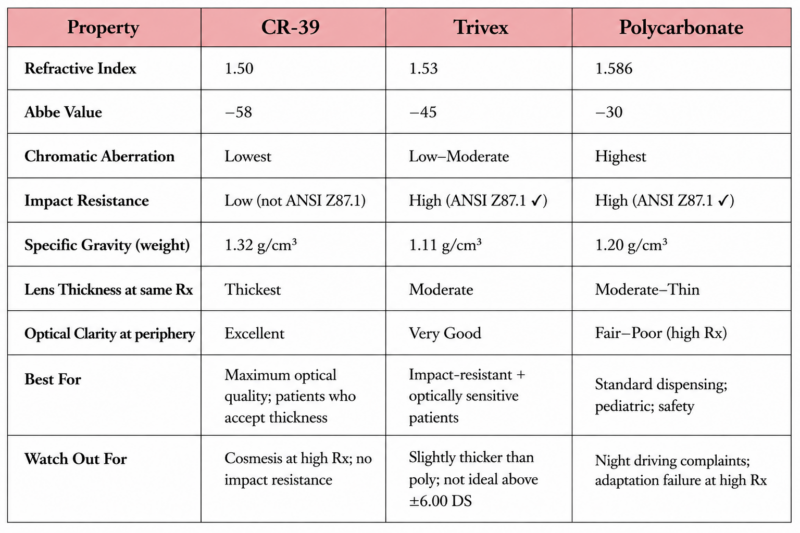
Two things stand out in this comparison. First, trivex lenses sit at approximately 45, significantly better than polycarbonate and competitive with lower high-index options. Second, the inverse relationship between refractive index and Abbe value is a physical property of these materials, not a manufacturing limitation. As a material is engineered to bend light more aggressively, it disperses light more aggressively as well. This is the trade-off built into every high index lenses recommendation above 1.60.
CR-39 has been the optical quality benchmark for a reason. It’s not the thinnest material available, but for patients who prioritize visual performance, no commonly dispensed material beats it on chromatic optical quality. The clinical conversation in most practices, however, is built almost entirely around thickness. Abbe value doesn’t appear on most order forms.

How Chromatic Aberration Affects Real Patients
Chromatic aberration from low Abbe value materials manifests in predictable ways:
Color fringing at the lens periphery. When the eye moves away from the optical center, which happens constantly during normal gaze, wavelengths separate more at the periphery, producing faint color fringing around high-contrast edges. Most patients can’t name it. They say the prescription “feels off.”
Reduced contrast sensitivity. The image resolves clearly at the center but lacks crispness. Patients notice this most on screens and under fluorescent lighting, two environments where most people spend the majority of their visual hours.
Halos and starbursts in low light. Point light sources at night (headlights, streetlights, dashboard indicators) produce visible diffraction patterns when chromatic dispersion is high. This is the complaint that most often prompts a call to the practice after a night commute.
Visual fatigue. When the visual system continuously compensates for chromatic artifacts it cannot fully suppress, it works harder. Patients don’t report eye strain precisely. They say they feel tired, or that they preferred their old glasses, or that something “just isn’t right.”
Three patient profiles account for the majority of material-related complaints:
Prescriptions above ±4.00 to 5.00 DS. Chromatic aberration scales with prescription power. A patient at -7.00 in polycarbonate lenses will experience aberrations that a patient at -2.50 in the same material won’t notice at all. The material isn’t different. The leverage applied to the material’s dispersion properties is.
Children who resist wearing their glasses. Pediatric patients prescribed polycarbonate lenses for impact resistance, which is entirely appropriate, sometimes complain that their glasses “feel weird” or actively avoid wearing them. Trivex lenses match polycarbonate’s ANSI Z87.1 impact resistance while delivering an Abbe value of ~45 versus polycarbonate’s ~30. For a child in the prescription range where Trivex is viable, the optical quality difference is real and the safety case remains intact.
Patients with a history of adaptation difficulty. A patient who has failed progressive adaptation or reported dissatisfaction with multiple pairs is sending a signal: their visual system is sensitive to optical variables. Introducing polycarbonate lenses or 1.74 high index lenses into that profile adds a variable that isn’t necessary. Removing it by choosing a higher-Abbe material costs the practice almost nothing while reducing remake risk.
Trivex Lenses vs. High Index Lenses: A Clinical Decision Framework
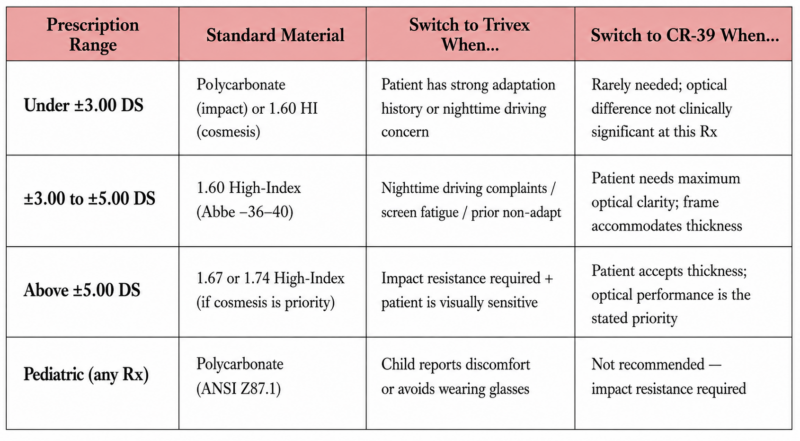
Lens design personalization doesn’t require elaborate systems or premium add-on fees. It requires asking a different set of questions at the point of material selection. The following framework applies across most dispensing scenarios:
Prescriptions under ±3.00 DS, no significant astigmatism: Chromatic aberration from polycarbonate lenses or 1.60 high index lenses is unlikely to be clinically significant. The default material for the clinical situation (polycarbonate for impact, 1.60 or 1.67 for cosmesis) is appropriate without Abbe value adjustment.
Prescriptions ±3.00 to ±5.00 DS: This is the inflection zone. For most patients, 1.60 high index lenses (Abbe ~36 to 40) are acceptable. For patients with nighttime driving complaints, adaptation history, or elevated screen use, trivex lenses are worth the explicit conversation. The refractive index difference (1.53 vs 1.60) produces a slightly thicker lens, typically 0.3 to 0.5mm in this Rx range, that most patients accept when the optical benefit is explained directly.
Prescriptions above ±5.00 DS: The optical case for higher Abbe value materials strengthens at every diopter above this threshold. For patients in this range who have no adaptation history and whose primary concern is cosmesis, 1.67 or 1.74 high index lenses remain a defensible choice when the patient understands the trade-off and accepts it. For patients in this range with any of the risk factors above, CR-39 in an appropriately sized frame, or trivex lenses where impact resistance matters, delivers measurably better optical performance.
The conversation that eliminates most material-related remakes: Tell the patient directly. “This material is thinner. It bends light slightly more aggressively, which for some patients, particularly when driving at night, produces more glare. Based on what you’ve told me about your lifestyle, I want to offer you the option of a material that’s optically sharper, even if it’s a millimeter or two thicker.” Patients who make an informed choice rarely call back with vague complaints. They knew what they were getting.
On manufacturing quality and material performance: Choosing the right material is the first variable. The second is how precisely that material is surfaced and verified. When working with custom ophthalmic lenses, particularly in trivex or CR-39 where the optical potential is higher, the lab’s surfacing tolerances determine whether that potential is realized. A trivex lens surfaced to ±0.12D tolerance performs differently than one surfaced to ±0.06D. The material selects the ceiling; the manufacturing process determines how close to it you get.
At MIA LAB, in-house surfacing across all materials is verified with Focovision and Visionix lensmeters calibrated to ±1 micron accuracy. The best optical lab for optometrists isn’t the one with the most material options. It’s the one that surfaces each material to its full clinical potential. For practices in South Florida looking for a consistent optical lens supplier florida-based, MIA LAB surfaces trivex, CR-39, and full high-index range in-house.
Polycarbonate lenses are the right call in most situations. The problem isn’t polycarbonate. It’s the assumption that it’s always the right call. A practice that builds Abbe value into its material selection conversation has a clinical differentiator that costs nothing to implement and reduces a class of remake complaints that most practices write off as patient sensitivity.
Trivex lenses exist for exactly the patients who fall between “polycarbonate is fine” and “the prescription is too high for anything but high-index.” Knowing precisely who those patients are is the difference between a material recommendation and a clinical judgment.
Frequently Asked Questions
- What are trivex lenses and when should I recommend them?
Trivex is an ophthalmic lens material with a refractive index of 1.53 and an Abbe value of approximately 45, significantly higher than polycarbonate lenses (~30) and competitive with 1.60 high index lenses. It matches polycarbonate’s impact resistance (ANSI Z87.1 compliant) while producing measurably less chromatic aberration. Trivex lenses are the best choice for patients who need impact resistance but have prescriptions in the moderate range (up to approximately ±4.00 DS) and are visually sensitive, drive at night, or have a history of adaptation difficulty with other materials.
- Why do polycarbonate lenses sometimes cause halos or visual distortion at night?
Polycarbonate lenses have one of the lowest Abbe values of any commonly dispensed ophthalmic material, at approximately 30. This means they disperse white light more aggressively than materials like CR-39 (Abbe ~58) or trivex (Abbe ~45). At higher prescriptions, or for patients whose gaze frequently moves away from the lens optical center, this dispersion produces chromatic aberration: color fringing at the periphery, reduced contrast, and halos or starburst effects around point light sources at night. For these patients, trivex lenses or CR-39 (depending on whether impact resistance is required) will consistently outperform polycarbonate.
- What is the Abbe value, and why does it matter for lens selection?
The Abbe value (also called the V-number) measures how much a lens material separates white light into its component wavelengths, a phenomenon called chromatic dispersion. A higher Abbe value means less dispersion and therefore clearer, sharper vision at the periphery and in low-light conditions. Most high index lenses have Abbe values in the low 30s; 1.74 high index lenses specifically sit at approximately 33. CR-39 sits at approximately 58. For patients with strong prescriptions or elevated visual sensitivity, this difference is clinically meaningful.
- Are trivex lenses thicker than polycarbonate lenses?
Yes, slightly. Trivex has a refractive index of 1.53 compared to polycarbonate’s 1.586, which means at the same prescription, a trivex lens will be marginally thicker, typically in the range of 0.3 to 0.6mm at moderate prescriptions. For many patients, this is not cosmetically significant, especially when the optical quality benefit is explained during the dispensing consultation. Trivex lenses are, however, lighter than polycarbonate by specific gravity, so the lens may actually feel similar or less heavy despite being marginally thicker.
- Should I use trivex or CR-39 for a patient who drives at night and has a strong prescription?
For prescriptions above ±5.00 DS, CR-39 is the material with the highest Abbe value (~58) of any commonly dispensed option, making it optically superior to both trivex and high index materials. The challenge is cosmesis: at -6.00 or higher, CR-39 produces a thick lens that many patients reject. If the patient has a prescription in the ±3.00 to 5.00 DS range and nighttime driving is a stated concern, trivex lenses are the recommended choice. They offer meaningfully better optical quality than polycarbonate lenses with acceptable cosmetic thickness. For higher prescriptions where the patient insists on a thinner lens, having the explicit Abbe value conversation and documenting the patient’s informed choice reduces comeback complaints significantly.
- How does material Abbe value interact with progressive lens design?
Progressive lenses already produce optical aberrations in their peripheral blend zones. This is inherent to the progressive design and exists in every lens regardless of material. A material with a low Abbe value adds its own chromatic dispersion on top of those existing peripheral aberrations, compounding the visual complexity in exactly the zones where the patient’s visual system is already working hardest to adapt. For patients who are new to progressives, have had previous non-adaptations, or are being fitted with high-add powers, choosing a higher-Abbe material removes one variable from an equation that has enough variables already.
- Does manufacturing precision affect how well a lens material performs optically?
Yes, and the relationship between material quality and surfacing precision is often underappreciated. A trivex lens or CR-39 lens with high Abbe value potential performs to that potential only if the surfacing tolerances are tight enough to realize it. Centration errors, Rx drift at the periphery, and progressive measurement inaccuracies compound chromatic aberration from the material. Practices working with an optical lens supplier that surfaces in-house, with calibrated QC verification on every pair, get more consistent optical outcomes across all materials, but particularly in higher-Abbe lenses where the quality ceiling is higher.
MIA LAB is a VSP-approved independent optical lab based in Hialeah, Florida, with 25+ years serving independent ECPs across South Florida. We surface trivex lenses, CR-39, and the full high-index range in-house, verified to ±1 micron at final QC. Practices looking for a reliable optical lens supplier florida-based can reach our team directly during business hours.


