
Expert Q&A: Tough Questions on Progressive Lenses and Fittings


Some days, progressive lenses feel effortless. The patient adapts quickly, the optics are clean, and you barely hear a word after dispense.
Other days, you get the classics:
- “It feels like the floor is moving.”
- “I can’t find my computer zone.”
- “Everything swims when I walk.”
- “I tried, but I just can’t get used to these.”
And of course, the person who has to turn that into a practical plan is your company .
This Q&A is written for optical professionals who work with progressive lenses every day and want a clear, realistic approach to selection, fitting, and progressive lens troubleshooting. We’ll cover how to choose designs, how to reduce non-adapts, what to measure for digital freeform progressive lenses, and how to work through common complaints like swim effect without guessing.
Who’s answering these questions
We’re writing this as someone who’s spent a lot of time in the trenches with progressive lens fittings, troubleshooting, and patient conversations. The goal here isn’t to sound impressive, it’s to help your company make better decisions faster and reduce remakes.
If you read any answer and think, “That’s exactly what happened in my chair last week,” then we’re doing this right.
Quick answers first
- Choosing custom progressive lenses isn’t about picking “the best” design. It’s about matching design priorities to lifestyle, frame parameters, and sensitivity.
- Digital/freeform progressives are less forgiving, which is why measurement consistency matters more than most practices admit.
- Swim effect complaints usually come from a mismatch between design, corridor, frame fit, and patient expectations, not from “bad lenses.”
- The fastest way to troubleshoot is a checklist, not instinct.
- For patients sensitive to swim and peripheral instability, designs that prioritize stability can make a noticeable difference.
If you want to review progressive options and design families, the cleanest place to start is MIA’s lens lineup
Question 1: “How do I choose between different progressive designs for a patient?”
If you want fewer remakes, the decision starts before you ever mention a brand.
When we’re deciding between progressive designs, we run through three questions:
1) What does the patient actually do most of the day?
- Office + monitor heavy?
- Driving, especially at night?
- Constant near work?
- Lots of switching between distance and intermediate?
That one question usually tells you what the design needs to prioritize.
2) Is this their first progressive lens experience?
First-time progressive wearers often need a design that feels calmer in motion and more forgiving in adaptation. Long-term PAL wearers usually tolerate stronger design characteristics well, especially if their prior lenses were similar.
3) What frame are we working with?
Small frames, steep pantoscopic tilt, or heavy wrap can amplify “swim” and distortions. The best progressive lens design on paper can fail in the wrong frame.
This is where lens design personalization matters. The best-performing outcomes usually come from matching design behavior to the patient, not from choosing the most expensive option.
Question 2: “What’s the best practice for measuring for digital/freeform progressives?”
For digital freeform lenses, consistency is the most underrated skill in your practice.
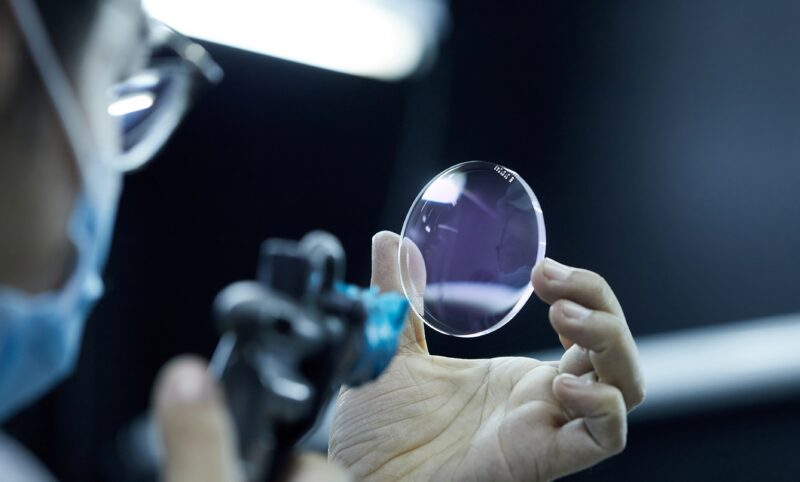
The measurements that most often make or break a digital freeform progressive lens fitting are monocular PD, fitting height, vertex distance, pantoscopic tilt and wrap angle.
The reality is simple:
“Freeform progressives aren’t picky, they’re precise.”
If your team measures differently from person to person, the patient experience becomes inconsistent too. That’s usually when you start seeing vague complaints that don’t match what you expect.
If you want to understand how freeform surfacing and finishing play into consistency and final optics, this page is a helpful reference.
Question 3: “A patient complains about swim effect. What should I check first?”
Swim effect is one of those complaints that sounds dramatic, but in most cases it has a clear, fixable cause.
When a patient says, “It feels like things move when I walk,” we check these in order:
Step 1: Confirm fit in the frame
- Is the frame sitting where it should?
- Is the fitting point aligned properly?
- Did the frame adjustment shift after dispense?
This is the most common issue, and it’s also the fastest to correct.
Step 2: Match corridor length to the frame and usage
A corridor that’s too short (or not appropriate for the frame) can make the transition feel compressed and unstable.
Step 3: Identify whether this is adaptation or sensitivity
Some patients are naturally more sensitive to peripheral distortion. Even with a perfect fit, they will notice swim more than others.
For those patients, stability-focused design choices can help. In real-world practice, many opticians lean toward designs that prioritize visual stability (and reduce perceived motion). MIA’s Remedy Plus is built around that concept, including Steady Plus Methodology.
And yes, sometimes we have to say the honest line that most patients actually appreciate:
“Your eyes are fine. Your brain is learning a new optical system.”
If the complaint doesn’t improve after proper adjustment and a reasonable adaptation window, you’re not dealing with psychology, you’re dealing with design and fit.
Question 4: “Intermediate is blurry. Distance and near are fine. What’s going on?”
This is one of the most common progressive complaints, especially in modern workplaces.
Typical causes:
- The corridor doesn’t match the patient’s working distance
- The patient spends most of their day in intermediate (office, front desk, multitasking)
- Fitting height is slightly off
- Expectations are unrealistic (they want single-vision intermediate performance)
A useful way to frame it (especially for first-time PAL wearers):
“Progressives give you multiple zones. But if your day is mostly one zone, we should design around that.”
Again, this comes back to lens design personalization. The more clearly you define lifestyle needs, the less time you spend troubleshooting later.
Question 5: “When do I remake a progressive lens versus adjust, educate, and retry?”
No one enjoys remakes. But dragging a patient through repeated frustration is usually worse.
Our decision path looks like this:
1. Recheck measurements and order details
2. Verify frame adjustment and fitting point placement
3. Confirm lens verification (markings, alignment, design)
4. Ask how long they’ve truly worn the glasses (not “tried them”)
5. Identify the symptom accurately: swim, blur, intermediate issues, nausea, etc.
If everything checks out and the patient still can’t adapt, a remake with a different design priority can be the cleanest solution.
If you want a practical place to send your staff for common questions and troubleshooting steps, MIA’s FAQ page is useful for the “what do we check first?” moments.
Question 6: “How do you explain premium freeform progressives to a cost-sensitive patient?”
The best explanation is simple and honest. Don’t turn it into a pitch.
Here’s what we usually say:
“Freeform progressives are more customized. That means the visual system tends to feel more stable, transitions can feel smoother, and adaptation is often easier for sensitive patients.”
If they like analogies:
“It’s the difference between a suit off the rack and one tailored to you. Both work, but the comfort and performance aren’t the same.”
If you keep the focus on reducing problems rather than “selling premium,” patients respond better. And you avoid the awkward feeling that you’re upselling for no reason.
A real-world troubleshooting checklist (save this for your team)
If you want to reduce chair time and avoid guesswork, use a checklist every time:
1. Confirm monocular PD and fitting height
2. Check frame fit and verify the fitting point position
3. Confirm whether it’s first-time PAL wear
4. Ask how many hours per day they’re wearing them
5. Identify where the problem happens: distance / intermediate / near
6. Review frame parameters (wrap, tilt, vertex)
7. Confirm design and corridor choice matches frame and lifestyle
8. Adjust the frame and recheck quickly
9. Reset expectations for adaptation (without overpromising)
10. If unresolved, consult lab support and consider remake options
If you want a deeper look at design technology that supports stability and performance, these pages are good references:
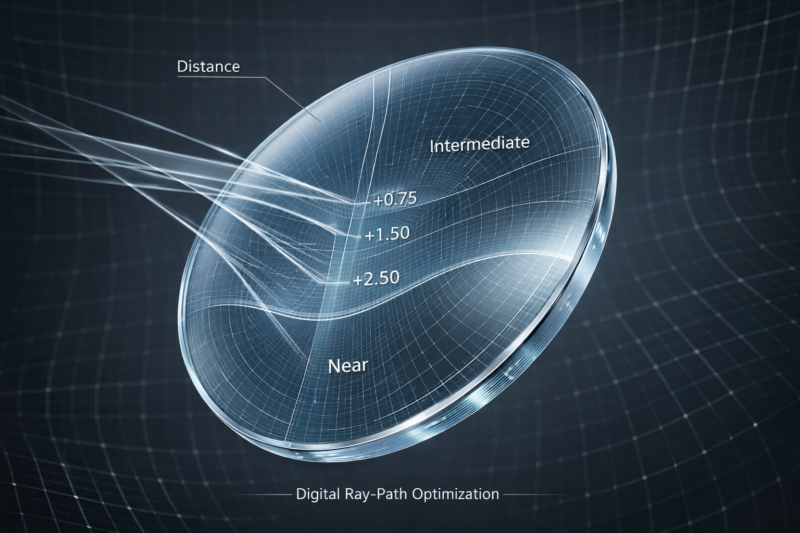
For practices that work with IOT designs, it’s also helpful to understand how IOT digital ray-path lenses are optimized for real wearing conditions. That terminology resonates with optical professionals because it relates directly to how the optics are calculated and delivered in a personalized design.
How MIA LAB fits into this
Progressive lens troubleshooting gets easier when you have a lab partner that actually supports you in real time.
What practices tend to value:
- access to real technical experts (not automated replies)
- fast turnaround so remakes don’t derail your schedule
- consistent quality on digital/freeform work
- clear progressive options so you can match design behavior to patient sensitivity
If you want to review progressive options or choose a design path for a tricky case, there is a start point.
And if you’ve got a situation you want help with, this is the fastest way to reach the technical team.
Quick FAQ
How progressive lenses work
Progressives provide a continuous power shift from distance to intermediate to near. Adaptation depends heavily on correct fitting, accurate measurements, and matching design behavior to lifestyle.
What causes swim effect in progressive lenses?
Common causes include frame fit, fitting height errors, corridor mismatch, frame parameters (tilt/wrap), or a design that doesn’t match the patient’s sensitivity profile.
Are digital freeform lenses worth it?
For patients who are demanding, sensitive to distortions, or spend a lot of time in intermediate vision tasks, freeform personalization often improves comfort and reduces complaints.
How accurate do measurements need to be for digital freeform progressive lenses?
Very. Freeform progressives tend to be less forgiving, which is why consistency and verified measurement technique matter.
When should I remake a progressive?
If fit and verification are correct, adaptation time has been reasonable, and symptoms persist, a remake using a different design priority can be the most practical solution.
If you’ve got a tricky progressive case, you don’t have to guess
Most progressive problems aren’t “mysteries.” They’re usually the result of small mismatches in design, fit, measurement, or expectations.
If you’ve got a tough case or a patient who “doesn’t like progressives,” don’t default to giving up. In many situations, the right adjustments and a smarter design choice solve it.
Have more questions? Contact our technical support team or drop us a question on social media. We’re here to help you deliver the best eyewear outcomes for your patients, one of the perks of partnering with MIA LAB.


