Lens Design Personalization: How Vertex, Pantoscopic Tilt, and Wrap Optimize Freeform Lenses

Most non-adaptations to premium freeform lenses aren’t design failures. They’re a failure of lens design personalization: the as-worn measurements the lab never received, so the lens was optimized for an average face instead of the patient in the chair.
That gap is invisible on a lensometer and invisible at pickup. It shows up three days later, when a patient with a perfectly verified prescription reports that the periphery swims, near vision feels narrow, or distance is sharp only when they tilt their head a specific way. The prescription is right. The as-worn optics are not.
What Lens Design Personalization Actually Requires
A refraction is measured at the phoropter, where the lens plane sits roughly perpendicular to the visual axis at a fixed distance from the eye. A finished pair of glasses almost never reproduces those conditions. The frame tilts, sits closer or farther from the cornea, and wraps around the face. Every one of those differences changes the power the eye actually receives.
The industry term for this set of measurements is position of wear (POW): how the lens sits in front of this patient’s eye in this frame. Digital freeform lenses are surfaced point by point on a computer-controlled generator, so the design can be calculated to deliver the intended refraction through the exact geometry the patient will wear, but only if that geometry is supplied. Without it, the calculation falls back on population averages: a pantoscopic tilt near 9°, a vertex around 13 to 14 mm, minimal wrap. Those defaults are fine for a low prescription in a conventional frame. They quietly sabotage a high prescription in a wrapped frame.
This is the practical difference between a freeform lens and a personalized one. The design is the same; the personalization is not.
The Three Parameters That Change As-Worn Power
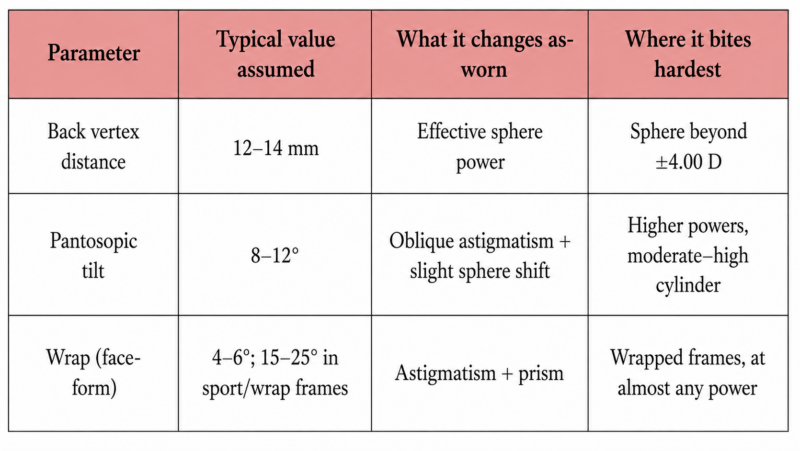
Three measurements do most of the work. The table is the quick reference; the sections below explain the mechanism behind each.
Back Vertex Distance
Back vertex distance is the gap between the back surface of the lens and the front of the cornea. Effective power depends on it. Move a lens closer to or farther from the eye and the power reaching the retina shifts: negligibly in low prescriptions, meaningfully past roughly ±4.00 D, and dramatically in strong prescriptions.
A −8.00 D myope fit 4 mm farther from the eye than the refraction assumed effectively gains about a quarter to a third of a diopter of minus power at the eye. That is enough to push a patient from comfortable to over-minused, with the eye strain and reluctant adaptation that follow. Personalization corrects for it by adjusting the surfaced power so the as-worn power matches the refraction, but the lab has to know the real vertex to do the math.
Pantoscopic Tilt
Pantoscopic tilt is the vertical rotation of the lens plane, with the bottom of the lens sitting closer to the face than the top. Most frames sit at 8 to 12°. The problem is optical: when a lens tilts relative to the visual axis, it introduces oblique astigmatism and a small sphere shift the patient never asked for. The induced error grows with the square of the tilt angle and scales with lens power, so it stays trivial in a +1.00 reader and becomes clinically real in a −6.00 or a moderate-to-high cylinder.
The traditional bench workaround is the rule of thumb to drop the optical center about 1 mm for every 2° of pantoscopic tilt, aligning the optical axis with the down-and-forward line of sight. That rule is a blunt instrument. It addresses one point on the lens and ignores the rest of the surface. A digital freeform progressive lens does the full calculation across the entire surface, but again, only against the tilt value it’s given. A guessed tilt produces a confidently wrong correction.
Wrap (Face-Form Angle)
Wrap, or face-form angle, is the horizontal curve of the frame around the face. Conventional frames wrap 4 to 6°. Sport and fashion-wrap frames reach 15 to 25°. Horizontal wrap induces astigmatism and prismatic error the same way tilt does vertically, and because wrap angles run larger than pantoscopic angles, the induced errors in a high-wrap frame can dwarf everything else on the order.
This is why an ordinary single-vision Rx dropped into a wrapped frame so often fails: the patient’s own eye doctor prescribed it correctly, the lab surfaced it correctly to the written numbers, and the wrap turned it into the wrong lens at the eye. Compensating for wrap is not a premium upsell in these frames. It’s the difference between a usable pair and a remake. It ties directly into the material and base-curve decisions that govern how prescription lenses are made for demanding frame shapes.
Compensated Power: Why the Lensometer “Disagrees” With the Rx
When these parameters are applied, the lab surfaces compensated power: values deliberately different from the written prescription so that the as-worn power equals the refraction. The same script ordered in a steep wrap comes back with numbers that look wrong on paper and read correctly at the eye:
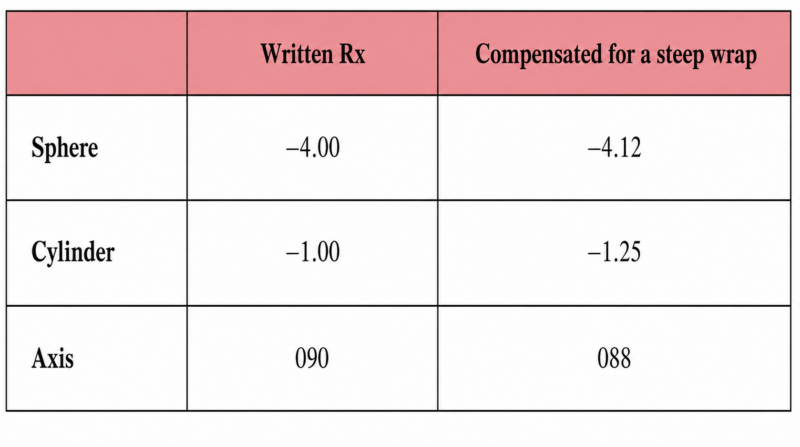
That is not an error. That is the personalization doing its job.
The operational consequence is that a compensated lens read flat on a lensometer will not match the doctor’s Rx, and a verification tech who doesn’t expect that will flag a correct lens as wrong and trigger an unnecessary remake. Any practice ordering personalized freeform needs its verification protocol to account for compensated values, whether that means reading the lab’s compensated ticket or checking against the as-worn target rather than the written script. It’s the same discipline that drives reducing optical remakes and non-adaptations: the failure isn’t in the glass, it’s in expecting compensated optics to behave like uncompensated optics.
Where Lens Design Personalization Pays Off and Where It Doesn’t
Personalization is not equally valuable on every job, and treating it as universal wastes chair time. The variables that decide how much it matters are prescription power, cylinder magnitude, and frame geometry.
The jobs below earn it and should be measured every time. A high myope in a sport wrap is the textbook case, with every parameter in play at once; a premium custom progressive lens for a patient who notices the last quarter diopter is the everyday one.
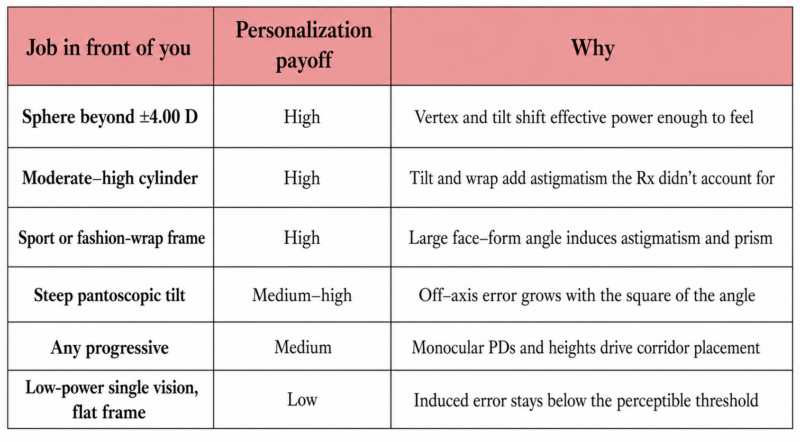
It matters least in low-power single vision in a flat, conventional frame, where the induced errors stay below what the patient can perceive. Even there, capturing accurate monocular PDs and fitting heights still improves a progressive, because corridor placement is a personalization question even when power compensation isn’t. The point isn’t to measure everything on every job; it’s to know which jobs punish a missing measurement and never let those go out on defaults. If you want the mechanics of the corridor itself, how progressive lenses work covers the design side that these measurements feed.
Building Personalization Into the Dispensing Workflow
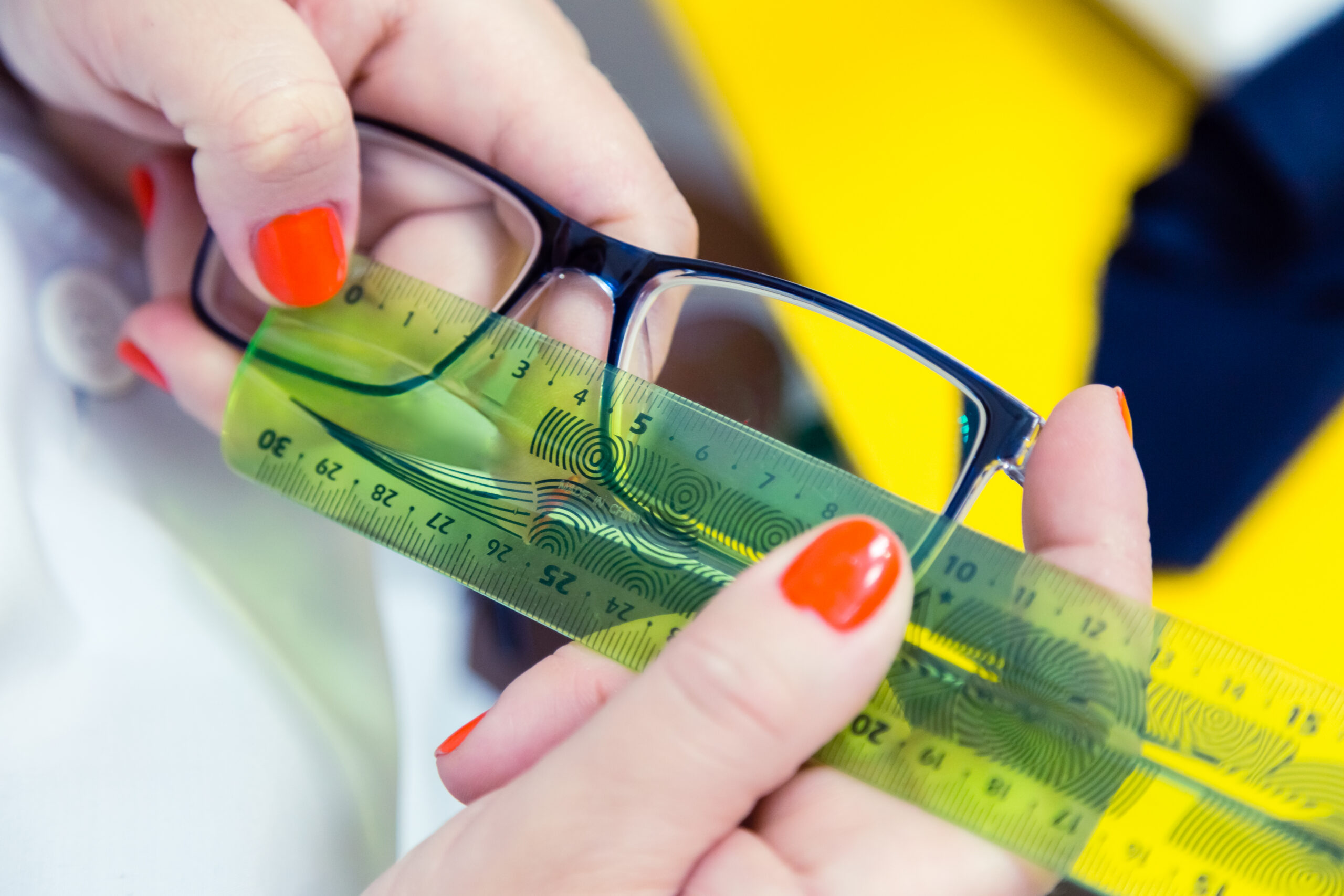
The measurements themselves are straightforward; the consistency is the hard part. Monocular PDs and fitting heights taken on the actual chosen frame, an honest vertex reading rather than a habitual “14,” and real pantoscopic and wrap values are all that personalization needs. A ruler, a pupillometer, and a careful optician can capture them. Tablet-based dispensing systems capture the same set faster and, more importantly, more repeatably, removing the operator-to-operator drift that makes a design perform beautifully for one staff member and inconsistently for another.
Whatever the tool, two habits separate practices that get clean adaptations from those that don’t. First, measure on the frame the patient is actually buying, not a default or a similar shape, because vertex and tilt change with every frame. Second, transmit the values on the order rather than leaving the field blank and letting the lab assume an average. A design running the IOT Digital Ray-Path 2 engine behind the Remedy line can only personalize to the numbers it receives; a blank position-of-wear field is an instruction to use the population default, not a request to optimize.
This is also a fair question to ask any lab partner directly: does the ordering path accept full position-of-wear data, and does the design actually consume it? The answer separates a lab that finishes lenses from one that personalizes them. That’s a reasonable thing to confirm when you’re evaluating the best optical lab for optometrists for your premium progressive patients. Practices weighing that decision can open an account and route a few complex jobs through as a real-world test.
The Bottom Line
A freeform lens is a promise that the design can be calculated for the individual. Lens design personalization is how that promise is kept, and the as-worn measurements are what the individual actually is. Skip them and you’ve bought a custom engine and fed it an average: a lens that verifies perfectly and still gets returned. Send them and the same design earns the adaptation rate that justified the premium in the first place. The technology was never the hard part. The three numbers were.
Frequently Asked Questions
- What measurements does lens design personalization actually use?
The core three that alter as-worn power are back vertex distance, pantoscopic tilt, and wrap (face-form) angle. Monocular PDs and fitting heights are also essential for placing the corridor and optical centers correctly, and some designs additionally optimize for the patient’s habitual near working distance.
- At what prescription does personalization start to matter?
The induced errors scale with lens power and with the square of the tilt or wrap angle, so they stay imperceptible in low prescriptions and become clinically meaningful roughly past ±4.00 D of sphere, at moderate-to-high cylinder, or in any frame with significant wrap regardless of power.
- Why does a compensated lens read differently from the written prescription on a lensometer?
Because the lab intentionally surfaces power that differs from the script so that the power at the eye, through the actual tilt, vertex, and wrap, equals the refraction. Reading it flat on a lensometer shows the compensated value, not the written Rx. That is correct, and why verification protocols must expect it.
- Can I still personalize custom ophthalmic lenses with only a manual ruler and pupillometer?
Yes. Accurate monocular PDs, fitting heights measured on the chosen frame, and honest vertex, tilt, and wrap readings are all the design needs. Digital dispensing systems mainly improve speed and repeatability between staff members; they don’t unlock anything a careful manual measurement can’t capture.
- Does wrap really change a simple single-vision prescription?
Yes, often more than pantoscopic tilt does, because wrap angles in sport and fashion frames run much larger. A correctly written single-vision Rx surfaced to the written numbers can fail in a high-wrap frame purely because the wrap-induced astigmatism was never compensated.
- What happens if I leave the position-of-wear fields blank on an order?
The lab applies population-average defaults, typically around 9° pantoscopic tilt, a mid-teens vertex, and minimal wrap. On a low prescription in a conventional frame that’s usually fine; on a high or highly astigmatic prescription, or a wrapped frame, it produces a lens optimized for a face that isn’t your patient’s.
- Is personalization worth it for every progressive patient?
Not equally. It’s non-negotiable for high prescriptions, strong cylinders, wrapped frames, and demanding premium wearers. For low-power patients in flat frames the power benefit is marginal, though capturing accurate monocular PDs and heights still improves corridor placement on any progressive.