
Camber Progressive Lens Technology Explained: How a Variable Base Curve Changes Adaptation


Camber progressive lens technology solves a problem most practices misdiagnose. A patient complains about a narrow reading area or peripheral blur, and the usual fix is to adjust the corridor. Often, though, the corridor isn’t the cause. A progressive built on a single, fixed base curve fights basic lens optics before the corridor design even enters the picture. No corridor adjustment repairs a base curve that’s wrong for the periphery.
The Base Curve Compromise Every Standard Progressive Makes
Every lens has a base curve, the front-surface curvature the design is built on. For any given power, one base curve minimizes oblique astigmatism at the periphery. Opticians call this the Tscherning ellipse: the curve that produces the least peripheral distortion at each power. A single-vision lens sits close to that ideal curve, because it only has one power to satisfy.
A progressive lens isn’t one power, though. It runs from distance through intermediate to near, and each zone has its own ideal base curve. A conventional progressive blank uses one base curve for the entire lens, usually optimized for distance. As a result, the near and intermediate zones inherit whatever peripheral astigmatism that compromise produces.
In low adds, this gap stays negligible. In moderate-to-high adds, or a stronger distance prescription, it widens, and practices already recognize the result: a “small” reading area, peripheral swim, or a near zone that feels narrower than the corridor length suggests.
How Camber Progressive Lens Technology Works
Camber progressive lens technology addresses this compromise directly. Instead of asking one base curve to serve the whole lens, the design lets the curve change by zone. Camber sits at the top of MIA LAB’s Remedy line, above Remedy Plus (a high-value, non-personalized design) and Remedy Max (which widens the near and intermediate zones but keeps a single base curve). In Camber, the base curve itself becomes part of the design.
The Camber Lens Blank
The front surface of a Camber blank uses a progressively increasing base curve, not one uniform curve. MIA LAB pairs it with a fully digital freeform back surface, so the lens carries complex curvature on both sides instead of one curved side doing all the work. Each zone sits closer to its own optically favorable curve, rather than sharing a curve borrowed from the distance power. This is a physical property of the blank itself, built in before any calculation runs.
Camber Rx Design
A variable blank only helps if the surfacing calculation uses it correctly. Camber Rx Design runs on IOT Digital Ray-Path 2 together with Steady Plus Methodology, and it calculates peripheral aberration and spherical error zone by zone. That’s exactly where a fixed base curve accumulates unwanted cylinder. Without this calculation layer, the blank’s geometry advantage never reaches the finished lens.
Personalization Parameters
Vertex distance, pantoscopic tilt, frame wrap, and usage preferences apply on top of the variable-curve blank, the same as any digital freeform order. The blank’s base-curve advantage stays fixed regardless of these inputs. Personalization determines how much of that advantage reaches the finished lens.
What This Looks Like at the Chair
MIA LAB tested camber progressive lenses in a controlled, within-subject comparison. Wearers tried the same progressive design for one week with Camber and one week without, while material, base-curve family, and frame stayed identical. Every wearer found the near zone easier to locate. Most rated near vision as equal to or better than their prior progressive, and most reported easier adaptation than expected. Because Mialab hasn’t published the sample size or test date, treat this as internal wearer-preference data, not a peer-reviewed trial, when discussing it with patients.
There’s also a secondary benefit that has nothing to do with adaptation directly. Since no zone is forced onto a steep compromise curve, the finished lens can often sit flatter without losing near-zone quality. In higher adds and higher-plus prescriptions, that’s a cosmetic win, since a standard progressive would otherwise bulge.
Where Camber Earns Its Place
Base curve compromise scales with add power and with how far the distance prescription sits from its naturally ideal curve. That means the advantage isn’t uniform across every job.
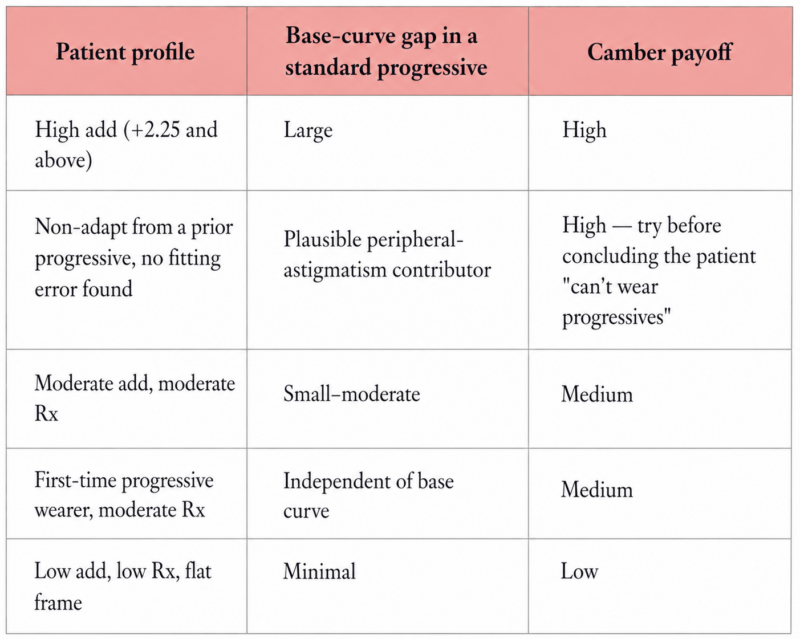
The clearest case is a patient who already failed a standard progressive with correct PDs, heights, and frame, and still complains about a small reading area or peripheral blur. That symptom pattern is the fixed-base-curve signature at moderate-to-high adds. For the corridor side of this diagnosis, see how progressive lenses work. Corridor and base curve are separate levers, and a non-adapt can trace back to either one.
Ordering Camber Progressive Lens Technology
Camber is still a digital freeform order, so the calculation is only as good as the data submitted. Default position-of-wear values won’t break the lens, but they do cap the benefit: the blank’s advantage is fixed, while the personalization layer on top isn’t.
The order-desk checklist is short. First, confirm accurate monocular PDs and fitting heights on the actual frame. Second, submit real vertex and pantoscopic tilt instead of defaults whenever base-curve compromise is likely to matter. Third, flag non-adapt cases explicitly, so the lab treats the order as a targeted retry rather than a routine reorder.
If a patient still doesn’t adapt, that’s a warranty conversation, not a write-off. MIA LAB’s no-questions-asked warranty on digital lenses covers the remake, the same as it would for any Remedy design. Practices testing whether Camber solves a recurring non-adapt pattern can open an account and run a comparison case against their current design.
Talking to the Patient About Camber
Camber progressive lenses sit above Remedy Plus and Remedy Max, so this is a second-pair or premium-upgrade conversation as much as a technical one. The mechanism gives staff a specific line instead of “new and improved”: this lens is built with a curve that changes across the lens instead of staying fixed, so the near area should feel larger and the edges cleaner. For a non-adapt patient, that specific claim is the difference between re-selling an idea that already failed and offering something structurally different.
The Bottom Line
A progressive complaint that looks like a corridor problem is sometimes a base-curve problem instead. Standard fixes (refine the corridor, adjust the add, try another brand) leave the base curve untouched. Varying the curve by zone is the more direct fix, and it shows up in the numbers practices already track: near-zone width, peripheral clarity, and second-visit remakes.
Frequently Asked Questions
- What is Camber progressive lens technology?
It’s a front-surface base curve that increases progressively by zone, instead of one fixed curve. MIA LAB calculates the design with Digital Ray-Path 2 and personalizes it to the wearer’s position-of-wear data, so each zone sits closer to its own optically ideal curve.
- How are Camber progressive lenses different from a standard freeform progressive?
Both use digital, point-by-point surfacing. The blank is what differs: a standard progressive uses one base curve for the whole lens, while Camber’s blank already varies base curve by zone before the freeform calculation runs.
- Does the variable base curve change how the lens is edged or fit into a frame?
No. Edging, mounting, and frame compatibility stay the same. The variation lives inside the optical design, not the physical fitting process.
- Which patients benefit most from Camber technology?
Patients with moderate-to-high adds, stronger distance prescriptions, or a documented non-adapt history despite correct fitting measurements see the largest difference, because the base-curve compromise scales with add power and Rx strength.
- What does the double-blind wearer study show?
Wearers compared the same design for one week each, with Camber and without, while material and frame stayed identical. The near zone was easier to find, near vision was rated equal or better, and adaptation was easier than expected. MIA LAB hasn’t published the sample size or date, so cite it as internal wearer-preference data, not a clinical trial.
- What happens if a patient still doesn’t adapt to Camber?
MIA LAB’s no-questions-asked digital-lens warranty covers the remake. Flag it as a non-adapt retry on the reorder, so the lab rechecks measurements with that history in mind.
- Where does Camber sit in the Remedy line?
At the top, above Remedy Plus (non-personalized) and Remedy Max (wider near/intermediate zones, standard base curve). That positions it as the natural upgrade or second-pair recommendation.
- Do I need different measurements to order Camber progressive lenses?
The requirements match any custom digital freeform order: monocular PDs, fitting heights, vertex, pantoscopic tilt, and wrap. The base-curve advantage is built into the blank regardless, but accurate data determines how much of it reaches the finished lens.
- Is Camber technology proprietary to MIA LAB?
Variable base curve is a known design approach in premium freeform. Camber is MIA LAB’s own implementation, built on its IOT Digital Ray-Path 2 and Steady Plus Methodology calculation stack.


