
Digital Single Vision Lenses: Turning Your Highest-Volume Job Into a Premium Tier

Digital single vision lenses are the premium tier hiding in your highest-volume job. Single vision is the lens most practices sell most often. It is also the one they upgrade least. The progressive patient hears a tiered menu, a coating pitch, and a second-pair talk. The single-vision patient hears a price. That habit forfeits your most frequent chance to trade up. It also shortchanges the patient who would gain the most: the twenty-to-forty-year-old who lives on screens.
That patient is not shopping for the cheapest lens. They came in because their eyes feel tired by mid-afternoon. They will pay for something that helps. Most practices never put that option on the menu.
Why Practices Skip the Single-Vision Upsell
Single vision carries a commodity anchor that progressives never had. Staff and patients both read a progressive as a technical product with tiers. They read single vision as the baseline. It is the lens you quote when there is nothing to explain. Online retail has hardened that anchor for a decade. It trains patients to price-compare a “single vision lens” as if every one were identical.
The result is a scripting gap. Most staff run a fluent premium-progressive conversation. Almost none run a premium single-vision one. So the young myope who spends nine hours a day on screens gets a stock lens and a total. Nobody signals that a better lens exists. The patient is not refusing the upgrade. They were never offered one.
What Digital Single Vision Lenses Actually Change
A conventional single-vision lens carries one fixed surface. It delivers the exact power at a single point: the optical center, viewed straight ahead. The eye does not stay there. As it rotates toward the edge of the lens, the light path lengthens and meets the surface at an angle. The power drifts. That off-axis error reads as oblique astigmatism and mean power error. It grows with the prescription and with distance from center.
A digital lens attacks that drift head-on. Instead of one fixed curve, the generator calculates the back surface point by point. It cuts the curve in fine increments. So the lens holds the prescribed power across a much wider zone, not just at the center. This is the same free-form platform that builds modern progressives, applied to a single-vision Rx. MIA LAB’s explainer on how free-form lenses are made walks through the process.
Position of Wear: What Stock Single Vision Lenses Ignore
Digital surfacing adds something a stock lens cannot: position-of-wear compensation. The lens accounts for how it sits on the face. That means vertex distance, pantoscopic tilt, and the frame’s wrap angle. In a flat frame with a low Rx, the adjustment is small. Modern frames wrap more and sit on steeper base curves. There, an uncompensated Rx pushes unwanted cylinder and power shift in front of the eye. The patient calls it a lens that never felt quite right. The IOT Digital Ray-Path 2 platform handles this on the back surface. It applies to single vision as much as to progressives.
Who Benefits From Digital Single Vision Lenses, and Who Won’t
Not every patient needs digital single vision lenses. Pretending otherwise erodes the trust the upgrade depends on. The gain scales with three variables. Match the recommendation to them.
The Three Variables That Decide It
The first is prescription strength. At low powers, off-axis error stays small. A near-plano emmetrope in a flat frame will not notice a difference. Past roughly two to three diopters, the peripheral drift becomes visible. There the digital lens earns its price.
The second is cylinder. Astigmatism is where atoric digital surfacing pulls ahead of a stock toric. The correction has to hold across two meridians as the eye roves. A patient with a real cylinder is a strong candidate at almost any sphere.
The third is the frame. A wrapped sport or fashion front induces the exact off-axis and tilt errors that position-of-wear compensation removes. Frame choice alone can move a borderline patient into the digital tier. Material matters too, and MIA LAB’s lens material comparison lays out the trade-offs.
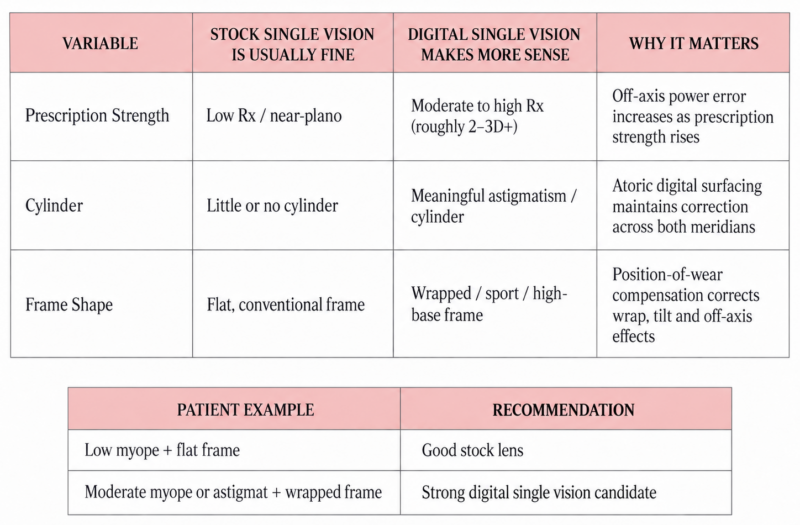
Put simply: a low myope in a flat frame is fine with a good stock lens. A moderate myope or astigmat in a wrapped frame is the patient you underserve today.
Digital Single Vision and Screen Strain, Positioned Honestly
The screen-heavy young patient is why this conversation pays off. Still, name the symptom correctly. Most of their end-of-day fatigue comes from accommodative and binocular effort at near, not from a distance error. A digital single-vision lens does not treat accommodation. It delivers the distance Rx they already need with less peripheral compromise. That removes one source of visual work across the day.
For near-dominant symptoms, offer a different tool. An accommodative-support single-vision design adds a small plus in the lower periphery. It eases the focusing demand at screen distance. Present it as its own choice, not as a vague “better for screens” claim. Overpromising, especially on blue light, turns a premium pick into a patient who doubts your judgment. Under-describe, and let the lens perform.
Building a Two-Tier Single-Vision Menu
The fix is structural, not persuasive. Give single vision the tiered menu progressives already have. Then the premium option exists by default. It no longer rides on whether a staff member remembers to mention it.
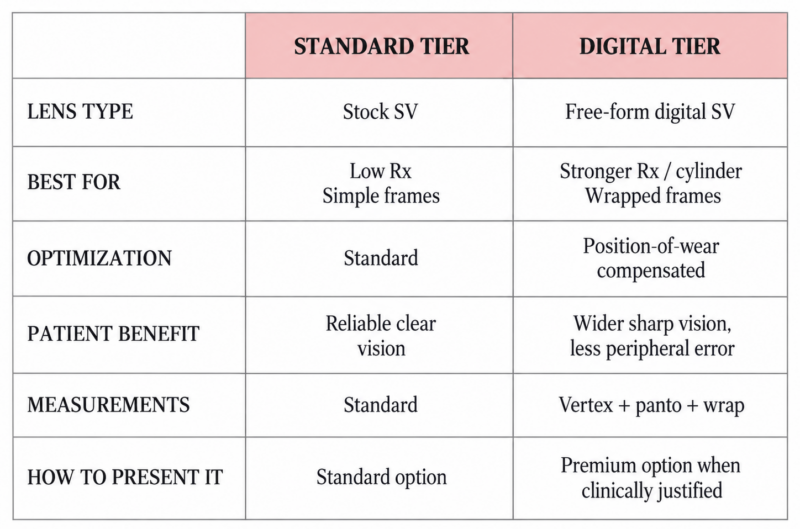
Two tiers work well. The standard tier is a quality stock lens in the right material with a good AR coating. It fits low prescriptions in simple frames. The digital tier is a free-form, position-of-wear-compensated single-vision lens. Recommend it by the three variables above, and price it accordingly. The whole range can sit on one page for the patient, the way MIA LAB organizes its digital lens menu.
The counter line is one sentence, tied to the patient’s own words. When someone mentions screen fatigue or a strong Rx, say it plainly: “For your screen time and your prescription, one lens keeps sharp focus across the whole surface, not just the center. It is worth the difference for you.” That sentence does the work. It names the benefit, ties it to the person, and states a value they can accept or decline.
Ordering matters as much as recommending. The digital tier only pays off when the lab gets the frame measurements and the position-of-wear data. A lab that surfaces, coats, and finishes under one roof keeps that spec intact from order to edge. That is the point of a full-service lens partner, not a job split across vendors. Practices adding a digital single-vision tier can open an account or talk the menu through with the lab before rolling it out at the chair.
The Takeaway
The premium tier most practices miss is not a new product line. It hides in the job they run more than any other. Single vision is not a lens to apologize for. For the right prescription, the right frame, and the patient who lives on a screen, digital single vision lenses are the easiest honest upgrade in the dispensary.
Frequently Asked Questions
- What are digital single vision lenses?
Digital single vision lenses are single-focus lenses. A generator calculates and cuts the back surface point by point, instead of grinding one fixed curve. The prescribed power then holds across a wide zone of the lens as the eye rotates, not only at the optical center. The same free-form surfacing can also match how the lens sits on the face.
- How do they differ from a standard single vision lens?
A standard lens optimizes one point and drifts off-axis. That drift adds oblique astigmatism and power error in the periphery, and it grows with the prescription. A digital lens corrects the drift across the surface. It can also account for vertex distance, pantoscopic tilt, and wrap angle. The wearer gets a wider zone of sharp, comfortable vision, clearest in strong prescriptions and wrapped frames.
- Which patients benefit enough to justify the upgrade?
Benefit scales with prescription strength, cylinder, and frame wrap. A low Rx in a flat frame shows little difference. A moderate or high Rx, a real cylinder, or a wrapped high-base frame are the clear candidates. Matching the recommendation to those variables keeps the upsell honest.
- Do digital single vision lenses fix screen fatigue?
Not directly. Most screen fatigue in younger patients comes from accommodative and binocular effort at near, not from a distance error. A digital lens delivers the distance prescription with less peripheral compromise, which cuts one source of strain. For near-dominant symptoms, an accommodative-support design that adds a small plus in the lower periphery fits better.
- Can single vision be personalized to position of wear like a progressive?
Yes. Position-of-wear compensation belongs to digital surfacing, not to the progressive design. It applies to single vision too. When the lab gets the frame measurements and fitting data, it optimizes the lens for vertex, tilt, and wrap. Those gains show up most in modern wrapped frames.
- How should we present a digital single vision option at the counter?
Give single vision a two-tier menu, so the premium option exists by default. Offer a standard stock lens for low prescriptions in simple frames, and a digital, position-of-wear-compensated lens for the candidates above. Introduce it in one sentence tied to the patient’s Rx and screen use, state the value, and let them decide.
- What does the lab need to make the lens correctly?
The prescription plus the position-of-wear data: frame measurements, vertex distance, pantoscopic tilt, and wrap angle. Without it, the lab can still surface the lens digitally, but the position-of-wear benefit disappears. A lab that surfaces, coats, and finishes in-house keeps the full spec intact through the whole job.


