Custom Progressive Lenses, Reimagined: Inside Unity’s V3 Elite Design

Unity has released its most data-driven custom progressive lenses yet. The Unity V3 Elite design is built around an AI algorithm trained on more than eight million anonymized prescriptions and half a million de-identified data points, a scale of clinical data most custom progressive lenses on the market simply aren’t built on.
What makes V3 Elite different isn’t just the size of the dataset. It’s what the algorithm does with it. Rather than applying a fixed corridor design across every prescription, the system factors in gaze dynamics data, how eyes actually move between near, intermediate, and far zones, to shape the lens around real visual behavior instead of population averages.
This puts Unity V3 Elite in the same conversation as the most advanced digital freeform progressive lenses ECPs can offer today, such as IOT Digital Ray-Path 2 and Essilor’s Varilux Physio Extensée with W.A.V.E. 2 Technology. Each solves the personalization problem from a different angle. IOT Digital Ray-Path 2 traces how light actually travels through the finished lens, correcting the design point by point for the wearer’s prescription, frame position, and line of sight. Essilor’s W.A.V.E. 2 Technology works at the level of the wavefront, identifying and smoothing the higher-order aberrations that blur vision as pupil size changes, sharpening the image without asking for extra measurements. Both are genuine advances over fixed-corridor designs, and both start from the optics of the lens itself.
For ECPs, that distinction matters. A lens design informed by eight million prescriptions has seen edge cases most labs never encounter in a single practice’s patient base, high adds, unusual pantoscopic tilts, atypical near-zone demands. That’s a meaningfully different starting point than a design refined in a lab, then rolled out to the field.

How Progressive Lenses Work, and Where Standard Designs Fall Short
Understanding how progressive lenses work explains most of the complaints ECPs hear at chairside. Most trace back to the same structural compromise: a standard corridor design has to balance three visual zones, distance, intermediate, and near, using a fixed geometry that doesn’t change based on how a given patient actually uses their eyes. The result is predictable. Peripheral distortion builds up along the sides of the lens as the surface introduces astigmatic error toward the periphery in exchange for a smooth power progression through the corridor, and patients feel it as swim, blur in their side vision, or a narrower “sweet spot” than they expected.
Adaptation period exists largely because of this compromise. Patients learn, often without realizing it, to move their head instead of their eyes to find the clear zone, a workaround the brain adjusts to, but one that some patients never fully tolerate. For ECPs, that shows up as remakes: patients who come back reporting distortion, a near zone that feels too small, or vision that “isn’t right” in ways that are hard to pin to a single measurement error, because the issue often isn’t a mistake, it’s the limitation of a fixed design applied to a variable population.
This is where the gaze dynamics data described above changes the starting point. A conventional corridor design is built once and then applied uniformly. Shaping that same design around actual scanning behavior, the eye movement involved in tasks like reading, screen use, and distance viewing, shifts where the widest, most stable zones sit on the lens. Instead of asking a patient’s visual system to adapt to the lens, the design starts closer to how that visual system already works.
For independent practices, that distinction has a direct operational read: designs informed by real gaze behavior tend to produce fewer patients who need extended chair time to explain “why it feels different,” and fewer remakes driven by peripheral complaints rather than actual prescription error.

What V3 Elite Changes for You and Your Patients
When you prescribe a progressive lens, you’re making a promise to the patient sitting across from you: that this pair will work better than what they had. V3 Elite is designed to make that promise easier to keep, without changing anything about how you already work.
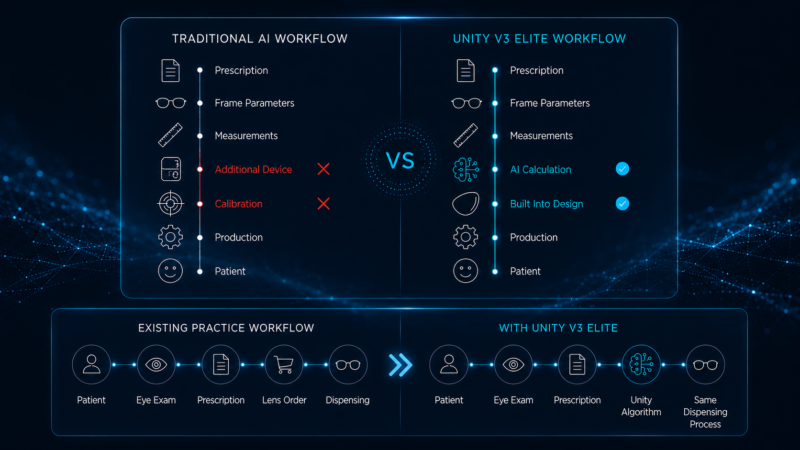
There’s nothing new to buy, install, or learn. No proprietary measurement device, no extra hardware, no additional data-capture step at the point of sale. You take the same measurements you already take for any digital freeform order (frame parameters, pantoscopic tilt, vertex distance, and the prescription), and the algorithm handles the personalization from there. The sophistication lives inside the lens calculation, not in your dispensing routine.
That’s worth pausing on, because most “advanced” lens options ask something of you in return: a new instrument to calibrate, a fitting protocol to train staff on, one more thing that can go wrong on a busy Saturday. V3 Elite doesn’t. The precision is built into the lens before it ever reaches your patient, so you get a more forgiving design without absorbing new risk in your own workflow.
What that buys you is fewer of the conversations no ECP enjoys: the patient back in your chair two weeks later, unhappy, describing distortion you can’t tie to a measurement error. A design built around real gaze behavior means fewer non-adapts, fewer remakes driven by peripheral complaints, and less chair time spent troubleshooting a lens that was technically made to spec but still doesn’t feel right. That’s time and goodwill you keep.
And because there’s no cost of entry on your end, the decision to offer V3 Elite comes down to the only question that should drive it: will it solve your patient’s problem better than what you’re fitting now? For the patients who’ve struggled with progressives before, the answer is often yes, and you’re the one who gets the credit when it works.
What This Means for Dispensing and Lab Workflow
Unity built the V3 Elite algorithm to work within the existing dispensing process rather than adding a step to it. There’s no additional equipment requirement, no proprietary measurement device, and no new hardware investment for the practice or the lab. The sophistication is in the lens design itself, the algorithm does its work before the lens ever reaches the edger, not during dispensing.
That matters more than it might sound like it does. Every additional piece of equipment or measurement protocol introduced at the practice level is a new point where something can go wrong: a missed parameter, a device that isn’t calibrated the same way twice, a step that gets skipped during a busy Saturday clinic. A lens design that delivers more precision without asking the practice to change how it measures or dispenses removes that risk entirely. The precision is built into the lens before it arrives, not layered on top of the existing workflow.
For labs, this also means V3 Elite fits into standard production without requiring new intake data beyond what’s already being collected for any digital freeform order, frame parameters, pantoscopic tilt, vertex distance, and the prescription itself. The gaze dynamics modeling happens inside the algorithm’s calculation, not through a separate data-capture step that ECPs need to learn or troubleshoot.
The practical result is a lower barrier to offering custom progressive lenses at this level of sophistication. A practice doesn’t need to justify new equipment costs or retrain staff on an unfamiliar measurement process to offer V3 Elite to patients, which means the decision to prescribe it comes down to the same question as any other lens choice: does it solve the patient’s problem better than what they’re already fitting.

The Support Behind the Lens You Prescribe
Prescribing a lens is one decision; trusting where it gets made is another. Part of what makes V3 Elite easy to stand behind is the infrastructure Unity has built around it: resources that exist to make your job easier and give you confidence in the work you send out.
Start with quality assurance. The Unity Gold Seal of Excellence, now in its second year, flags the labs that meet Unity’s highest production standards, which means you don’t have to take a quality claim on faith or judge it by turnaround time alone. When you’re placing a demanding Rx, you can point to an outside benchmark rather than a marketing promise, and because Gold Seal status is re-evaluated over time rather than granted once, it tells you where standards hold up today, not years ago. You can check current status yourself on Unity’s Lab Network page before any case goes out.
Then there’s what Unity puts directly in your hands, at no cost:
- University: ongoing education for you and your staff, so keeping current on lens design and dispensing doesn’t mean hunting down training on your own time.
- Patient-ready materials: a customizable sales flyer, data sheet, and job stuffer that do the explaining for you, so you can hand a hesitant patient something clear instead of building the pitch from scratch at the counter.
- A current network list: updated monthly on Unity’s Lab Network page, so you always know your work is going somewhere that’s certified right now, not on a list that’s gone stale.
The point of all of it is leverage for you. It means when a patient asks why this lens costs more, you have real answers. When you send an Rx out, you know it’s landing somewhere held to a standard. And when you want to grow the premium side of your practice, you’re not doing it alone. You can explore the complete toolkit on Unity’s lab resources page.
The Bottom Line
Progressive lens technology keeps advancing in ways that are easy to describe in specs and hard to feel in a fitting chair, until a patient puts on a pair and the adaptation period that used to take two weeks barely registers at all.
That’s the standard V3 Elite is built toward: not custom progressive lenses that perform well on paper, but ones precise enough that the patient stops thinking about them entirely.
Frequently Asked Questions
- How is gaze dynamics data different from a standard progressive lens design?
A standard progressive lens applies a fixed corridor shape based on population averages, regardless of how a specific patient’s eyes move. Unity V3 Elite instead factors in gaze dynamics data, real scanning behavior between near, intermediate, and far zones, so the lens is shaped around how the patient’s visual system actually works, rather than an average.
- Does dispensing Unity V3 Elite require new equipment or measurement tools?
No. Unity built the V3 Elite algorithm to work with standard intake data already collected for digital freeform orders, frame parameters, pantoscopic tilt, vertex distance, and the prescription itself. There’s no additional device, no proprietary measurement protocol, and no new step added to the existing dispensing workflow.
- What is the Unity Gold Seal of Excellence?
The Gold Seal of Excellence is a quality certification Unity awards to labs that meet its highest production and quality-control standards: It’s now in its second year, and Unity re-evaluates and updates the list of Gold Seal labs on an ongoing basis rather than treating it as a one-time designation. Practices can check current Gold Seal status directly through Unity’s Lab Network page.
- How is a progressive lens different from a bifocal?
A bifocal lens has a visible line dividing distance and near vision, with a fixed jump in power at that line and nothing in between. A progressive lens blends distance, intermediate, and near power into one continuous, line-free surface, which is the difference between bifocal and progressive lenses that patients notice most: no visible segment line, but a wider range of usable vision at all distances, provided the design and fit are right for the patient.
- Are progressive lenses for presbyopia a good fit for V3 Elite?
Presbyopic patients are the core audience for any progressive lens, and they’re often the ones most affected by a narrow or unstable near zone, since presbyopia by definition means relying on that zone throughout the day. Because V3 Elite is built to widen and stabilize the near-to-intermediate transition using gaze dynamics data, it’s particularly well suited to presbyopic patients who’ve struggled with standard progressive designs in the past, though final fit still depends on individual measurements and frame parameters.
- Does Unity V3 Elite work with AR coatings or photochromic lenses?
Yes. V3 Elite is a lens design, not a separate product category, so it’s compatible with standard anti-reflective coatings and photochromic treatments in the same way any digital freeform progressive lens would be. The design change happens at the surfacing stage. Coatings and photochromic treatments are applied afterward, independent of the algorithm used to shape the lens.
- How do I find out if a lab is part of the Unity Enabled Lab Network?
Unity maintains a current, monthly-updated list of Unity Enabled Labs and their Gold Seal status on its Lab Network page. Checking this list directly is the most reliable way to confirm a lab’s current standing, since certification status is re-evaluated over time rather than permanent.
- Why do some progressive lens patients need an adaptation period, and can lens design reduce it?
Adaptation period exists because standard progressive designs introduce peripheral distortion as a tradeoff for blending multiple viewing distances into one lens, and patients typically need time to unconsciously adjust head and eye movement to avoid that distortion. Designs that account for a patient’s actual gaze behavior are built to reduce how much distortion the patient encounters in the first place, which can shorten or ease that adjustment period, though individual adaptation still varies.