CamberPure™ Progressive Lenses: Clarity Without Compromise in Every Material

You fit a progressive in polycarbonate or 1.67. The Rx checks out, the heights are right, the frame is adjusted, and the patient still says something feels “not crisp.” Nothing is technically wrong, so the complaint is hard to fix. One cause that standard designs do not address is chromatic aberration, and it is the problem CamberPure™ was built to tackle.
CamberPure™ is a new premium progressive design from IOT (Indizen Optical Technologies) and Younger Optics. It builds on the Camber™ variable base curve that many of our accounts already know, and adds a new technology that reduces chromatic aberration in every lens material. Here is what it is, who it suits, and how to order it from Mialab.
What is CamberPure™?
CamberPure™ is a freeform progressive lens that combines four technologies, as IOT describes them:
- Chromatic Aberration Reduction: “Minimizes color distortion for crisper, more natural vision.” PATENT PENDING: US 19/340,753.
- Variable Base Curve: “Continuously changing front-surface curvature expands near-vision zones and enhances peripheral clarity.” PATENT: US 8042941
- Digital Design: “Personalized lens optimization based on prescription, frame, and position of wear for truly custom performance.” PATENT: US 11609437 B2
- Power Optimization Methodology: “Maintains consistent power across the lens for smoother transitions, faster adaptation, and improved binocular balance.” PATENT: US 10330950
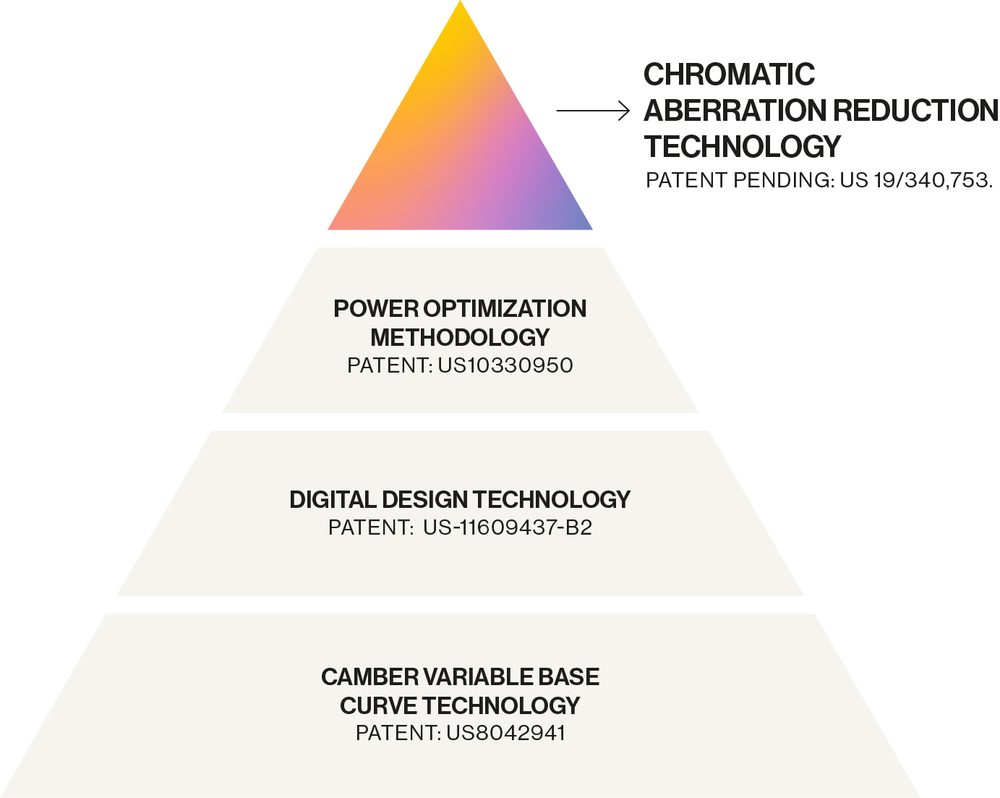
The front of the lens is a Camber™ semi-finished blank with a base curve that steepens from top to bottom. The back is a digital freeform surface calculated for the wearer. If you have read our Camber™ progressive lens technology explainer, the front surface will sound familiar. What is new is how the back surface is calculated.
Chromatic aberration: the problem CamberPure™ targets
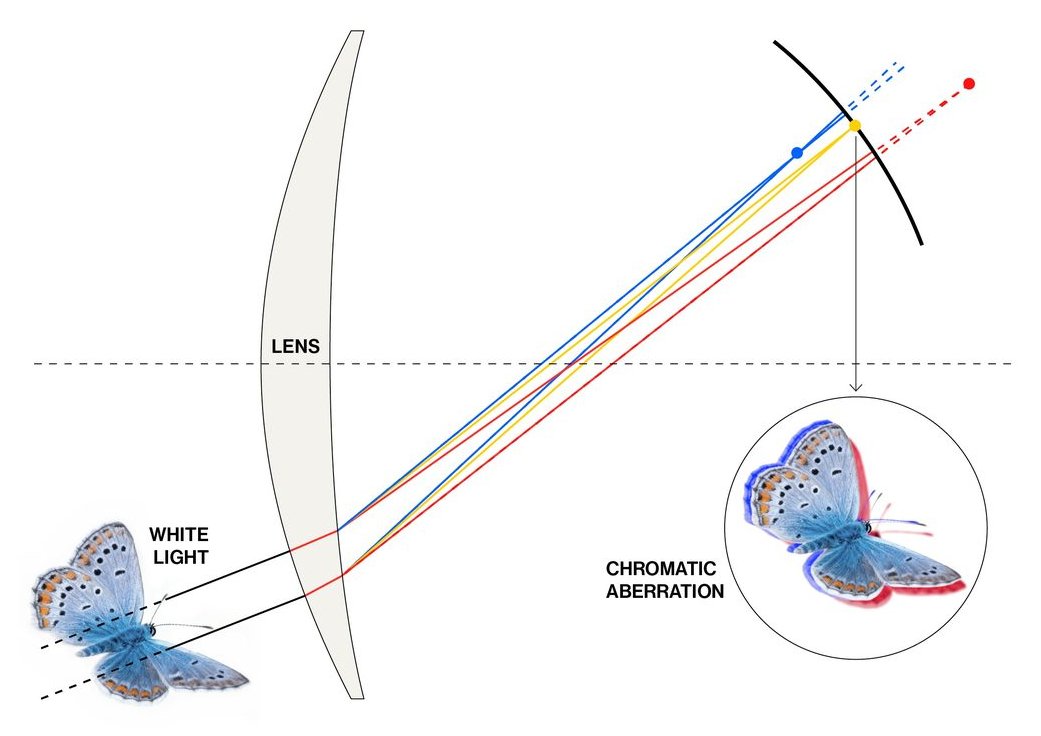
When light passes through a lens, its colors bend at slightly different angles, the same way a prism splits light. The eye cannot focus every color at once, so away from the optical center the wearer can see softer edges, lower contrast, and in stronger cases color fringing. IOT notes that these effects are most noticeable in low Abbe materials, stronger prescriptions and larger frames.
That matters because the materials practices recommend for thin, light, impact-resistant lenses (polycarbonate, 1.67 and 1.74) are the low Abbe ones. Patients rarely describe chromatic aberration by name. They say the lenses feel tiring, or not as sharp as their old pair.
What Abbe value means, in plain terms
Every lens material spreads white light into its colors a little. Abbe value (also called the Abbe number or V-number) tells you how much. The higher the Abbe value, the less the colors separate. The lower the Abbe value, the more color spread a wearer can notice.
Anyone who dispenses knows the trade-off. The materials that make lenses thinner, lighter or more impact resistant tend to have lower Abbe values. On IOT’s chart, hard resin sits at 58, while polycarbonate sits at 30 and 1.67 and 1.74 high-index sit at 33. The full chart is further down this post.
One technical detail is worth knowing. Abbe value is calculated from how a material bends three reference colors: blue light at about 486 nm, yellow at about 588 nm and red at about 656 nm. Keep those three numbers in mind, because they come back below.
Why progressive wearers notice it away from the center
Through the optical center, light passes straight through and the colors stay together. Away from the center, the lens acts like a prism, and a prism is exactly what splits white light into colors. The farther the eye looks from the optical center, and the stronger the prescription, the more prism the wearer looks through. A common rule of thumb in ophthalmic optics puts the color spread at roughly the prism at that point divided by the material’s Abbe value. More prism or a lower Abbe value both mean more color spread.
That lines up with the three risk factors IOT names: low Abbe materials, stronger prescriptions and larger frames. Larger frames put more of the lens far from the optical center. Progressive wearers are especially exposed, because the design asks them to use areas away from the distance optical center all day, looking down through the corridor to read and across the lens toward the periphery.
How CamberPure™ reduces chromatic aberration
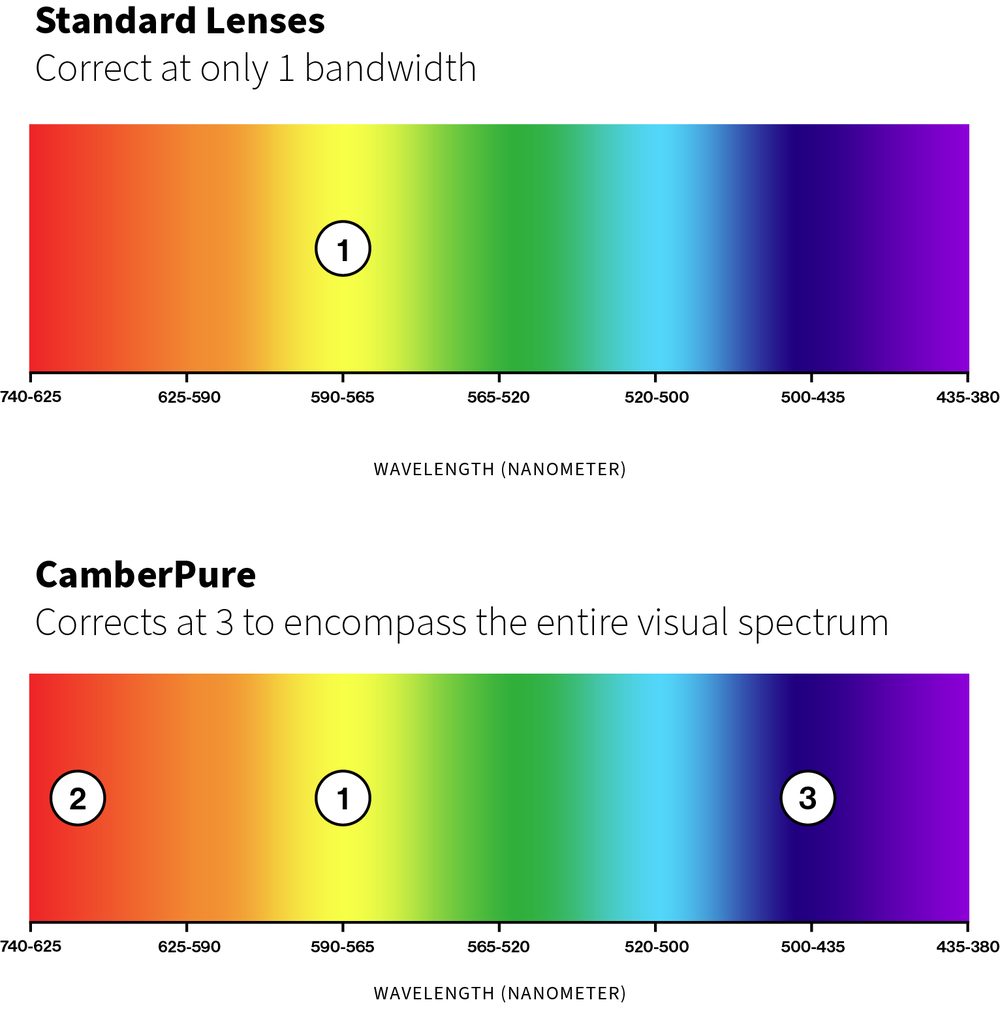
Conventional lens designs are optimized for one standard wavelength of yellow light (587.6 nm). According to IOT, CamberPure™ is optimized point by point for color convergence across the spectrum (656, 588 and 486 nm), bringing red, yellow and blue closer to the same focus. IOT explains that the back surface design reduces oblique aberrations and also reduces prism at the periphery, which IOT describes as equivalent to using a material with a higher effective Abbe value.
Why red, yellow and blue?
The three wavelengths IOT uses (656, 588 and 486 nm) are essentially the same red, yellow and blue reference colors used to calculate a material’s Abbe value. A conventional freeform design is computed for the yellow wavelength only, and the material’s dispersion decides what happens to red and blue. CamberPure™ brings red and blue into the calculation too, point by point across the back surface, so the design itself works against the color spread that the Abbe value describes.
IOT explains the mechanism this way: CamberPure™ “reduces chromatic aberration by altering the lens geometry using free-form technology.” The back surface “not only reduces oblique aberrations away from the optical center,” it “also reduces prism at the periphery.” Because color spread grows with prism, less prism at the periphery means less color spread in the areas where progressive wearers notice it most.
A higher effective Abbe value, in the same material
CamberPure™ does not change the lens material. Polycarbonate is still polycarbonate, with the same Abbe value of 30. What changes is how the finished lens performs. In IOT’s words, “the lower levels of chromatic aberration achieved by CamberPure™ are equivalent to using a material with a higher effective Abbe value.” IOT has published these effective Abbe values by material:
| Lens material | Abbe value | Effective Abbe value with CamberPure™ |
|---|---|---|
| Polycarbonate | 30 | about 41 |
| 1.67 / 1.74 | 33 | about 41 |
| 1.60 | 43 | about 52 |
| Trivex® | 45 | about 56 |
| Hard resin | 58 | about 69 |
IOT’s note on these figures: “The data presented is based on mathematical hypotheses and theoretical models. It is not guaranteed to reflect real-world results and should be used for informational purposes only.”
Here is one way to read it. In CamberPure™, IOT models polycarbonate (Abbe 30) performing like a material with an Abbe value of about 41, close to where 1.60 high-index sits on its own (43). The same holds for 1.67 and 1.74, which move from 33 to about 41 in IOT’s model. Every material on the chart moves up, including hard resin and Trivex®, so the benefit is not limited to high-index.
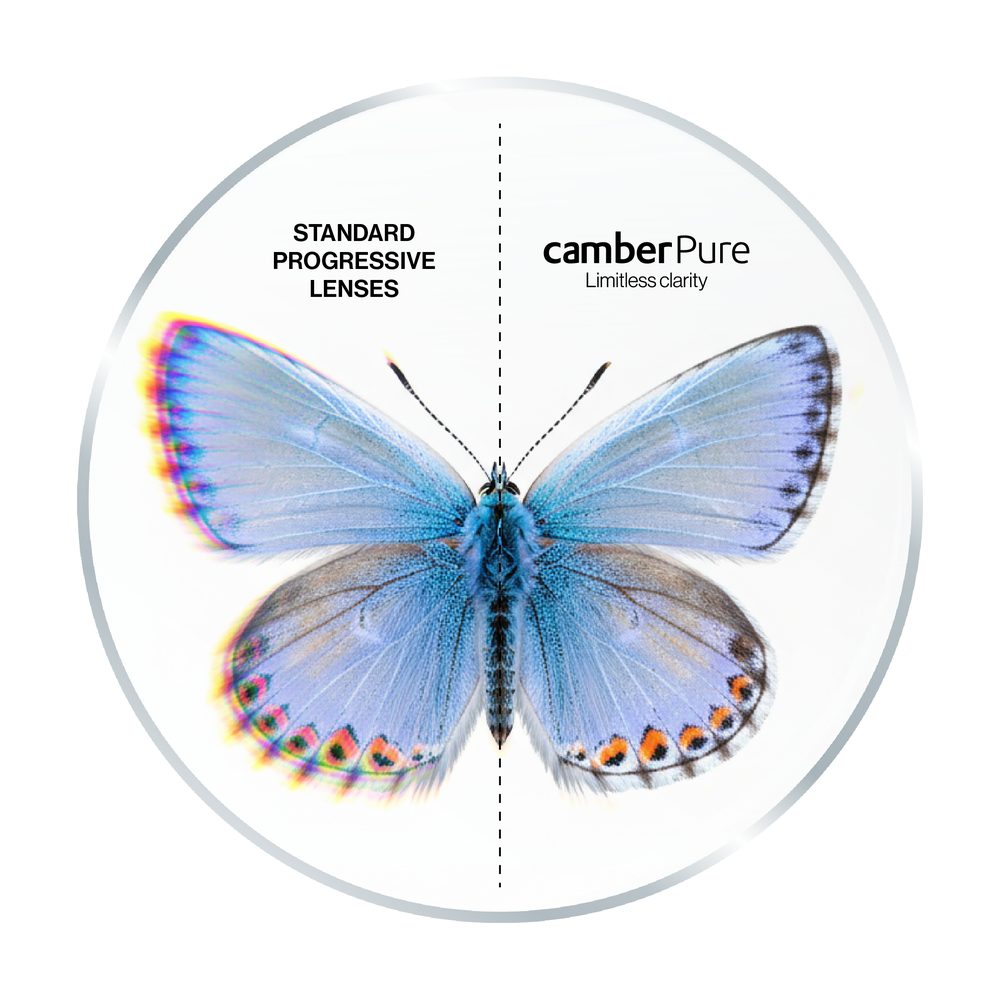
The manufacturer’s materials state a reduction in chromatic aberration of up to 20% across lens materials. In plain terms: the patient keeps the thin, light material you recommended, and the design works to recover clarity that the material would otherwise cost them.
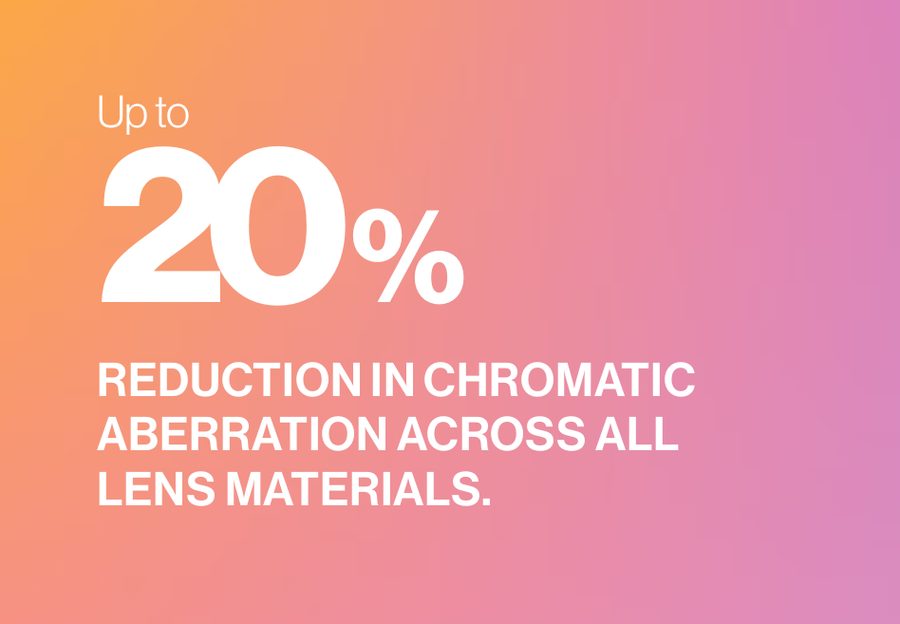
On its CamberPure™ product page, IOT also reports up to 19% reduction in chromatic aberration in 1.67 index lenses and up to 18% in 1.60 index lenses.
Explaining it to patients
Patients do not need the optics lesson. A short version that stays true to IOT’s materials:
- “Thin, light lens materials bend colors slightly differently, and that can make edges look soft, especially toward the sides of the lens.”
- “CamberPure™ is designed for red, yellow and blue light, not just one color, so the colors line up more closely.”
- “You keep the thin, light material, and the lens design works to keep your vision crisp and natural.”
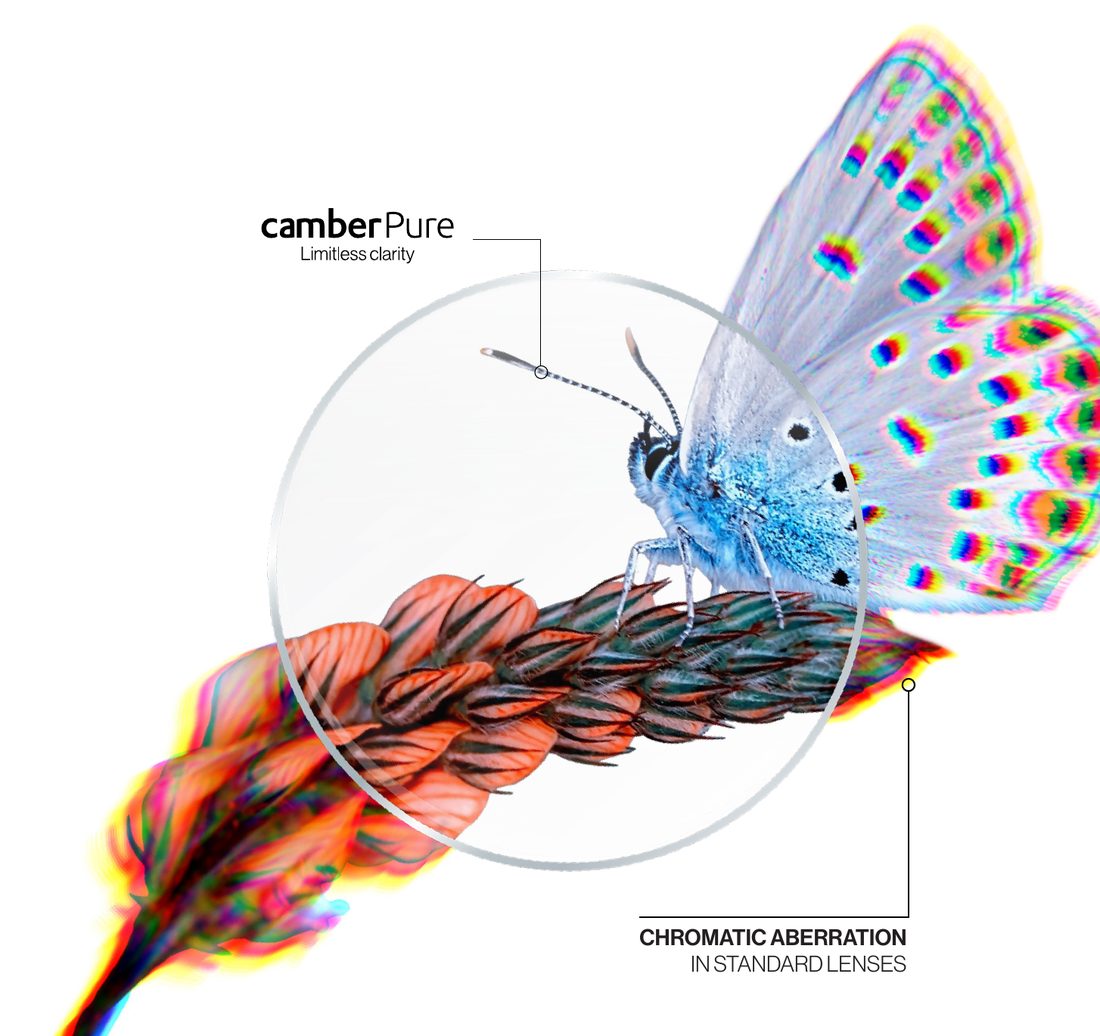
What patients notice
IOT’s patient brochure describes the benefits wearers can expect:
- Sharper, more accurate vision: crisp detail at every distance and in every direction.
- Natural color and contrast: vivid, true-to-life colors with enhanced contrast sensitivity.
- Effortless adaptation: smooth transitions between zones and faster adaptation to new glasses.
- All-day comfort: designed to minimize eye strain and visual fatigue, even during long screen use.
- Lightweight and refined: slim lenses that deliver clarity and lasting comfort.
The near zone also benefits from the Camber™ front surface. Because the base curve steepens toward the bottom of the lens, each zone sits closer to a curve that suits its power. Our Camber™ technology page explains that front surface in detail.
Which patients are good candidates?
Based on IOT’s guidance, CamberPure™ is a strong fit for:
- Wearers in polycarbonate or high-index lenses, where chromatic dispersion is more pronounced.
- Medium to high prescriptions, and patients choosing larger frames.
- Patients who are sensitive to color fringing or halos, or who describe vague “not crisp” complaints after a correct fit.
- Heavy screen users and active patients who want stable, consistent vision.
- First-time progressive wearers who would benefit from easier adaptation.
- Patients who want the best visual clarity and comfort in a thin, light lens.
It sits in the ultra-premium progressive category, so it is a natural recommendation when a patient asks for the best progressive you offer, or as a premium second pair.
Materials and options at Mialab
CamberPure™ is currently listed with Mialab in clear and Transitions® Gen S™ in these materials:
- Hard resin (plastic)
- Polycarbonate
- Trivex®
- 1.60 high-index
- 1.67 high-index
- 1.74 high-index
Coatings and add-ons are available. Ask our team about our AR options on the anti-reflective coating page. If you need a style that is not listed, call us and we will check availability. For a quick overview to share with your team, see our CamberPure™ page.
Ordering CamberPure™ from Mialab
CamberPure™ is a digital freeform order, so the quality of the data you send shapes the finished lens.
- Send accurate monocular PDs and fitting heights taken on the actual frame. CamberPure™ is available in minimum fitting heights of 14 to 18 mm.
- Send real position-of-wear values (wrap, pantoscopic tilt and vertex) whenever you can. If they are missing, IOT’s default values are used.
- Flag non-adapt history. If the patient struggled with a previous progressive, note it on the order so our team can review the job with that in mind.
Mialab is an IOT Approved Partner Lab for CamberPure™.
All digital lenses from Mialab carry a 1-year warranty, for any reason, within that year. You can track every job in real time, and a real person answers when you call or email. Our whole team supports customers in English and Spanish.
New to Mialab? Open a wholesale account, request our price list, or order online if you already have an account.
The bottom line
Thin, light materials solved one problem for progressive wearers and quietly created another. CamberPure™ pairs the Camber™ variable base curve with a back surface designed to reduce chromatic aberration, so patients do not have to choose between a lighter lens and a sharper one. For practices, it is a clear way to explain why your premium progressive is different.
Frequently Asked Questions
- What is CamberPure™?
CamberPure™ is a premium freeform progressive lens from IOT and Younger Optics. It combines a Camber™ variable base curve front surface with a digital back surface that is designed to reduce chromatic aberration in every lens material.
- How is CamberPure™ different from Camber™?
Both use the Camber™ variable base curve blank. CamberPure™ adds IOT’s Chromatic Aberration Reduction technology (patent pending: US 19/340,753), which optimizes the lens for red, yellow and blue light instead of one wavelength.
- What is chromatic aberration?
It happens when a lens bends different colors of light by different amounts. Away from the optical center, that can cause softer edges, lower contrast and color fringing, especially in low Abbe materials such as polycarbonate and high-index.
- Does CamberPure™ raise the Abbe value of the lens material?
No. The material and its Abbe value stay the same. IOT says the lower chromatic aberration CamberPure™ achieves is equivalent to using a material with a higher effective Abbe value. For example, IOT models polycarbonate (Abbe 30) at an effective Abbe value of about 41, and notes these figures are based on theoretical models.
- Does CamberPure™ work in polycarbonate and high-index?
Yes. IOT designed it for all materials and notes the effect is especially valuable in polycarbonate and high-index. Mialab lists it in plastic, polycarbonate, Trivex®, 1.60, 1.67 and 1.74.
- Is CamberPure™ available with Transitions®?
Yes. Mialab offers CamberPure™ in clear and Transitions® Gen S™. Call us about other options.
- Which patients benefit most?
Wearers in polycarbonate or high-index, medium to high prescriptions, larger frames, heavy screen users, patients sensitive to halos or color fringing, and first-time progressive wearers.
- What measurements do I need to order?
Monocular PDs, fitting heights on the actual frame, and position-of-wear values (wrap, pantoscopic tilt, vertex) when available. Minimum fitting heights range from 14 to 18 mm.
- Is CamberPure™ covered by Mialab’s warranty?
Yes. All digital lenses from Mialab carry a 1-year warranty, for any reason, within that year.
- Is Mialab an approved CamberPure™ lab?
Yes. Mialab is an IOT Approved Partner Lab for CamberPure™.
- How do I start ordering?
Existing accounts can order online or call (305) 364-7100. New practices can open a wholesale account on our website.
Mialab is a lab based in South Florida, serving eyecare professionals across the United States since 1997. 2129 W 76th St, Hialeah, FL 33016.