

Eyewear for Healthcare Workers on Night Shift: Lenses for Screens, Fluorescent Light and Twelve-Hour Shifts

Most nurses and physicians are dispensed glasses built for a nine-to-five office job, then wear them for twelve hours under fluorescent light, behind a mask, at three working distances, and wipe them with whatever is on the cart. The prescription is correct. The pair is specified for the wrong day.
Eyewear for healthcare workers fails in predictable ways: the near zone is too narrow for the charting station, the lenses fog every time the mask goes on, the AR crazes within months, and the drive home into morning sun undoes the sleep the patient needs. Each of those is a specification decision the practice controls. This guide walks through them in the order they show up on a shift.
Map the Shift Before You Choose a Design
Three working distances, one pair of glasses
A hospital shift splits vision across distinct zones, and the split is different from an office:
| Viewing Distance | Vision Zone | Common Nursing Tasks |
|---|---|---|
| 35–40 cm | Close work | Medication labels, syringe graduations, IV lines, wristbands and lab printouts. |
| 50–75 cm | Intermediate | The EHR workstation, workstation-on-wheels, infusion pump screens. |
| 1.5–3 m | Room distance | The bedside monitor across the room, the whiteboard, the patient’s face. |
Add hallway walking and stairs, and the wearer needs clear distance as well. Ask which zone dominates the shift. An ICU nurse spends hours at the workstation and the monitor; an ER physician moves constantly between rooms. The answer changes the design.
Ask the right history questions
Three questions belong in every intake for a healthcare worker: What unit and what shift? Which screens do you use, and at what distance? Do you wear an N95 or surgical mask for most of the shift?
Lens Designs That Match the Work
Under 40: single vision with accommodative support
Younger staff on twelve-hour shifts spend long stretches focused at intermediate and near distances. A digital single vision lens keeps the field clear across the screen, and an anti-fatigue design adds a small boost in the lower zone to reduce the accommodative load late in a shift. These are lenses for screen use without the adaptation demands of a progressive.
Presbyopes: a progressive with real intermediate width
For staff past 45, the everyday pair is a progressive, but the design matters. A standard progressive built around distance and reading leaves a narrow intermediate corridor, which is exactly where the EHR screen sits. A freeform design with a wider intermediate zone, calculated for the patient’s position of wear, gives a usable channel for the workstation without giving up distance for the hallway. If the patient needs a refresher on corridor geometry, our guide on how progressive lenses work covers the trade-offs.
Fitting height deserves extra care. Healthcare workers often look down through the lens at a chart while standing, then tilt the head back to read a monitor mounted high on the wall. Measure in the frame they will actually wear, with normal posture, and send pantoscopic tilt and vertex with the order.
The charting-station second pair
For presbyopes who chart for hours, an occupational progressive (near-variable design) is the strongest second pair in the case. It gives a wide intermediate and near field with clear vision to about room distance, which covers the workstation and the bedside monitor. It is not a walking lens. Dispense it with clear instructions: wear it at the station and in the patient room, switch to the everyday pair in the hallway and on the drive home.
Coatings for Fluorescent Light and Screens
Anti-reflective is not optional
Hospital lighting is bright, overhead and everywhere: ceiling panels, procedure lights, monitor glow in a dark room at 3 a.m. Each source produces reflections on an uncoated lens surface, which show up as ghost images and reduced contrast. A quality anti-reflective coating removes those reflections on both surfaces. At night, when the pupil is larger and the unit is dim, the difference is most noticeable.
Keep the lens clear for clinical color judgment
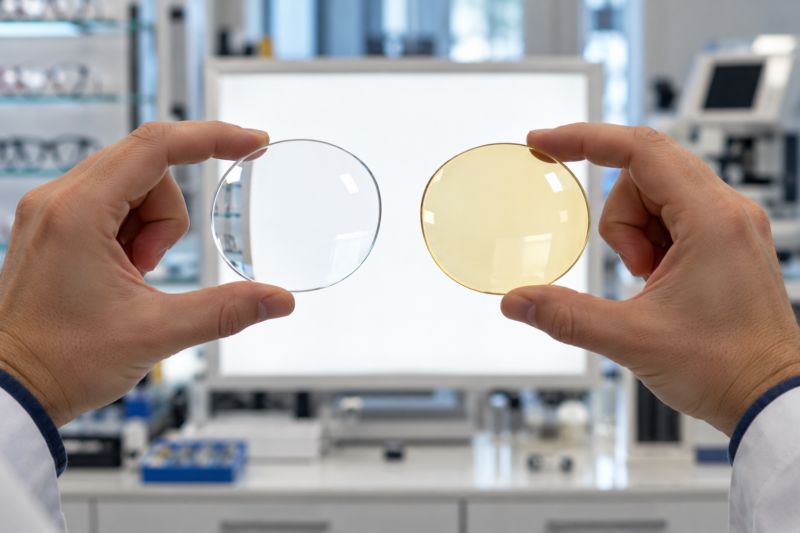
Clinical work depends on accurate color: skin tone, cyanosis, wound appearance, color-coded labels and line clamps. Avoid fashion tints and strongly yellow or amber blue-filtering lenses on the working pair. If a patient asks for blue-light filtering, choose a low-residual-color option and be honest about the evidence: it can improve comfort for some wearers, but it is not a treatment for eye strain or a fix for shift-work sleep. For a comparison of coating options, see our premium lens coatings comparison.
Anti-fog for mask-wearing staff
Warm exhaled air escapes over the top of a mask and condenses on a cool lens. For staff who wear an N95 or surgical mask for most of the shift, specify a permanent anti-fog coating, or an AR stack with an anti-fog-compatible top coat. Pair it with fit: adjustable nose pads let the frame sit slightly forward of the mask edge, and a well-molded mask wire reduces the airflow that causes fog in the first place.
Durability for Twelve-Hour Shifts
Material: light and impact resistant
Glasses in a hospital get dropped, knocked off during patient transfers and slipped into scrub pockets. Polycarbonate and Trivex both resist impact and weigh less than CR-39, which matters on the nose for twelve hours. Trivex offers better optical clarity in moderate prescriptions; polycarbonate lenses are thinner at higher powers. Both block UV by material.
Coatings that survive cleaning protocols
Healthcare workers clean their glasses with what is at hand: alcohol wipes, disinfectant wipes and hand sanitizer on the fingers. Repeated contact with strong alcohols and disinfectant chemistry can degrade the hydrophobic top coat and, over time, the AR stack, which shows up as smearing and then crazing. Give every healthcare patient a clear cleaning rule: rinse with water, wash with a drop of mild dish soap, dry with a clean microfiber. Keep lens-safe wipes in the scrub pocket instead of reaching for the disinfectant cart.
Prescription glasses are not protective eyewear
Standard dress eyewear does not protect against splashes or sprays of blood and body fluids. Staff need designated eye protection (goggles or a face shield that fits over glasses, or prescription safety eyewear with side protection) for procedures with splash risk. Say this at dispensing. It protects the patient, and it protects the practice from the assumption that a regular pair is enough.

The Commute Home After a Night Shift
The drive home is the part of the shift most dispensers forget. A night-shift worker heads into bright morning light at exactly the time their body needs to prepare for sleep, and that light exposure works against daytime sleep. Dark sunglasses on the commute home are a common recommendation for shift workers for that reason.
That makes a dedicated sun pair, or a photochromic lens designed to activate behind the windshield, a useful part of the prescription rather than an upsell. Standard photochromics activate poorly in the car, because most windshields block the UV that triggers them. If the patient wants one pair for work and the drive, confirm that the photochromic chosen activates in the car, and that its clear state is truly clear for clinical color work indoors.
A Specification Checklist for Healthcare Workers
- Unit, shift and mask use recorded in the history.
- Design matched to the dominant zone: digital single vision or anti-fatigue under 40; progressive with a wide intermediate zone for presbyopes.
- Occupational second pair for presbyopes who chart for long stretches.
- AR on both surfaces, with a durable hydrophobic top coat.
- Anti-fog for staff who mask for most of the shift.
- Polycarbonate or Trivex in a lightweight frame with adjustable nose pads.
- Clear working lenses: no strong tints or heavily colored blue filters.
- Cleaning instructions given and written down.
- Splash protection discussed: Rx glasses are not PPE.
- A commute solution: sun pair or in-car photochromic.
How MIA LAB Supports Healthcare Eyewear Orders
Healthcare workers are some of the most demanding wearers a practice sees, because they use every zone of the lens for twelve hours and clean their glasses more often than anyone else. At MIA LAB, AR is applied in-house in Hialeah, so coating adhesion and top-coat quality are controlled in the same building as surfacing, and our freeform designs are calculated for the position-of-wear measurements you send. If hospitals and clinics near your practice are a patient base you want to grow, open an account and send us your first healthcare order.
A nurse’s glasses are a working tool, used harder than almost any other pair you dispense. Specify them for the shift. The patient will notice by 3 a.m.
FAQ
- What are the best glasses for nurses who work twelve-hour shifts?
Lightweight polycarbonate or Trivex lenses in a frame with adjustable nose pads, with AR on both surfaces. Under 40, a digital single vision or anti-fatigue design; over 45, a progressive with a wide intermediate zone for the workstation, plus an occupational second pair for long charting sessions.
- Can an occupational progressive be worn all shift?
Only at the station and in the patient room. A near-variable design gives clear vision to about room distance but not beyond, so it is not safe for hallway walking or driving. Most presbyopic staff need an everyday progressive as well.
- Do blue-light filtering lenses help night-shift workers sleep?
The evidence does not support blue-filtering lenses as a fix for shift-work sleep problems. Some wearers report more comfort at screens. Keep any filter low in residual color so it does not affect clinical color judgment, and recommend dark sunglasses for the morning commute instead.
- How should healthcare workers clean coated lenses?
Rinse with water, wash with a drop of mild dish soap, and dry with a clean microfiber cloth. Avoid alcohol and disinfectant wipes and hand sanitizer on the lenses, since repeated exposure can degrade the hydrophobic top coat and the AR coating.
- How do you stop glasses fogging under an N95 mask?
Specify a permanent anti-fog coating or an AR with an anti-fog-compatible top coat, adjust the nose pads so the frame sits slightly forward of the mask, and mold the mask’s nose wire closely to reduce escaping air.
- Are prescription glasses enough eye protection in a hospital?
No. Regular prescription glasses do not protect against splashes of blood or body fluids. Staff need goggles or a face shield that fits over their glasses, or prescription safety eyewear with side protection, for any procedure with splash risk.


