
How to Improve Optical Margins With the Right Wholesale Optical Lab


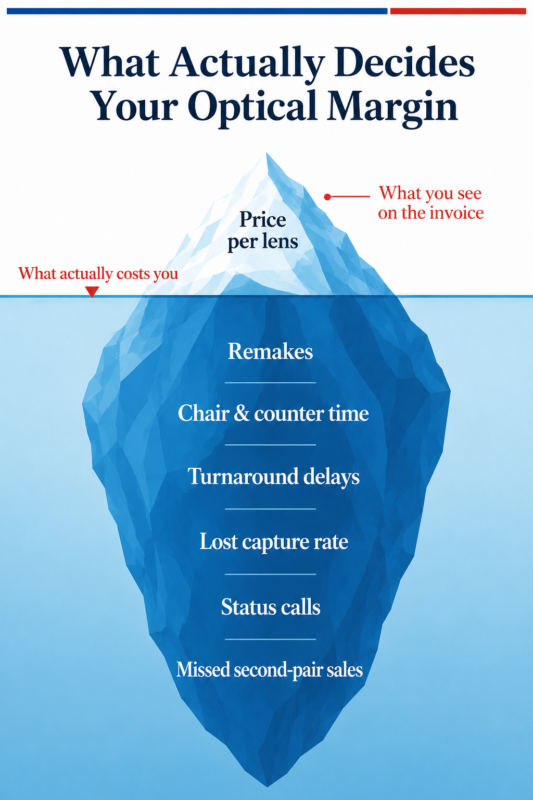
Lens cost of goods is the single biggest controllable number in your optical revenue, and the wholesale optical lab you choose sets most of it. Yet most practices pick a lab off a price sheet — comparing cost per lens and little else. That’s the wrong number to optimize. Price per lens is the smallest cost in the equation, and the costs that actually decide your margin never appear on the invoice.
Managed care fixes your reimbursement; that number isn’t yours to move. What you control is what it costs to fulfill each job — and that is set almost entirely by your lab. This article breaks down the four margin levers a lab controls, then gives you a way to evaluate one on total cost instead of sticker price.
Why Optical Margin Is Under Pressure
Three forces compress independent optical margins at once, and understanding them is what makes the lab decision matter.
Managed care sets both the frame allowance and the lens reimbursement, so on many plans a completed pair barely clears cost of goods. Patients increasingly treat eyewear as a commodity, which pushes you to discount at the counter. And staffing is thin — the optician placing lab orders is usually also verifying jobs and handling remakes, so the lab relationship gets set once and rarely re-examined.
The common thread is that reimbursement and patient expectations are outside your control, but fulfillment cost is not. That makes lens cost of goods your highest-leverage lever — and the lab is what moves it.
Lever 1: Remake Rate
A remake looks free because the lab redoes the job at no charge, which is exactly why it drains margin invisibly. The real cost is a second round of chair and counter time, a second QC and dispensing cycle, and a delayed pickup on a job you’ve already been paid for.
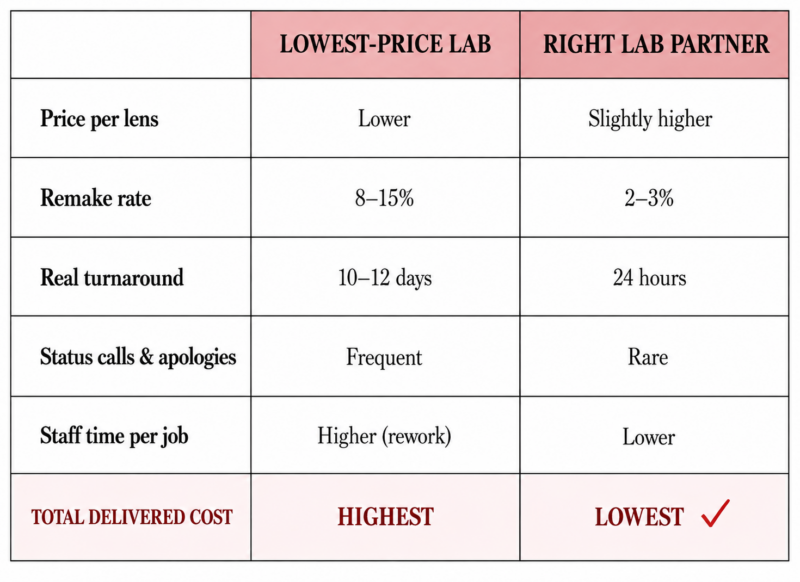
The scale is larger than most practices assume. Industry remake rates commonly run 8–15% of optical volume. On a practice doing 200 jobs a month, the gap between a 12% lab and a 3% lab is roughly eighteen recovered jobs every month — eighteen fewer delays, complaints, and hours of wasted staff time.
So a lower price per lens means nothing if the remake rate is double. The root cause of avoidable remakes is variability: inconsistent coating adhesion, loosely verified prescriptions, surfacing that drifts job to job. A lab that runs tight in-process quality control — and coats AR in-house rather than outsourcing it — removes the handoffs where that variability creeps in. Remake rate is a margin number disguised as a quality number.
Lever 2: Turnaround Time
Turnaround is usually filed under patient experience. It is actually a revenue number, and it moves margin in two specific ways.
First, capture rate. When you quote “5 to 7 business days” but the lab runs 10 to 12, the waiting patient is the one who starts looking for a faster option. Second, the second-pair sale. A practice with genuine 24-hour turnaround on uncut lenses can put glasses in a patient’s hands this week, which is what makes the second-pair and backup-pair pitch credible instead of aspirational.
Fast, dependable turnaround also cuts back-end cost: fewer status calls, fewer “where are my glasses” complaints, fewer canceled jobs. Turnaround this predictable depends on the lab’s throughput and on efficient, error-free order handling between your front desk and the lab.
Lever 3: Premium Product Mix
Basic single-vision jobs on a managed care plan will never carry the practice. The margin lives in the premium tier — freeform progressives, high-index materials, quality AR, photochromics, polarized.
Practices under-recommend these for one reason: a premium lens that fails in the first 90 days costs more than a remake, because it makes the patient question your judgment. That is a lab problem wearing the costume of a sales problem. When the lab’s premium products are consistent — when the freeform progressive adapts and the AR coating survives two years without crazing — your staff recommends them without hesitation.
That recommendation is where the margin is made. A wholesale lab with a consistent, warrantied premium portfolio isn’t just a supplier; it’s the reason your opticians can sell up with confidence. Margin follows confidence, and confidence follows consistency.
Lever 4: One Lab vs. Several
Splitting jobs across multiple labs feels like insurance, but it works against margin. Every added lab multiplies variability and weakens your standing with each one.
A single dependable optical lab partner that earns your full volume gives you the opposite: consistent output across every job, a real relationship when something goes sideways, and the leverage to get problems fixed fast. Consistency on every job is worth more than a slightly lower quote on some of them.
How to Evaluate a Wholesale Optical Lab on Margin
Switching labs feels risky, so practices tolerate an underperforming one far longer than the numbers justify. Evaluate a lab the way you’d evaluate any cost center — on total delivered cost.
Start with your own last 90 days: your remake rate, your average real turnaround (not the quoted one), and the share of jobs that required a status call or an apology. Those three figures are your current true cost.
Then score any candidate lab on five questions:
- Does it coat AR in-house, or outsource it — and what does that do to consistency?
- What is its actual turnaround on uncut lenses, and will it commit to that number?
- What are its warranty terms on premium and digital lenses?
- Is it a VSP-approved lab that fits your managed care mix?
- Can it support your front desk — including bilingual, Spanish-speaking service if your practice needs it?
The lab that wins on those five questions is almost never the one with the lowest quote. It is the one with the lowest total delivered cost.
Where MIA LAB Fits
MIA LAB is an independent wholesale optical lab built around exactly these levers. AR coating runs in-house in Hialeah, so consistency is controlled rather than outsourced. Uncut lenses turn around in 24 hours. QC is done to ±1 micron on Focovision and Visionix lensmeters, every digital lens carries a free no-questions-asked warranty, and the team is bilingual, VSP-approved, and family-run since 1997 — more than a million lens orders in. Each of those is a lever on the numbers that decide your optical margin. Practices comparing labs can open an account and test the difference on their own jobs.
The Bottom Line
The cheapest wholesale optical lab and the most profitable one are rarely the same lab. Price per lens is the number you can see; remakes, turnaround, and premium consistency are the numbers that decide whether optical carries your practice or quietly drains it. Choose on total delivered cost, not the quote.
Frequently Asked Questions
- How does choosing a wholesale optical lab affect my practice’s margins?
The lab sets your lens cost of goods, remake rate, and turnaround — the three inputs that decide fulfillment cost. Because managed care fixes reimbursement, the lab is the largest controllable factor in optical profitability. A lab with a low remake rate and fast turnaround can be more profitable even at a higher price per lens. - Is a cheaper wholesale optical lab always better for margin?
No. Price per lens is the smallest cost in the equation. A lab that quotes less but returns 10–15% remakes and runs 10-day turnaround costs more in staff time, delays, and lost capture than a higher-priced lab with a 2–3% remake rate, a 3-business-day standard turnaround. Compare total delivered cost, not the sticker price. - Why does in-house AR coating matter for an independent optical lab?
AR coating is a common failure point, and coatings that fail early trigger remakes and erode patient trust. A lab that coats in-house controls adhesion and consistency directly instead of relying on an outside vendor’s handoff, which reduces avoidable remakes — a hidden but significant margin cost. - How much does turnaround time actually affect optical revenue?
More than most practices measure. Slow or unpredictable turnaround lowers capture rate, weakens the second-pair conversation, and generates status calls that consume staff time. True 24-hour turnaround on uncut lenses — and a dependable 3-business-day standard turnaround on finished jobs — becomes a genuine competitive advantage rather than a liability you apologize for. - Should an independent practice use one wholesale lab or several?
For most independent practices, consolidating volume with one dependable optical lab partner produces more consistency and stronger leverage than splitting jobs. Multiple labs multiply variability and weaken your standing with each one. - What should I look for when switching wholesale optical labs?
Compare candidates on remake rate, actual turnaround, warranty terms, managed care compatibility such as VSP approval, and front-desk support — including bilingual service where needed. Start by measuring your current lab’s real numbers over 90 days so you have a baseline. - Does a wholesale optical lab in Florida make a difference for local practices?
For Florida and South Florida practices, a regional lab shortens shipping, supports faster turnaround, and in markets like Miami-Dade can offer bilingual, Spanish-speaking support that matches the patient base. Proximity translates into fewer delays and easier problem-solving.


