
Polycarbonate Lenses for Sport and Safety Eyewear: How to Spec Impact-Safe Pairs That Fit the Rx

Most sport and safety orders leave the practice with one instruction on the ticket: “poly.” It’s the right material call and an incomplete spec. Polycarbonate lenses answer the impact question, but they say nothing about the two variables that actually decide whether a wrapped sport frame delivers usable vision: the frame’s base curve and its wrap angle. Get those wrong and the patient gets an impact-safe lens that makes the periphery swim. Spec sport and safety eyewear well and it’s the highest-margin second pair in the practice; spec it as “just poly” and it comes back as a remake.
Impact Resistance Is a Material Property and a Standard
Impact safety is not a coating or an upsell. It’s built into the lens material, and it’s governed by test standards that differ depending on whether the eyewear is recreational or occupational.
Polycarbonate vs Trivex for impact
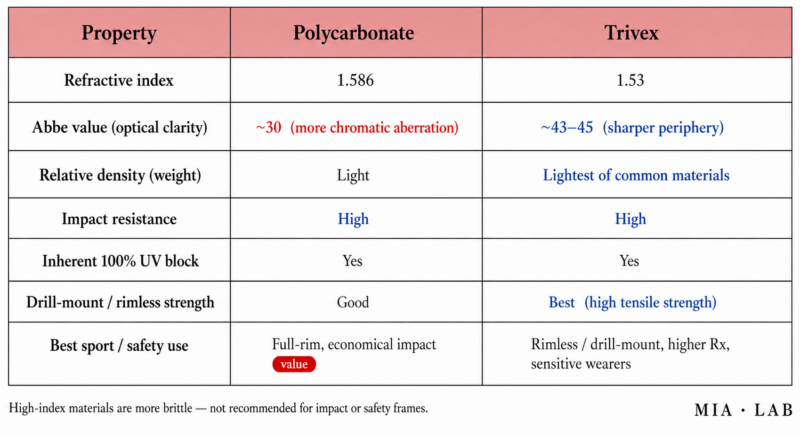
Polycarbonate lenses (index 1.586) remain the default for impact because they absorb energy without shattering and block 100% of UV inherently. The trade-off is optical: an Abbe value near 30 means visible chromatic aberration in the periphery and in higher powers, exactly where a wrapped frame already pushes the visual axis. Trivex lenses (index 1.53) match polycarbonate on impact resistance while delivering an Abbe value in the mid-40s, the lowest density of any common material, and higher tensile strength at drill points. For rimless or drill-mount sport frames, Trivex is the more forgiving material on the bench and the sharper one in the periphery. This is also why the high index vs polycarbonate lenses question rarely applies here: high-index materials are more brittle and are the wrong call for impact. The full trade-off across CR-39, polycarbonate, and Trivex is broken down in our independent optical lab’s lens material comparison.
What “safety-rated” actually means
Recreational sport eyewear and certified occupational safety eyewear are not the same order. Occupational protection is governed by ANSI Z87.1, which separates basic impact from high impact (a high-mass and high-velocity test); high-impact lenses carry a “Z87+” mark and require a Z87-rated frame plus a minimum center thickness, typically not below 2.0 mm for high impact. Recreational and racquet-sport eyewear falls under ASTM standards instead. Everyday dress lenses meet ANSI Z80.3, which is not a protective standard at all. When a patient says “safety glasses,” confirm whether they need a certified Z87 job-site pair or an impact-resistant recreational pair. The center-thickness and frame requirements diverge, and polycarbonate lenses finished too thin will fail certification even in the right material.
Why a Wrapped Frame Breaks the Prescription
A sport frame wraps around the face. That geometry, a high base curve plus a steep wrap angle, is what makes the frame protective and what corrupts a conventionally surfaced prescription.
Base curve and induced error
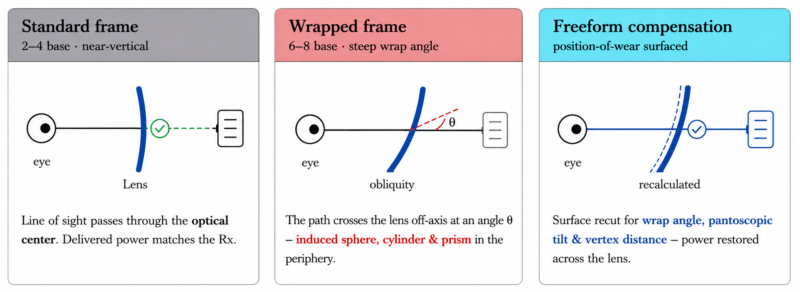
A wrapped frame carries a 6-to-8 base curve where a standard frame carries a 2-to-4. Drop a lens surfaced for a flat frame into a steeply curved one and two things happen: the lens may not seat in the bevel at all, and the patient views the world through the lens periphery at an angle the prescription never accounted for. The result is induced sphere, unwanted cylinder, and prism, strongest exactly where an athlete needs reliable peripheral vision. The base curve the frame demands is not optional; it’s a fabrication constraint the lens has to be calculated around.
Position-of-wear compensation
The fix is freeform. Position-of-wear (compensated) lenses recalculate the surface for the frame’s wrap angle, pantoscopic tilt, and vertex distance, so the delivered power at the eye matches the intended Rx across the whole lens, not just at the optical center. For single vision this cancels the off-axis error a wrap induces. For multifocals it’s non-negotiable: custom progressive lenses hold a usable corridor in a wrapped frame only when the design is digitally compensated for position of wear. Mialab’s freeform Remedy Sport designs, built on IOT Digital Ray-Path 2, are surfaced for exactly this case. The full digital lens portfolio is detailed on our digital and freeform lenses page.
Fabricating a Wrapped Sport Lens
Compensation on the surface is only half the job. The lens still has to be edged and mounted into a frame that wasn’t built to be gentle.
Fabrication demands that the finished lens base curve match the frame within tolerance, or the lens either won’t seat or will pop under stress the first time the frame flexes on impact. Wrapped and rimless sport frames also concentrate stress at the mount, which is where material choice and edging precision converge: Trivex at the drill points, a clean bevel or groove, and controlled center thickness on the polycarbonate lenses that carry the Rx. Working with an in-house finishing and edging operation with trace-driven edging and drill-mount capability is what keeps a wrapped order from becoming a remake. Our MEI Bisphera edger handles rimless, high-base, and metal sport frames, and every finished pair is verified against the Rx in quality control before it ships. Edging on the same site that surfaced the lens removes the base-curve mismatch that outsourced finishing so often introduces.
Tints, Sun, and the Second Pair
Most sport and safety eyewear is worn outdoors, which turns a protective order into a sun order.
Impact material handles the collision; it does nothing for glare or long-term UV load. For outdoor athletes, add uv protection lenses confirmation (inherent in polycarbonate and Trivex, but verify on any tinted CR-39), a polarized or mirror option for water, road, and snow glare, and anti reflective coatings on the back surface. Backside AR kills the reflections that bounce off the inside of a wrapped lens into the eye, a problem wrap geometry makes worse than a flat frame. A Hialeah lab that runs AR in-house lets you bundle these premium lens coatings into one order instead of chasing a separate coating vendor. That’s the second-pair conversation that actually closes: not “do you want another pair,” but “your everyday lenses aren’t rated for the field, and they aren’t built for the sun.” The same logic makes polycarbonate lenses the floor for active kids, since youth sports are where impact protection matters most and everyday lenses fail hardest.
A Spec Checklist for Sport and Safety Orders
Before the order leaves the counter, confirm five things:
- Use case: certified occupational (ANSI Z87/Z87+) or recreational sport? This sets the frame, the material floor, and the minimum center thickness.
- Material: polycarbonate lenses for pure impact economy; Trivex for rimless, drill-mount, or optically sensitive wearers.
- Frame geometry: record the wrap angle and base curve. Anything past a mild wrap needs position-of-wear compensation.
- Design: single vision or a compensated freeform progressive; standard progressives do not survive a wrapped frame.
- Sun and coatings: backside AR, UV confirmation, and a tint or mirror if the pair is worn outdoors.
A lab that surfaces the compensated design and edges the wrapped frame under one roof is what makes this checklist executable instead of aspirational. That single-source control is one of the factors that separates an optical lab partner from a vendor, and it’s a core reason ECPs rank MIA LAB among the best optical labs for optometrists in South Florida.
The Bottom Line
Sport and safety eyewear fails when the practice treats it as a material choice and the lab treats it as a standard job. It’s neither. It’s an impact-rated material carrying a prescription that has been recalculated for how a wrapped frame actually sits on the face, and then finished on equipment that respects the frame’s curve. Spec both, and the athlete gets peripheral vision they can trust at speed. Spec one, and you get a remake wearing safety goggles.
Ready to build wrapped sport and safety pairs that don’t come back? Open an account with MIA LAB.
Frequently Asked Questions
- Are polycarbonate lenses or Trivex better for sport and safety eyewear?
Both meet high-impact requirements. Choose polycarbonate lenses for the most economical impact protection in full-rim frames, and Trivex for rimless or drill-mount sport frames, higher powers, or visually sensitive patients. Trivex’s higher Abbe value and tensile strength give sharper peripheral optics and stronger mount points.
- Do wrapped sport frames really need special lenses?
Yes. A steeply wrapped frame positions the lens at an angle the standard prescription doesn’t account for, inducing unwanted power, cylinder, and prism in the periphery. Position-of-wear compensated freeform lenses recalculate the surface for the wrap angle, tilt, and vertex distance so the delivered Rx is accurate across the lens.
- Why do polycarbonate lenses have to match the sport frame’s base curve?
If the finished lens base curve doesn’t match the frame within tolerance, the lens won’t seat correctly in the bevel and is prone to popping out under the flex and impact a sport frame is designed to take. Matching base curve during surfacing and edging is essential to a durable, safe fit.
- Can custom progressive lenses work in a wrap frame?
Only when they are freeform designs compensated for position of wear. Conventional progressives lose their usable corridor in a wrapped frame. Sport-specific compensated progressives hold a stable intermediate and reading zone despite the wrap.
- Are ANSI Z87 safety lenses the same as recreational sport lenses?
No. ANSI Z87.1 governs certified occupational protection with defined impact tests, frame marking, and minimum thickness. Recreational sport eyewear typically follows ASTM standards. Confirm which the patient needs, because certification requirements change the material and finishing spec.
- Do impact-resistant lenses still need UV and sun protection?
Impact resistance and UV protection are separate properties. Polycarbonate lenses and Trivex block UV inherently, but for outdoor use you should still add a tint, a polarized or mirror option for glare, and backside anti reflective coatings to control reflections that wrap geometry intensifies.
- Should high index lenses ever be used for sports?
No. The high index vs polycarbonate lenses decision favors polycarbonate or Trivex for any impact application. High-index materials prioritize thinness for strong prescriptions but are more brittle, making them the wrong choice for sport and safety frames.


