Post-Surgical Dispensing: Custom Ophthalmic Lenses After LASIK And Cataract Surgery

Custom Ophthalmic Lenses After LASIK And Cataract Surgery: Why Standard Designs Underperform
Most ECPs apply the same lens-selection logic to post-surgical patients that they apply to everyone else. The prescription is measured, a design is chosen, and the order goes to the lab. The problem is that refractive surgery doesn’t just change the prescription. It changes the optical system. And a changed optical system requires a different lens design response.
This distinction is underappreciated in dispensing. It’s one of the reasons post-LASIK and post-cataract patients have measurably higher progressive lens complaint rates than refractive-equivalent patients who haven’t had surgery. The prescription isn’t wrong. The lens design assumption is.
Understanding exactly how surgery alters the eye, and why custom ophthalmic lenses with position-of-wear optimization close that gap, is the difference between a dispense that works and one that comes back.
How Refractive Surgery Changes The Optical System
LASIK, PRK, And The Reshaped Cornea
LASIK and PRK correct refractive error by ablating corneal tissue, flattening the central cornea for myopes, steepening the periphery for hyperopes. The result is a cornea that no longer behaves like a prolate ellipse. In most myopic ablations, the cornea becomes oblate: flatter centrally than peripherally.
This matters for dispensing because corneal shape directly influences higher-order aberrations, particularly spherical aberration. A post-LASIK patient corrected to plano or low plus will typically show elevated spherical aberration compared to a non-surgical patient with an identical manifest refraction. The clinical consequence is familiar: halos, reduced contrast sensitivity under mesopic conditions, and reduced tolerance for residual refractive error at the lens surface.
A standard progressive lens design, optimized for a prolate corneal model, introduces some degree of mismatch against an oblate post-surgical cornea. This doesn’t always produce complaints, but in visually demanding patients, or in patients being corrected in the intermediate and near zones of a progressive, it adds aberration on top of existing aberration. That stack is where non-adaptations originate.
Cataract Surgery And The Fixed-Power IOL
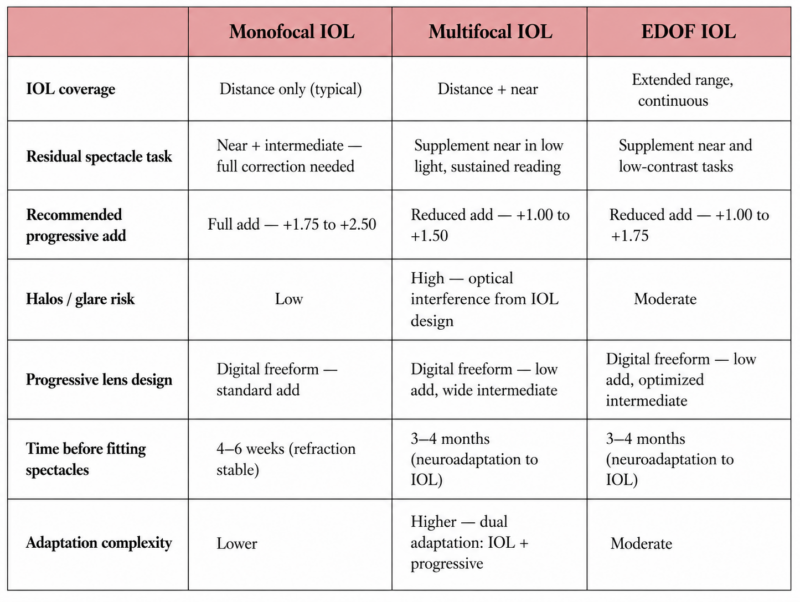
Post-cataract patients present a related but distinct challenge. The crystalline lens has been replaced by a monofocal, bifocal, or extended-depth-of-focus (EDOF) IOL. Each IOL type creates a specific visual demand profile that changes how spectacle lenses should be selected.
Monofocal IOLs, the most common type, are typically targeted for distance. The patient requires near and intermediate correction in spectacles. This is effectively a surgically induced presbyopia superimposed on whatever residual refraction the IOL left behind, plus any corneal astigmatism not corrected intraoperatively.
The dispensing challenge here is subtle. These patients frequently present with low-sphere prescriptions (plano, +0.25, or low minus) combined with meaningful cylinder and significant add power. In standard progressive lens design, low-power prescriptions offer less base curve leverage and less prism thinning. Conventional surfacing in this power range produces more peripheral distortion relative to the optical demand, not less. The easier the prescription looks on paper, the more the lens design has to work to compensate, and conventional surfaced progressives are not built to do that work.
Multifocal and EDOF IOLs add another layer. These designs split or extend light to provide depth of focus, but they do so by introducing halos and contrast reduction that most patients accept as a trade-off. Adding a progressive spectacle lens with its own intermediate and near optics can create adaptation interference, particularly early post-operatively, when the visual cortex is still calibrating to the IOL’s characteristics.
Why Standard Progressive Designs Fall Short Post-Surgically
A conventionally surfaced progressive is manufactured by applying a fixed front curve (semi-finished blank) to a back surface calculated for the prescription. The progressive design is locked into the front surface and cannot account for the wearer’s actual position of wear, frame geometry, or, critically, the specific aberration profile of the eye it’s meant to correct.
For the majority of patients, this approximation is sufficient. The visual system adapts, and standard progressives perform well within their design envelope.
Post-surgical patients sit outside that envelope in specific, predictable ways:
- Their corneal aberration profiles are non-standard
- Their IOL characteristics may interact with progressive zone optics in ways a blanket design cannot anticipate
- Many are highly demanding wearers. They had surgery precisely because they wanted excellent vision and their tolerance for optical compromise is lower than average
This is where digital freeform progressive lenses change the clinical equation.
How Digital Freeform Lenses Compensate Where Standard Designs Cannot
Digital freeform progressive lenses are surfaced on the back of the lens using high-precision computer-controlled generators. Rather than applying a fixed front-surface progressive design, freeform surfacing calculates the entire power map on the back surface, incorporating position-of-wear parameters directly into the calculation.
The lens design adapts to the wearer’s specific frame geometry (pantoscopic tilt, wrap angle, vertex distance, and frame B measurement) as well as to the prescription itself. The progressive corridor and addition zone are optimized for the actual power and fitting point, not a population average.
For post-surgical patients, this matters at the level of aberration management. A digital freeform progressive lens calculated with full position-of-wear optimization minimizes induced oblique astigmatism and coma at the intermediate and near zones, the zones most problematic for post-LASIK and post-cataract patients adapting to progressive correction.
IOT Digital Ray-Path Lenses And Post-Surgical Visual Performance
The IOT Digital Ray-Path 2 calculation method extends freeform optimization to account for how the eye actually rotates behind the lens. Standard progressive designs assume the eye rotates through a geometric pupil center, an approximation that introduces meaningful error at off-axis gaze angles.
Digital Ray-Path traces actual ray paths through each point on the lens as the eye rotates to that point, then calculates the surface needed to minimize aberration at that specific gaze direction. For peripheral zones of the lens, where post-surgical patients with reduced contrast tolerance are most sensitive, this produces demonstrably less distortion and cleaner transitions between distance, intermediate, and near.
For a post-LASIK patient already managing elevated spherical aberration from corneal changes, reducing the lens-side aberration contribution at off-axis gaze is not a refinement. It’s a clinically meaningful intervention. Custom ophthalmic lenses built on this calculation platform are the appropriate design class for this patient population, not an upgrade tier.
Clinical Decision Framework: When To Prescribe Digital Freeform
Not every post-surgical patient needs a premium custom progressive lens. The decision depends on three intersecting factors:
Visual demands and complaint profile. A post-cataract 70-year-old who reads for short periods and drives locally has different tolerance than a 52-year-old post-LASIK patient who spends four hours daily in intermediate-near gaze. The second patient’s complaint risk is meaningfully higher, and the payoff from a precision digital design is proportionally larger.
The prescription itself. Low-sphere, high-cylinder Rx profiles, which are common post-cataract, are where conventional surfacing struggles most. If sphere is under ±1.00 D and cylinder exceeds ±0.75 D, digital freeform progressive lenses are indicated on optical grounds alone, independent of the surgical history.
History of adaptation difficulty. Any patient with a documented remake or non-adaptation to a standard progressive, plus a post-surgical prescription change, should go directly to a freeform design. The combination of altered corneal or IOL optics and a new refraction is too much to put through a non-optimized lens.
When all three factors are present (demanding visual lifestyle, challenging Rx, prior adaptation difficulty), the indication for custom ophthalmic lenses with full lens design personalization is unambiguous.
Setting Expectations At Dispensing
Digital freeform lenses reduce the optical reasons for non-adaptation. They do not eliminate the neurological component. Post-surgical patients, particularly those with multifocal or EDOF IOLs, may still require an extended adaptation period, not because the spectacle lens is wrong, but because the visual system is simultaneously calibrating to the IOL’s optical characteristics.
Set this expectation explicitly at the time of dispensing. The framing matters:
“Your eyes are still adjusting to your IOL while also learning where to look through the progressive zones. The lens is doing exactly what it should. Give it two full weeks of consistent wear before we evaluate how it’s performing.”
Patients who understand the mechanism adapt better. The mechanism explanation is also the credibility signal that differentiates your practice from any optical chain that hands the glasses over and says “call us if you have problems.”
Understanding how progressive lenses work in a surgically altered eye is not advanced optometry. It’s the clinical reasoning that prevents the remakes that are hardest to diagnose. The prescription verifies correctly. The lens checks out at lensometry. The patient still can’t adapt. Custom ophthalmic lenses, precisely calculated for that specific post-surgical optical system and position of wear, are not an upsell. They are the correct clinical choice for a non-standard eye.
Frequently Asked Questions
- Why do post-LASIK patients complain about glare and halos even with a perfectly correct spectacle prescription?
LASIK ablation induces elevated spherical aberration in most myopic cases. This aberration exists in the cornea itself and is separate from any spectacle lens contribution. Standard progressive designs can add peripheral aberration at off-axis gaze. Digital freeform lenses reduce the lens-side contribution, but cannot eliminate the corneal component. Night driving and mesopic conditions will always be more challenging for post-LASIK patients than for patients with natural, prolate corneas.
- How long after cataract surgery should a patient wait before being fitted for progressive lenses?
Refraction typically stabilizes 4 to 6 weeks post-operatively for uncomplicated monofocal IOL cases. For multifocal and EDOF IOLs, neuroadaptation can take 3 to 4 months. Prescribing before refraction stabilizes risks a remake when the Rx settles. A practical guideline: wait for two consecutive refractions at least two weeks apart that agree within ±0.25 D sphere and ±0.25 D cylinder before ordering the final progressive.
- Do patients with multifocal IOLs still need progressive lenses?
Many do, particularly for sustained near tasks. Most multifocal IOLs provide reasonable intermediate and near vision in photopic conditions but show reduced performance under low light and for high-contrast near work. A progressive with a lower add (often +1.00 to +1.50 rather than a full +2.00 or higher) can supplement the IOL’s range without creating optical interference that worsens halos.
- Are there lens materials that work better for post-surgical patients?
Trivex and higher-Abbe-value materials reduce chromatic aberration, a consideration for patients managing contrast sensitivity changes post-surgically. In the low-power Rx profiles common post-cataract, material choice is secondary to design choice. A Trivex lens with a premium digital freeform progressive design will typically outperform a high-index lens with a conventionally surfaced progressive, on optics alone.
- What should I document when a post-surgical patient returns with a progressive adaptation complaint?
Document: monocular vs. binocular onset, specific viewing distance of the complaint, whether the complaint occurs in primary gaze or only at off-axis angles, time of day (mesopic conditions implicate halos rather than design), and whether IOL biometry has been confirmed post-op. This separates a lens design problem from a residual refractive problem from neuroadaptation, and determines whether the solution is a remake, a refraction, or a referral back to the surgeon.
- Does pantoscopic tilt matter more for post-surgical progressive wearers?
Yes, for two reasons. Post-cataract patients with fixed IOLs rely more heavily on the lower progressive zone because they have no accommodative reserve to compensate for off-axis distortion. And any cylinder in the spectacle Rx is more visually significant when there is no accommodative buffering. Poor pantoscopic fit in this population produces subjective symptoms disproportionate to what the lensometer would suggest.
- Can MIA LAB produce custom ophthalmic lenses for post-surgical patients with unusual Rx profiles?
Yes. Mialab’s Remedy lens line uses IOT Digital Ray-Path 2 surfacing with full position-of-wear optimization, the calculation method discussed throughout this article. Our QC process verifies finished lenses to ±1 micron on a Visionix lensmeter, which is clinically relevant for the low-power, high-add profiles common in post-cataract prescriptions. Contact our team to discuss specific Rx cases.