
Anti-Fatigue Lenses vs Progressive Lenses


Anti-Fatigue Lenses vs Progressive Lenses: Which One Is Right for Your Patient?
Defaulting to progressive lenses for every complaint of near-vision difficulty is one of the most common, and most costly, dispensing decisions in optical practice. It isn’t wrong in established presbyopes. But in the patient who’s 38 years old, straining after four hours on a screen, and struggling to explain what exactly feels off, a progressive lens is the wrong solution to the wrong problem.
Anti-fatigue lenses and progressive lenses solve different problems at the level of optics. Treating them as interchangeable alternatives, or worse, treating anti-fatigue lenses as a “starter pack” before the real prescription, results in non-adaptations, remakes, and patients who quietly stop trusting your recommendations.
This article gives you a clinical framework for separating these two patient populations before you write the prescription. For a deeper look at how progressive lenses are designed and why some patients struggle to adapt, see How Progressive Lenses Work: A Practical Guide for Optical Practices.
What Anti-Fatigue Lenses Actually Do (and What They Don’t)
Anti-fatigue lenses (sometimes called digital lenses, near-vision boosters, or extended focus lenses) are not a mild progressive. They are single-vision distance lenses with a slight addition of +0.50 to +0.75 D incorporated into the lower portion of the lens.
Their mechanism is accommodative relief. The ciliary muscle that drives near focus is a muscle like any other: it fatigues under sustained demand. For a patient spending six or eight hours a day shifting focus between a monitor, a phone, and a document, that demand is continuous. Anti-fatigue lenses reduce the accommodative effort required for near tasks, not by correcting presbyopia, but by reducing the load before presbyopia has meaningfully set in.
What they don’t do: they don’t replace distance-to-near optics. A patient who genuinely cannot read without optical assistance is not an anti-fatigue candidate. Putting them in an anti-fatigue lens and calling it a trial run for progressives is not a clinical rationale. It’s an expectation mismatch waiting to become a remake.
What Progressive Lenses Actually Do
A progressive lens provides continuous, seamless correction across three focal distances (distance, intermediate, and near) within a single ophthalmic lens. The corridor of progression, designed into the lens surface, changes power gradually from the distance zone at the top through the intermediate to the reading zone at the bottom.
The optics are more demanding than any other spectacle lens design. Peripheral distortion is inherent to the design; corridor width determines how much functional vision is available at intermediate and near; fitting parameters (fitting cross height, vertex distance, pantoscopic tilt, wrap angle) directly affect whether the prescribed power lands where the patient’s visual axis crosses it.
This is why progressive lens adaptation isn’t random. Patients who struggle most often have one of three problems: the prescription itself is slightly off, the fitting measurements were imprecise, or the lens design doesn’t match the patient’s visual demands. None of those problems are solved by telling the patient to “give it a week.”
Progressive lenses are clinically indicated when accommodative amplitude is genuinely insufficient for the patient’s daily visual demands, typically when the add power reaches +1.00 D or higher, which corresponds to clinically confirmed presbyopia, not accommodative fatigue.
The Clinical Distinction: Two Different Patients
The confusion between anti-fatigue and progressive candidates usually comes down to one overlapping symptom: difficulty with near vision. But the mechanism behind that symptom tells you which lens belongs on the prescription.
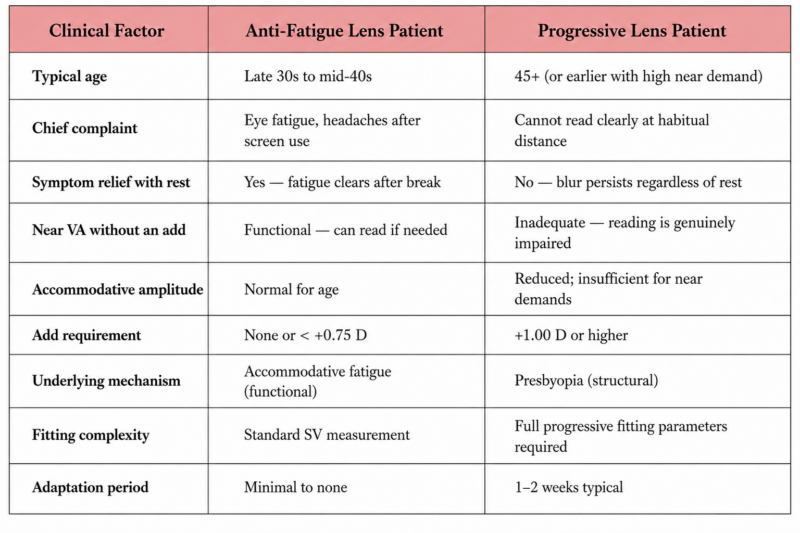
The anti-fatigue patient typically presents in their late 30s to mid-40s. Their distance vision is clear and stable. They have no difficulty reading, but after extended near or screen work, they notice blur, headaches, or a vague visual “tiredness” that clears after rest. Crucially, they can read without glasses if they need to. What they need is reduced accommodative demand, not optical correction for near. Their cycloplegic refraction shows normal accommodative amplitude for their age range; the fatigue is functional, not structural.
The progressive lens patient has crossed the clinical threshold of presbyopia. They cannot comfortably or clearly read at habitual working distance without optical assistance, regardless of how long they’ve been using near vision. Their add requirement is +1.00 D or more. They may be adapting from single-vision reading glasses or bifocals, or presenting for the first time with a complaint that near vision is simply not functional anymore. No amount of accommodative rest resolves the underlying optics.
The overlap zone, patients with an add of +0.75 D who also work heavily on screens, requires clinical judgment. A trial frame demonstration at the dispensing stage, not a trial lens prescription, is the right tool here.
Why Getting This Wrong Costs More Than One Remake
Non-adaptation in first-time progressive wearers is expensive at multiple levels. The lens gets remade. The fitting appointment gets repeated. But the downstream cost is the one practices undercount.
A patient who tries progressives and can’t adapt, particularly if they were a borderline candidate, doesn’t just return the lenses. They question the recommendation. They wonder whether their optometrist was upselling them. They mention it to someone in their social circle. Optometry’s referral engine runs on exactly the kind of trust that one negative fitting experience erodes.
Conversely, a pre-presbyopic patient who is correctly prescribed anti-fatigue lenses and experiences immediate relief becomes an excellent progressive lens candidate 18 to 24 months later, because they already know what it feels like when their optical prescription is right. The clinical relationship that converts a screen-fatigue complaint into a successful first progressive prescription is built on exactly that foundation.
The business case for precise lens selection isn’t the upsell. It’s the long-term patient relationship that comes from getting it right the first time.
A Decision Framework for the Dispensing Chair
The following criteria help clarify which lens category the patient actually needs:

When the picture is unclear: A brief trial frame demonstration during the exam, comparing their habitual Rx at near versus an add of +0.50 or +0.75, is more informative than any questionnaire. The patient’s response in the chair is your best data point.
Lens Design Quality Changes the Clinical Outcome
If the patient is a progressive lens candidate, lens design quality determines adaptation success as much as the prescription itself does.
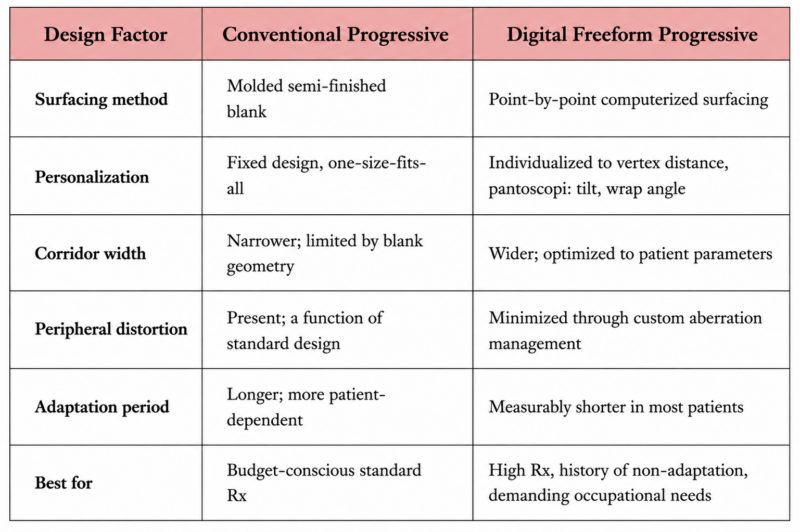
Conventional progressive lenses distribute aberrations across the peripheral zones. The width of the usable intermediate and near corridors is largely a function of how aggressively peripheral distortion has been minimized. Entry-level progressive designs compromise corridor width to hit price points. The clinical result is a narrower channel of functional vision that demands more head movement, more adaptation time, and more patient tolerance.
Digital freeform progressive lenses, manufactured through computerized point-by-point surfacing, allow the designer to individualize the progressive surface to the patient’s actual wearing parameters: vertex distance, pantoscopic tilt, frame wrap, even the patient’s head-turn habits. The result is a wider usable corridor, reduced peripheral distortion, and measurably faster adaptation in most patients. For a detailed explanation of how freeform surfacing works, see What Is Freeform Technology in Optical Lenses?
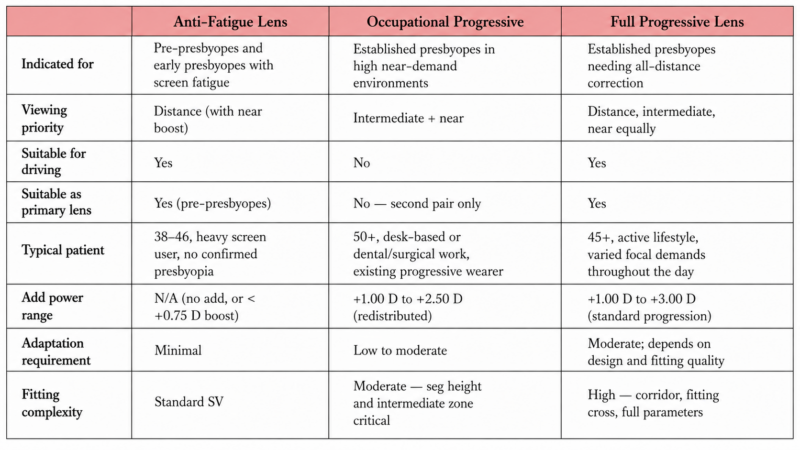
For occupational progressive lenses (patients with high near-vision demands, extended screen time, or ergonomic constraints that don’t suit standard progressive posture), a specialized occupational design redistributes the power allocation to prioritize intermediate and near rather than distance. These are not replacements for full progressive lenses; they are second-pair solutions for specific working environments.
At Mialab, Remedy progressive lenses are surfaced using IOT Digital Ray-Path 2 technology with Steady and Steady Plus methodology, a manufacturing approach designed to minimize the gap between the prescribed lens and what the patient actually sees. For practices with patients who have a history of progressive non-adaptation, the combination of precise fitting data and digitally surfaced lens design is the highest-probability path to a first-fit success.
What Anti-Fatigue Lens Quality Looks Like
Not all anti-fatigue lenses are equal either. The quality factors that matter clinically are:
Design optimization: A well-designed anti-fatigue lens uses the base single-vision prescription as its optical starting point and adds a precisely computed near boost in the inferior optical zone. The transition should be gradual enough to avoid image jump, steep enough to provide meaningful relief.
Fitting precision: Unlike a standard single-vision lens, the reading boost on an anti-fatigue lens needs to land where the patient actually looks during near tasks. Monocular PD measurement and proper segment height determination matter, particularly for patients with significant anisometropia or strong oblique astigmatism.
Coating compatibility: Patients who wear lenses for screen use are typically in environments with a mix of overhead fluorescent, LED backlit monitors, and ambient natural light. An AR coating that reduces reflectance across the full visible spectrum, including the high-energy blue-light range, reduces the cumulative photostress that contributes to digital fatigue. For anti-fatigue lens wearers, the coating is not an upgrade. It’s part of the solution.
Choosing the Right Lens for the Right Environment
For established presbyopes, a single progressive lens design doesn’t fit every use case. Understanding when to recommend a second pair, and which design, is part of the same clinical conversation.
The patient sitting across from you doesn’t know the difference between accommodative fatigue and presbyopia. They know their eyes hurt and they want them to stop. The clinical value you deliver, the judgment that separates the right prescription from the nearest available option, is exactly what they’re paying for.
Anti-fatigue lenses resolve a specific problem. Progressive lenses resolve a different one. Knowing which problem the patient in front of you actually has is the whole job.
Frequently Asked Questions
- What is the difference between anti-fatigue lenses and progressive lenses?
Anti-fatigue lenses are single-vision distance lenses with a mild near boost (+0.50 to +0.75 D) built into the lower portion of the lens. They reduce accommodative demand during sustained near work. They don’t replace the optics of multifocal correction. Progressive lenses provide continuous correction across distance, intermediate, and near focal distances and are indicated for patients with clinically confirmed presbyopia requiring an add power of +1.00 D or more. The two lenses serve different patient populations with different underlying visual needs. - Can anti-fatigue lenses delay the need for progressive lenses?
Anti-fatigue lenses reduce accommodative fatigue in pre-presbyopic patients, but they do not alter the natural progression of presbyopia. Presbyopia is an age-related loss of accommodative amplitude driven by increasing rigidity of the crystalline lens. No spectacle lens design changes that trajectory. Anti-fatigue lenses are appropriate for the patient who doesn’t yet need progressives; once presbyopia is clinically present and add power is required, progressive lenses are the correct optical solution. - Who is the ideal candidate for anti-fatigue lenses?
The ideal anti-fatigue lens candidate is a patient in their late 30s to mid-40s who reports visual fatigue, headaches, or blur after extended screen time, but whose near visual acuity is functional without an add. These patients often describe symptoms that improve after rest, a hallmark of accommodative fatigue rather than true presbyopia. Heavy screen users, remote workers, and anyone with a high near-task load who is not yet presbyopic are strong candidates for anti-fatigue lenses. - At what age do patients transition from anti-fatigue lenses to progressive lenses?
There is no fixed age. The transition is driven by clinical findings, not birthdays. Most patients with an anti-fatigue lens prescription begin requiring a measurable add (+1.00 D or higher) sometime between their mid-40s and early 50s, depending on their accommodative reserve and near-task demands. The transition point is when anti-fatigue relief is no longer sufficient to resolve the complaint, which is the same moment the clinical examination confirms presbyopia. - Do anti-fatigue lenses help with digital eye strain?
Anti-fatigue lenses address the accommodative component of digital eye strain: the muscular fatigue from sustained near focus. They work most effectively when combined with an AR coating that reduces screen glare and blue-light reflectance, proper ergonomic screen positioning, and managed screen breaks. They are not a solution for dry eye, uncorrected refractive error, or binocular vision disorders, all of which can present with similar digital fatigue symptoms and should be ruled out during the examination. - What are occupational progressive lenses and when should I recommend them?
Occupational progressive lenses (sometimes called office lenses or near-variable-focus lenses) are progressive designs with a compressed distance zone that prioritizes intermediate and near vision. They are intended as second-pair lenses for patients who spend most of their day at desk or screen environments where far-distance vision is secondary. They are not suitable for driving or general outdoor wear. The ideal candidate is an established progressive wearer who finds their general-purpose progressive restricts their intermediate field during extended computer use. - How does digital freeform technology affect progressive lens adaptation?
Digital freeform progressive lenses are surfaced using computerized, point-by-point calculation that tailors the progressive surface to the patient’s measured wearing parameters, including vertex distance, pantoscopic tilt, and frame wrap. This allows for a wider usable corridor and reduced peripheral distortion compared to conventional molded progressive designs. Clinically, the effect is a measurably shorter adaptation period and better optical performance in peripheral gaze, particularly relevant for patients with higher prescriptions, significant astigmatism, or a history of progressive non-adaptation. See also: Expert Q&A: Tough Questions on Progressive Lenses and Fittings and Lens Material Guide.


