
Personalizing Patient Interactions in Your Optical Practice: Small Gestures, Big Impact
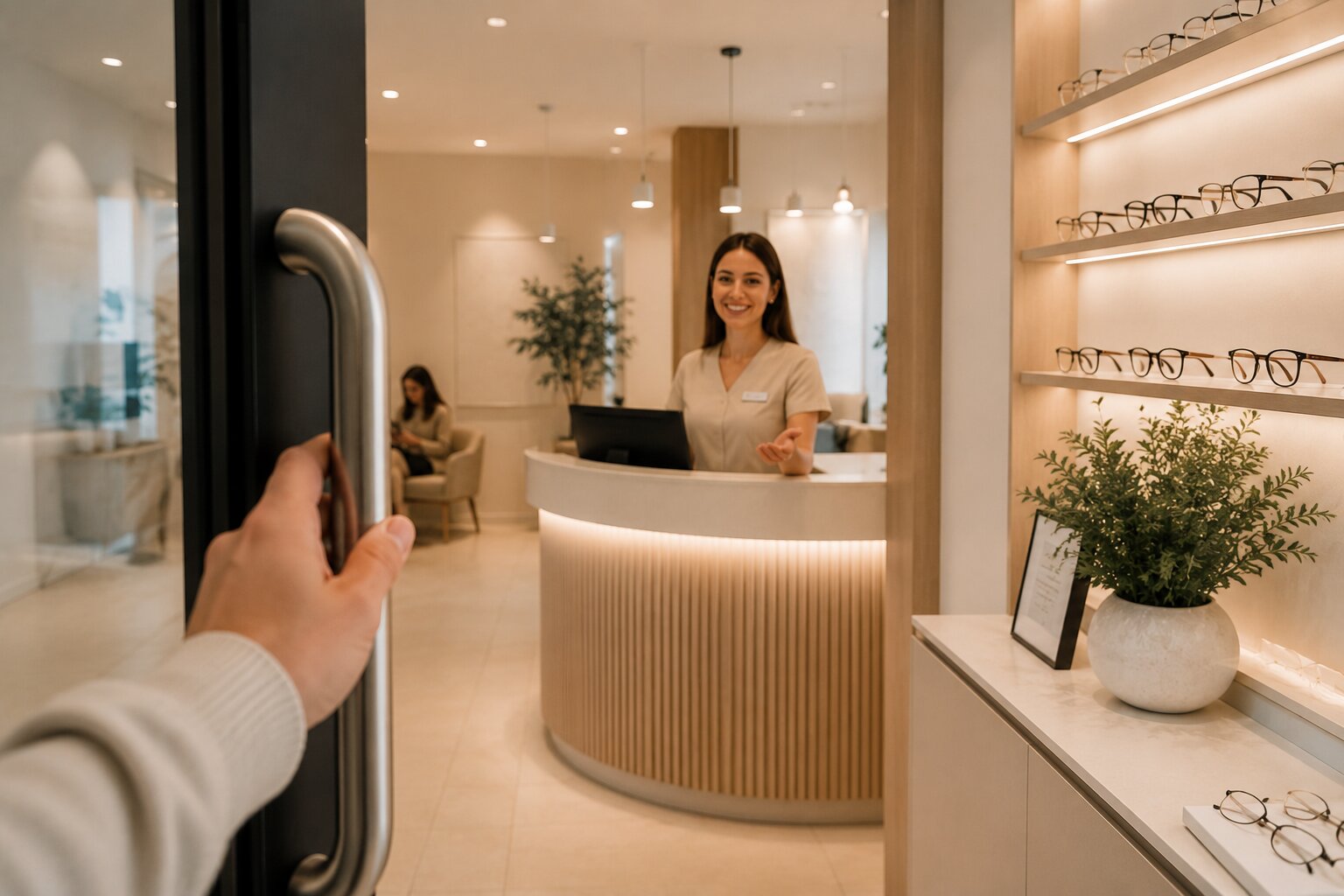

There’s a moment that happens in optical practices every day.
A patient walks in for the first time, a little uncertain. Maybe they just got their first progressive prescription. Maybe they’ve had a bad experience somewhere else. Maybe they’ve been wearing the wrong lenses for two years and don’t know it yet. They sit down, they wait, they interact with your team, and within the first ten minutes, their impression of your practice is already forming.
That impression is built almost entirely on small things.
Not the technology. Not the frame selection. Not the lens materials you carry, though all of that matters too. The first impression is built on whether someone at the front desk used their name. Whether the optician noticed they were nervous and slowed down. Whether the doctor explained the prescription in plain language instead of reciting numbers. Whether the glasses were ready when they said they’d be ready.
These are the small gestures. And in an industry where patients have more choices than ever (chains, online retailers, discount clubs), the small gestures are what make them come back.
This article is about how independent optical practices build the kind of patient experience that creates loyalty without a marketing budget. And it’s about why the systems behind that experience, including your choice of optical lab in Florida, matter more than most practice owners realize.
Why Personalization Is the Most Underused Growth Strategy in Optometry
Most practices think about growth in terms of new patient acquisition. More ads. More Google reviews. More referral programs. These things matter, but they’re expensive, competitive, and unpredictable.
Personalization works differently. It’s a retention and referral engine that compounds over time. A patient who feels genuinely seen and remembered doesn’t just come back. They bring people with them. They answer “where do you get your glasses?” with your practice name, without being asked.
The data supports this. Studies in healthcare retention consistently show that patients who report feeling personally recognized by their provider are significantly more likely to return for annual care, more likely to purchase eyewear at their exam, and measurably more likely to refer family members. The difference in behavior between a patient who feels known and one who doesn’t isn’t marginal. It’s the difference between a 30% recall rate and a 70% one.
And the investment required? A team trained to notice. Systems that support memory. Partners, including your optical lens supplier in Florida, who deliver consistently enough that your promises hold.
That’s it.
The Anatomy of a Personalized Patient Interaction
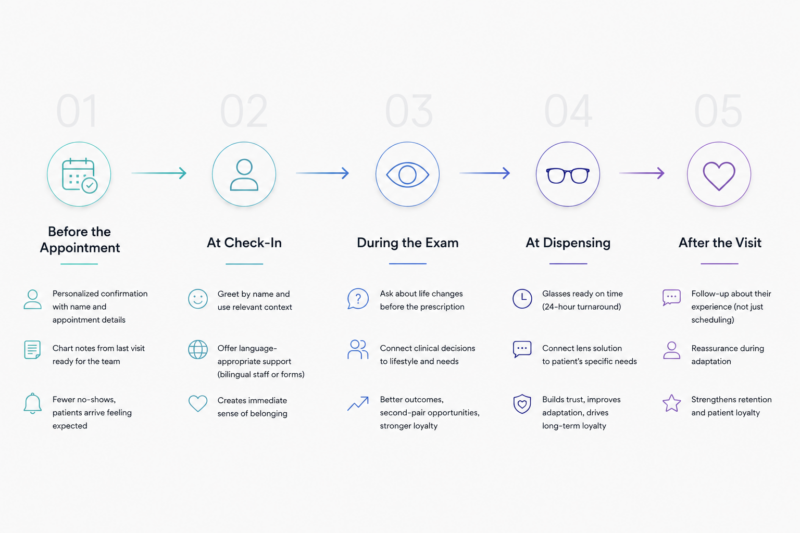
Personalization in an optical practice isn’t about elaborate programs or expensive technology. It’s about a sequence of small, intentional moments that together create the feeling of being known.
Here’s what that looks like across a typical patient visit.
Before the Appointment
The personalization starts before the patient walks through the door.
A confirmation text that uses their name and references their specific appointment type (“Hi Maria, just confirming your progressive lens fitting tomorrow at 2 PM”) signals that they’re not just an entry in a scheduling system. A brief note in their chart from the last visit (“asked about blue light options, has a teenager who might benefit”) gives your team something to work with the moment they arrive.
Practices that do this consistently report fewer no-shows, higher dispensing rates, and patients who arrive already feeling like they’re expected. Because they are.
At Check-In
The first thirty seconds at the front desk sets the tone for everything that follows.
Using a patient’s name when they arrive is the minimum. The better version is using context: “Good to see you back, Mr. Johnson, you mentioned last time you wanted to look at lighter frame options. We pulled a few things we thought you’d like.” That takes fifteen seconds and forty words. The patient remembers it for years.
For practices serving diverse communities, particularly in South Florida where a significant portion of patients are Spanish-speaking, this moment of recognition extends to language. A bilingual greeting, a form offered in both languages, a staff member who switches naturally: these aren’t operational conveniences. They’re statements about who you consider to belong in your practice.
During the Exam
The clinical appointment is where most personalization either happens or doesn’t.
The simplest version: asking what changed since the last visit before asking about the prescription. What’s their job like now? Are they spending more time on screens? Did they mention they were planning to start driving at night more often? These questions take two minutes and produce clinical information, but they also communicate that the provider is thinking about them as a person, not a prescription number.
The more sophisticated version involves connecting clinical decisions to life context explicitly. “Given that you’re working from home now and spending eight hours on a screen, I want to talk about an office lens option in addition to your progressive. Here’s why that would make your days more comfortable.” That’s personalization that sells a second pair, improves a clinical outcome, and creates loyalty simultaneously.
At Dispensing
Dispensing is where practices win or lose a patient’s long-term loyalty, and most don’t treat it that way.
A patient who waits longer than they were told is already slightly frustrated before they try the glasses on. A patient whose glasses arrive exactly when promised, or early, arrives in a state of trust. That trust makes adaptation easier. It makes the product feel better before they’ve even worn it.
This is where your fast prescription lens lab in Miami becomes a direct patient experience tool.
When Mialab surfaces and finishes a lens in-house (uncut lenses average 24 hours, jobs with AR about 2 more days), that timeline lands in your dispensary, and your patient gets their glasses when you said they would. That’s a small thing. It’s also everything.
The dispensing conversation itself is another personalization moment most practices underuse. Noting what the patient said about their lifestyle during the exam and connecting it to the lens solution they’re receiving: “Remember you mentioned the night driving? The Matrix AR coating we put on is specifically good for reducing halos and glare. You should notice a difference on your commute.” They didn’t just buy a coating. They bought a solution to their specific problem.
After the Visit
Most optical practices’ post-visit contact is purely operational: a recall reminder, maybe an insurance renewal notice.
The practices with the highest patient retention rates add one more layer: a follow-up that’s about the patient’s experience, not the practice’s schedule.
A text three days after dispensing: “Hi Maria, just checking in to make sure your new progressives are feeling comfortable. Any questions about adaptation, reach out anytime.” That’s fifteen words and two minutes of staff time. For a first-time progressive wearer who’s been wondering if the slightly different visual field is normal, it’s the difference between calling you and calling a competitor.
The Systems That Make Personalization Scalable
Here’s the honest challenge: personalization doesn’t scale through willpower. It scales through systems.
A practice with a hundred patients a week cannot rely on individual staff memory to deliver consistent personalized interactions. What it can do is build systems that capture the information, surface it at the right moment, and make the personalized response the path of least resistance.
Patient notes in your practice management system. Not just clinical notes. Notes about conversations: what the patient mentioned wanting, what concerned them, what they said about their lifestyle. When this information is available at check-in, front desk staff can be personalized without relying on memory.
A dispensing checklist that includes a personalization step. Before a patient arrives to pick up glasses, someone on the team reviews their chart and prepares one relevant, specific comment about their lenses. This takes thirty seconds and transforms the pickup from a transaction into a continuation of a relationship.
Consistent lab turnaround as a system input. Personalization promises like “your glasses will be ready Thursday” only hold if the operational reality supports them. Working with a fast optical lab in Miami that actually delivers means your team can make specific commitments to patients and keep them, every time. Broken promises are the fastest way to undermine personalization. Kept promises compound it.
Bilingual support infrastructure. For practices in South Florida serving Spanish-speaking patients, personalization in the patient’s language requires support beyond a bilingual staff member. Educational materials, dispensing guides, follow-up communications: all of it needs to exist in Spanish for the interaction to feel genuinely personalized rather than partially accommodated. MIA LAB provides bilingual patient materials as part of our lab partnership, specifically because we understand what it means to serve Miami and Hialeah practices with diverse patient populations.
What Patients Actually Remember
It’s worth being specific about what creates lasting patient impressions, because it’s often not what practices focus on.
Patients rarely remember the brand of lens they received. They rarely remember the coating tier you recommended. They don’t go home and explain digital surfacing technology to their spouse.
They remember:
Whether their glasses were ready on time. Or early. Being early is a small gesture with outsized impact. A patient who expected glasses on Friday and gets a call Wednesday afternoon has a story to tell.
Whether anyone followed up. A single post-dispensing check-in puts a practice in a category occupied by almost no one in the local market.
Whether they felt heard. Not examined. Not processed. Heard. This is the difference between a provider who says “your prescription changed, here are your options” and one who says “based on what you told me about your work situation, I want to walk you through two options and explain the tradeoff.”
Whether the experience matched what they were told. Consistency of promise and delivery is the foundation of trust. And trust, in healthcare, becomes loyalty faster than any other variable.
Whether the staff remembered them. Even simple recognition, like “good to see you again” when the staff member genuinely means it, registers differently than a generic greeting. Training your team to actually look at who is walking in before they speak is one of the cheapest and most effective patient experience improvements available.
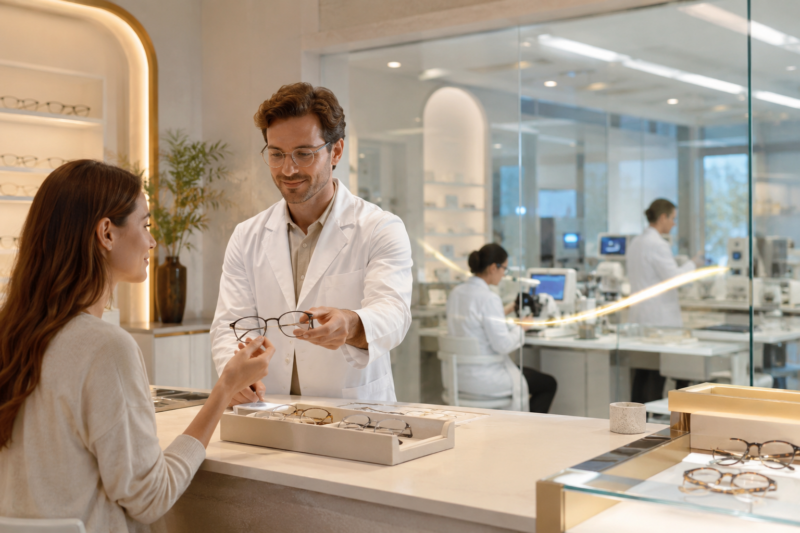
How Your Lab Partner Shapes the Patient Experience You Can Deliver
This connection is underappreciated by most practice owners, so it’s worth making explicit.
The patient experience your practice can deliver is bounded by the operational reliability of your supply chain. If your fast lens lab for clinics in Miami delivers inconsistently, you cannot make reliable promises to patients. If remake rates are high, your dispensing appointments become damage control conversations instead of loyalty-building moments. If your lenses arrive with quality issues, the conversation you carefully designed around a specific patient’s needs gets derailed by a product problem.
A lens lab in South Florida for optometrists that operates as a true partner: in-house surfacing, in-house coating, QC at every stage, and a 24-hour average turnaround on uncut lenses (about 2 more days with AR), gives your practice the operational floor it needs to build personalization on top of.
MIA LAB’s in-house finishing at our Hialeah facility means we’re not outsourcing your patients’ lenses to a third party and hoping for the best. When you order a Remedy progressive with Matrix AR coating for a patient you’ve carefully fitted, we surface it, coat it, finish it, and QC it under one roof before it ships. That consistency is what allows your team to say “your glasses will be ready Thursday” and mean it every single time.
That’s not a product feature. That’s a patient experience feature. And for independent practices competing against chains with larger marketing budgets, reliable execution is the most powerful patient experience investment available.
For practices looking for an optical lab near them in Miami, FL that combines speed, quality, and bilingual support, Mialab was built for exactly that partnership.
Building a Personalization Culture, Not Just a Personalization Policy
The last thing worth saying is that personalization doesn’t live in a checklist. It lives in a culture.
A practice where the team genuinely cares about the people coming through the door will find personalization happening naturally, in moments that no policy could have anticipated. The optician who notices a patient looks tired and asks if they’re doing okay. The front desk person who remembers that a returning patient has a daughter who was due to come in for her first exam. The doctor who sends a handwritten card to a long-term patient who just mentioned they were moving away.
These things can’t be systematized. But they can be cultivated. By hiring people who care. By creating an environment where taking time with patients is valued, not penalized. By removing the operational friction (the late lenses, the remake conversations, the supply chain failures) that wears teams down and makes genuine care harder.
The practices that are known in their community, that have the Google reviews that mention staff by name, that have patients who’ve been coming for fifteen years didn’t build that through advertising. They built it through thousands of small moments, delivered consistently, over time.
Everything else, from the technology and frame selection to the lens products and the lab you choose, either supports that or gets in the way of it.
Choose accordingly.
Frequently Asked Questions
-
What does “personalizing patient interactions” actually mean in an optical practice?
It means treating each patient as an individual with specific needs, history, and context, rather than as a generic appointment. It includes using their name, remembering details from previous visits, connecting clinical recommendations to their actual lifestyle, and following up after dispensing. The cumulative effect is a patient who feels known, not processed.
-
How does a fast optical lab in Miami improve the patient experience?
How does a fast optical lab in Miami improve the patient experience? Directly. When your optical lab, with a 24-hour average turnaround on uncut lenses and about 2 more days with AR, delivers on its turnaround promises, patients get their glasses when you said they would.
-
Can small practices afford to invest in patient personalization?
Personalization is one of the highest-ROI investments available to small practices because most of it costs nothing. Staff training in active listening, a note-taking habit in patient charts, a post-dispensing text: these require time and attention, not budget. The return is measurably higher retention, more referrals, and higher capture rates at dispensing.
-
How important is bilingual service for optical practices in South Florida?
For practices serving Spanish-speaking communities in Miami, Hialeah, Doral, and surrounding areas, bilingual service is not optional. It’s a baseline for genuine personalization. A patient who receives care primarily in their second language will never feel as fully understood as one served in their first. Working with a bilingual lab partner and providing Spanish-language patient materials is a meaningful extension of this commitment.
-
How does lab consistency affect patient loyalty?
Every broken delivery promise erodes trust. Every remake conversation that could have been avoided damages the patient relationship. A consistent lens lab in South Florida for optometrists removes these friction points from the patient journey, allowing the interactions your team has carefully designed to land without operational interference.
-
What’s the single highest-impact personalization change an optical practice can make today?
Implement a post-dispensing follow-up contact, such as a text or call 2 to 3 days after a patient picks up new glasses, checking on adaptation and inviting questions. Most practices don’t do this. The ones that do consistently report higher patient satisfaction scores, fewer unaddressed complaints, and measurably better recall compliance.
-
What makes MIA LAB a good partner for practices focused on patient experience?
Three things: turnaround reliability that allows practices to make and keep delivery promises, in-house quality control that reduces remakes and their impact on patient trust, and bilingual support infrastructure that helps practices serve diverse South Florida communities with the personalization those patients deserve.
At MIA LAB, we understand that our work doesn’t end when a lens ships. It ends when your patient puts on their glasses and says “these are perfect.” That’s the standard we build toward: one lens, one practice, one patient at a time.


