
Optical Lab vs Wholesale Lab: How to Choose the Right Partner


Why Choosing the Right Optical Lab Partner Directly Impacts Your Practice
Most practices don’t lose patients because of refraction errors. They lose them because of inconsistent results, delays, or lenses that don’t meet expectations.
The choice between an independent optical lab and a wholesale optical lenses provider directly affects three things: turnaround time, remake rates, and how confidently your team can recommend products.
This is not a vendor decision. It is an operational decision.
Optical Lab vs Wholesale Lab: What Is the Real Difference
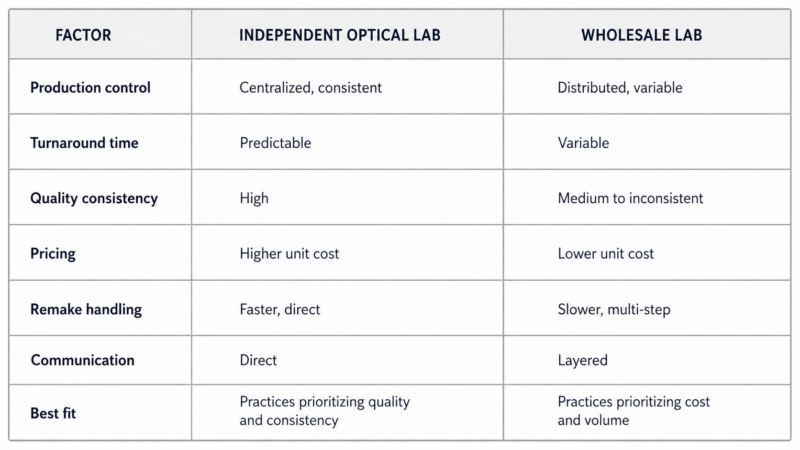
An optical prescription lab typically operates as a full-service production partner. It controls surfacing, coating, edging, and quality checks internally or within a tightly managed workflow.
A wholesale lab, in contrast, often acts as a distributor or aggregator. Jobs may be routed through multiple facilities depending on pricing, availability, or volume agreements.
The difference is not always visible on paper, but it becomes visible in consistency.
An independent optical lab is structured to prioritize control and repeatability. A wholesale model is structured to prioritize scale and cost efficiency.

How Each Model Affects Your Daily Operations
In practice, the lab model shows up in how predictable your day-to-day work becomes.
With a dedicated optical lab partner, you typically see more stable turnaround times, clearer communication on complex jobs, and fewer surprises in lens quality. Adjustments and remakes are easier to manage because the production chain is more transparent.
With a wholesale optical lab, pricing may be competitive, but variability increases. Turnaround times can fluctuate, and responsibility for quality is less centralized. When issues happen, resolution often takes longer because multiple parties may be involved.
Over time, this difference compounds into either operational stability or constant small disruptions.
Turnaround Time and Reliability: Where the Difference Becomes Visible
Speed is not just about how fast a job is completed. It is about how predictable that timing is.
A reliable optical lab partner provides consistent turnaround windows. This allows your team to set accurate expectations with patients and avoid follow-up calls or delays.
Wholesale models may offer fast average turnaround, but variability is higher. Jobs can be quick one week and delayed the next, depending on routing and workload distribution.
For practices operating in competitive markets such as Miami optical lab for clinics environments, predictability is often more valuable than occasional speed.
Quality Control and Remakes: The Hidden Cost of the Wrong Lab
Quality issues rarely appear as obvious defects. More often, they show up as subtle inconsistencies: coatings that wear faster than expected, edges that are not polished cleanly, or lenses that technically pass inspection but do not feel right to the patient.
An independent optical lab typically maintains tighter control over optical lens manufacturing processes. This includes surface preparation, coating application, and final inspection.
Wholesale labs may rely on distributed production, which increases the chance of variation between jobs.
The result is not always higher defect rates, but higher inconsistency. And inconsistency is what drives remakes.

Pricing Models: What You Actually Pay For
Wholesale labs are often positioned as the lower-cost option. In many cases, the unit price is lower.
However, the real cost of a lab is not the invoice price. It is the total cost of delivering a successful job.
This includes staff time spent on follow-ups, remakes, adjustments, and managing patient expectations. It also includes the impact of delays on patient satisfaction.
An optical lab partner with higher upfront pricing but lower variability often results in lower total operational cost.
The difference becomes clear when you track remake rates and chair time, not just invoices.
Optical Lab vs Wholesale Lab Comparison
When a Wholesale Lab Makes Sense
Wholesale models are not inherently wrong. They are effective in specific scenarios.
They work best for high-volume, price-sensitive environments where standard prescriptions dominate and variability can be absorbed operationally.
If your practice is focused on basic dispensing with minimal customization, a wholesale optical lenses provider can support that model efficiently.
When You Need a Dedicated Optical Lab Partner
A dedicated optical lab partner becomes critical when your practice relies on consistency.
This includes cases where you offer premium lenses, custom ophthalmic lenses, advanced coatings, or digital designs. It also applies when your patient base expects a higher level of service and is less tolerant of delays or inconsistencies.
In these environments, the lab is not just a supplier. It is part of the patient experience.
For practices evaluating long-term partnerships, this is where the difference becomes decisive.
https://mialab.com/how-to-choose-the-best-optical-lab
How to Choose the Right Optical Lab for Your Practice
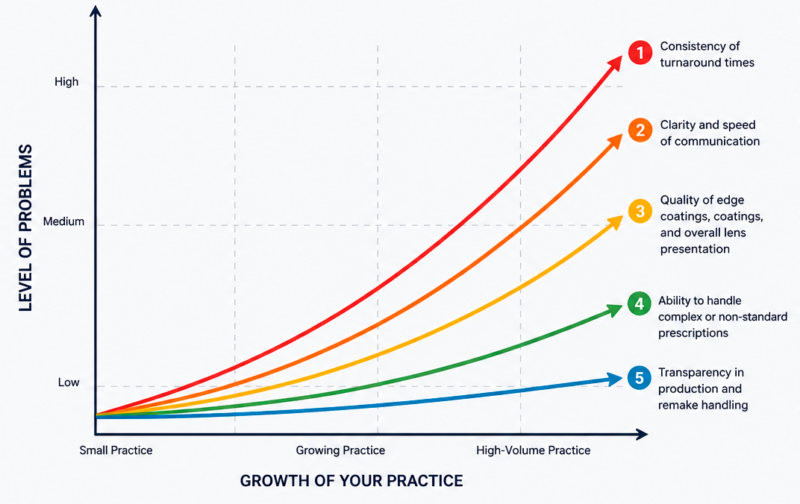
The fastest way to evaluate a lab is not by pricing or catalog, but by how it performs under real conditions.
There are five indicators that consistently reveal the right optical lab partner:
- consistency of turnaround times across multiple orders
- clarity and speed of communication when issues arise
- quality of edge finishing, coatings, and overall lens presentation
- ability to handle complex or non-standard prescriptions without delays
- transparency in production and remake handling
If these are stable, the lab will support your growth. If they are inconsistent, problems will scale with your volume.
The Role of Location: Does a Local Optical Lab Matter
For many practices, working with an optical lens supplier in Florida or a local optical prescription lab offers advantages in turnaround and communication.
A local lab can reduce shipping time, allow faster remake cycles, and improve coordination on urgent jobs.
However, location alone is not enough. A local lab with inconsistent production will still create problems. The priority should always be consistency first, proximity second.
FAQ: Optical Lab vs Wholesale Lab
- What is the main difference between an optical lab and a wholesale lab?
An optical lab partner manages production within a controlled workflow, ensuring consistency in surfacing, coatings, and finishing. A wholesale lab typically distributes jobs across multiple facilities, which can reduce costs but increase variability in quality and turnaround times. - Why does consistency matter more than speed in an optical lab?
Consistent turnaround times allow practices to set accurate patient expectations and reduce follow-ups. Even if a wholesale lab occasionally delivers faster, unpredictable timing creates operational friction and affects patient satisfaction over time. - How does lab choice impact remake rates?
Remakes are often driven by subtle inconsistencies in coatings, edging, or lens performance rather than obvious defects. Independent optical labs maintain tighter production control, which reduces variation and leads to fewer remakes. - Is a wholesale optical lab always the more cost-effective option?
While wholesale labs may offer lower unit pricing, the total operational cost can be higher due to increased remakes, staff time, and patient management. A reliable optical lab partner often reduces these hidden costs through consistency and predictable outcomes. - When should a practice choose a dedicated optical lab partner instead of a wholesale lab?
Practices offering premium lenses, custom ophthalmic solutions, or advanced coatings benefit from a dedicated lab partner. In these cases, consistency, communication, and production transparency directly support patient experience and long-term growth.
Final Insight: Your Lab Defines Your Consistency
Every lens you dispense carries your reputation.
When your lab is consistent, your recommendations become easier, your team becomes more confident, and your patients notice fewer problems.
Choosing between an independent optical lab and a wholesale lab is not about comparing vendors.
It is about deciding how much variability your practice is willing to accept.


