
High Index Lenses Explained: When and Why to Use Them


What Are High Index Lenses and Why They Matter in Practice
High index lenses are materials with a higher refractive index that allow you to achieve the same prescription with less physical thickness. In optical lens manufacturing, this directly affects surfacing curvature, edge thickness, and final lens geometry.
In practice, this is not a technical upgrade – it is a control mechanism.
It allows you to control how the lens will look in the frame before the job is even sent to the lab. That matters because most patient dissatisfaction with lenses is not about prescription accuracy. It is about appearance and perceived quality.
If you regularly hear “these look thick” or “they don’t sit right in the frame,” you are not dealing with an optical issue. You are dealing with a material selection issue.
For a direct comparison with other materials used in practice, see:
https://mialab.com/blog/high-index-vs-polycarbonate-lenses
How High Index Lenses Reduce Thickness and Improve Edge Profile
The practical effect of high index lenses shows up at the edge.
In minus prescriptions, edge thickness increases exponentially as power increases. Standard plastic (1.50) and even polycarbonate (1.59) reach a point where the edge becomes visually dominant, especially in frames larger than 52–54 eye size.
Moving to 1.67 or 1.74 high index lenses reduces that edge mass and changes the visual balance of the frame. The lens stops looking like a thick insert and starts integrating into the frame design.
In plus prescriptions, the benefit is central thickness reduction, but in most retail environments, minus prescriptions are where high index creates the most visible impact.
The key takeaway: high index does not just reduce thickness. It changes how the lens is perceived in real-world wear.
When High Index Lenses Actually Make a Visible Difference
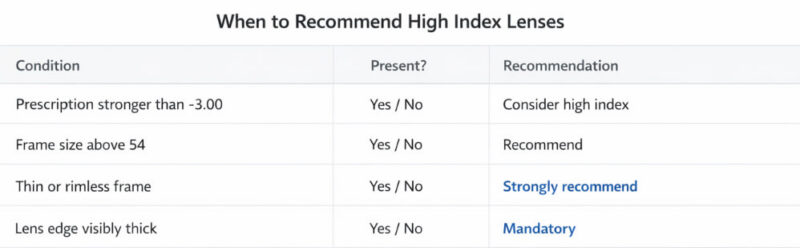
High index lenses should be driven by visibility of thickness, not by prescription alone.
Key Triggers in Practice
Prescriptions above approximately -3.00 to -4.00, where edge thickness becomes noticeable in standard materials
Frame sizes above 54 eye size or wide shapes, where edge exposure increases significantly
Patients selecting thin metal or rimless styles, where lens thickness cannot be visually hidden
In these cases, not recommending high index creates a predictable outcome: the patient accepts the order, receives the glasses, and then questions the result.
In premium positioning, especially when dispensing custom ophthalmic lenses or digital designs, high index is not optional. It is part of delivering a consistent visual standard.
When High Index Lenses Are Not Necessary
High index lenses do not add value in every case, and over-prescribing them reduces trust.
In prescriptions under ±2.00, thickness differences are minimal in most frame sizes. The patient will not see a meaningful change in appearance.
In safety-driven cases such as children or occupational eyewear, material selection should prioritize impact resistance, not refinement. Polycarbonate or Trivex lenses are more appropriate in those situations.
There is also a behavioral factor. Some patients are not sensitive to lens thickness or aesthetics. If the frame hides the edge effectively, upgrading material will not change their perception.
The practical rule is simple: if thickness is not visible, high index will not be appreciated.
1.74 High Index Lenses: When the Highest Index Makes Sense
1.74 high index lenses are often overused and misunderstood.
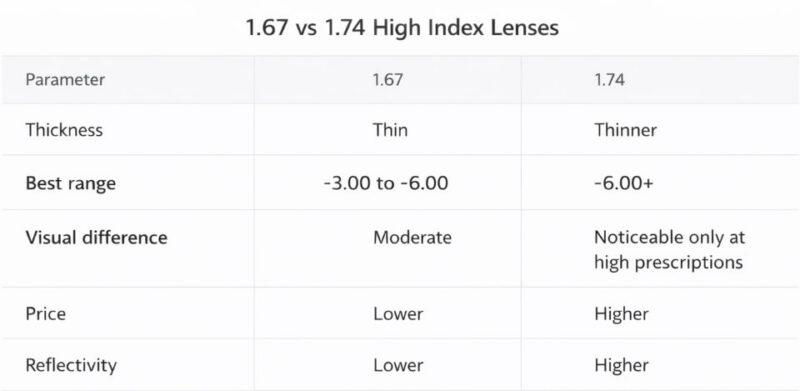
The difference between 1.67 and 1.74 becomes meaningful in prescriptions stronger than approximately -6.00, particularly in larger frames. Below that range, the visual improvement exists but is often marginal.
Where 1.74 becomes valuable is in edge refinement. It reduces the “heavy ring” effect at the lens edge and improves cosmetic balance in thin frames.
However, higher index materials increase reflectivity and require better coating performance. Without a high-quality anti reflective coating, the lens may appear visually noisy despite being thinner.
This is why material and coating should always be paired decisions, not separate upgrades.
Lens Thickness vs Frame Choice: Why Material Alone Is Not Enough
Many thickness issues are incorrectly attributed to the lens instead of the frame.
A large square acetate frame will produce thick edges even in high index. A smaller, rounder frame can make a mid-index lens look acceptable.
In practice, controlling lens thickness is a three-part equation: prescription, material, and frame geometry.
If you only adjust one variable, results will remain inconsistent.
Experienced opticians solve thickness issues before the order is placed by guiding frame selection. Material then becomes a refinement tool, not a correction tool.
How High Index Lenses Affect Patient Perception and Satisfaction
Patient feedback around lenses is highly predictable.
When lenses appear thick, patients question quality, even if vision is correct. When lenses appear thin and balanced, patients assume higher performance, even without understanding the material.
This is why high index lenses reduce perception-based complaints.
They do not eliminate all optical issues, but they remove one of the most visible triggers of dissatisfaction: disproportionate lens thickness.
In practices tracking remakes, thickness-related objections are often among the easiest to eliminate through better material selection.
How to Make the Right Recommendation in Practice
The fastest way to decide is to combine prescription and frame size before discussing materials.
If the combination produces visible edge thickness, move directly to high index. If it does not, keep the recommendation simple and avoid unnecessary upgrades.
This approach does two things. It reduces decision fatigue for the patient, and it standardizes recommendations across staff.
Consistency here has a measurable effect. Fewer remakes, fewer second-guessing conversations, and more confidence during dispensing.
The Role of the Optical Lab in High Index Performance
High index lenses are less forgiving in production.
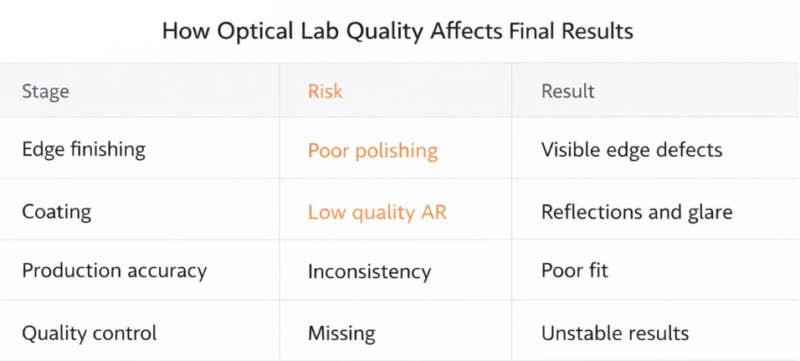
As lenses become thinner, edge quality, polish, and coating performance become more visible. That means even small inconsistencies in finishing can affect how the final lens looks and performs.
This is why lab consistency matters more with high index materials.
A reliable optical lab helps control thickness, maintain clean edges, and ensure coatings are applied to a high standard. Without that, even the right material choice can lead to uneven results.
To see how lab process and quality control affect the final outcome, see:
https://mialab.com/blog-how-freeform-lenses-are-made-step-by-step
FAQ: High Index Lenses
- Are high index lenses worth it?
They are worth it when lens thickness is visible. In prescriptions above -3.00 to -4.00 or in larger frames, they noticeably improve how the glasses look. - Do high index lenses make glasses thinner?
Yes. They reduce lens thickness by bending light more efficiently, with the most visible effect in minus prescriptions. - When should you choose high index lenses?
When the combination of prescription and frame creates visible thickness, especially in larger or thin-frame styles. - What is the difference between 1.67 and 1.74 lenses?
1.74 lenses are thinner and mainly make a difference in stronger prescriptions, typically above -6.00. In lower prescriptions, the visual change is minimal. - Do high index lenses have any downsides?
They can reflect more light and require high-quality coatings. They are also less impact-resistant than materials like polycarbonate.
Final Insight: High Index Is a Control Tool, Not an Upsell
High index lenses are not about selling a premium option.
They are about controlling the final result before the lens is made.
Practices that use them strategically do not just improve aesthetics. They reduce remakes, stabilize outcomes, and make their recommendations easier to trust.


